
Dear Lovers of Food and Justice,
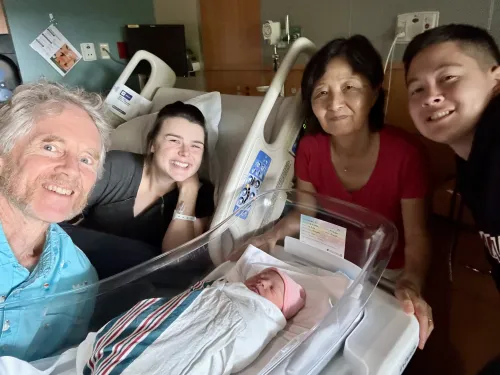
Grandfatherhood is amazing so far. Honestly, I didn’t think I’d be this enamored.
Last week, my daughter-in-love MacKenzie and son Elias gallantly made it through a challenging birthing process and Elena Katharine Kang made her debut on planet Earth!
Fortunately, they live just five miles away, but unfortunately the more regular childcare won’t happen until MacKenzie goes back to teaching in 2027.
Until then, I’ll bide my time pondering Vavilovian mimicry and old boats. But before I get into that, let’s head back to Hawai’i to see how folks (almost all are women) on Maui are protecting people’s homes after the wildfires in the face of disaster capitalism threats.
That question of how we protect what we love – and who gets to decide what happens next – is also at the heart of the story unfolding in Lahaina.
The Lahaina Community Land Trust in Maui
As I mentioned in the last Love Letter, the Hunger Program searched out groups in Hawai’i who were responding to the wildfires and the Lahaina Community Land Trust (LCLT) rose to the top. The LCLT, led by a committed and talented group of women, formed the land trust in Lahaina in the aftermath of the 2023 disaster.
This month marks the third anniversary of those terrible fires, and I’ve been thinking about how much the LCLT is doing to make sure the residents have a say in Lahaina’s future. They knew early on that the fires would trigger a once-in-a-generation transfer of land because of the devastation in Lahaina. The question was whether millionaires and billionaires would take over or whether they could keep the land and people’s homes in the hands of locals.
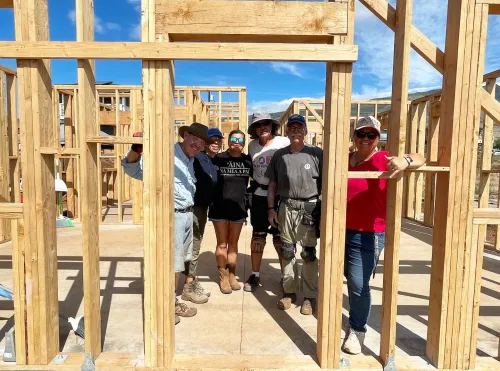
So far, LCLT has secured 24 pieces of ʻāina (land), protected 10 homes for Lahaina ʻohana, and helped five families rebuild and return home. As they say it, “when we restore our relationship with ʻāina, we have a chance to restore everything – and when we secure land, we secure our future.”
But protecting land is only part of the equation. If people can’t afford to rebuild, keeping the land in local hands doesn’t necessarily keep the community intact.
Keeping ‘Ohana Home: In addition to LCLT’s ʻāina and housing stewardship program, they launched the Keep Lahaina Home Insurance Gap Program earlier this year to help families rebuild when their insurance proceeds fall short—ensuring homes are rebuilt while homeowners retain their equity.
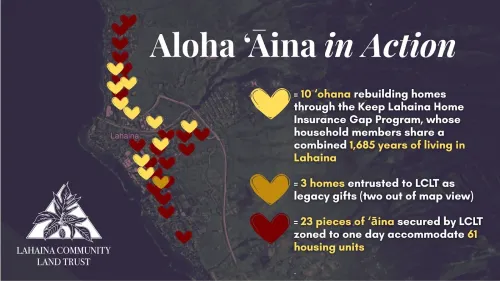
In exchange, a permanent deed restriction stewarded by LCLT is placed on the home ensuring that the unit of housing remains owner-occupied and, if sold, affordable for Lahaina families in perpetuity. This is another way to ensure that Lahaina’s land and homes are never lost to investors, while also protecting Lahaina’s generational ‘ike (knowledge).
All told, the Keep Lahaina Home program’s first 10 ‘ohana benefitting from this rebuilding program have a combined 1,685 years of living in Lahaina. This program is already benefitting 60 family members, including 22 children and seven elders.
The LCLT story is a story about protecting what matters across generations, which got me thinking about another kind of inheritance – an old wooden boat, a memory, and the strange new world of artificial intelligence.
One Thing I Love: Restored Rowboats
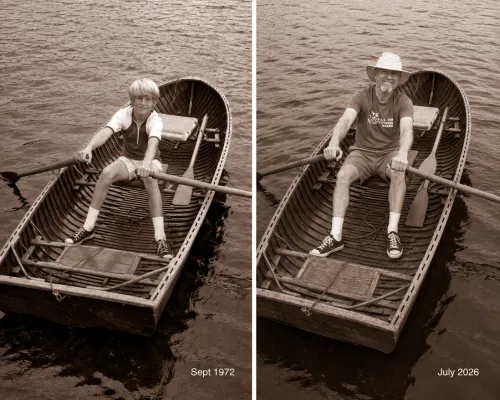
Wood is such a fantastic medium if you have the tools, time, and talent to be able to restore it and maintain its life. Restoring old boats is a special skill – thank you Cousin Paul! – and this old boat spans 60 years. The photo on the left was taken of me at age 12 at my grandparent’s house on Lake Mohawk in New Jersey. The boat still exists in real life, but the photo of "me" on the right was created by a very clever machine.
Yes, we’ve entered an age where we no longer can trust our eyes.
I’m amazed by artificial intelligence and simultaneously frightened at the prospect of super intelligence.
In a few weeks, I’ll offer an online study session where interested folks can come together to explore their questions, concerns, hopes and fears, especially as it impacts vulnerable people and contributes to poverty. My hope is that a core group of us might periodically gather to learn ways of steering the “machine” in ways that support life, the sacred, and the things and people we love. Send me a note if you’re interested ([email protected]).
And if AI has me wondering what it means to be uniquely human and intelligent, plants continue to give me plenty to wonder about, too.
Another Thing I Love: Vavilovian Mimicry
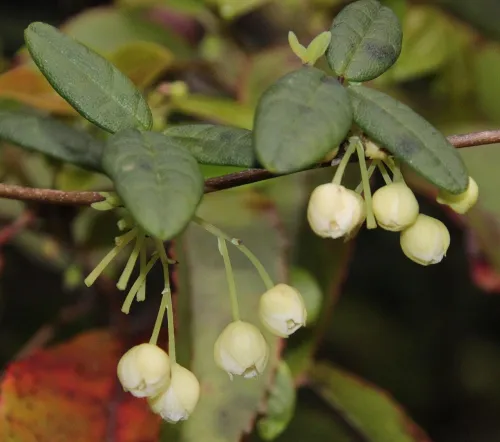
In my last Love Letter, where we looked at the Vavilovian mimicry of rye, I promised to share the story of a woody vine found in the Chilean rainforest, the chameleon vine. Its Latin name is Boquila trifoliolata, locally known as pilpil or voqui blanco, and it is a shapeshifter.
I’ll let Zoë Schlanger tell part of the story from her wonderful book, The Light Eaters. While visiting Chile, she came across a boquila growing next to Ranunculus repens, a weed that had only arrived in the area about a decade earlier. Yet the boquila had somehow arranged its leaves to closely resemble the ranunculus – not just in size and shape, but even in the angles of the leaves.
“The boquila growing nearby had arranged itself as a perfect replica in size and overall silhouette.”
That was remarkable enough, but the bigger surprise was that the plant was mimicking something that could not have been part of its evolutionary history. As Schlanger explains, the weed had only been there for ten years. There simply hadn’t been time for the two plants to evolve this relationship together. The mimicry appeared to be happening in real time.
And then came another surprise. A week before Schlanger’s visit, a gardener in London had sent researcher Ernesto Gianoli photographs of a boquila mimicking a completely unrelated houseplant – a tiny-leaved ground cover native to New Zealand, thousands of miles from the Chilean rainforest.
“The mimicry phenomena was intrinsic to the entire species, then, and would express itself no matter where a plant went. That was spontaneous as hell.”
Spontaneous as hell. I love that. And it raises some interesting questions about what plants perceive, what they can learn, and what we mean when we talk about intelligence.
Speaking of plants, let’s come back down to earth – or at least to my front yard.
Garden Update
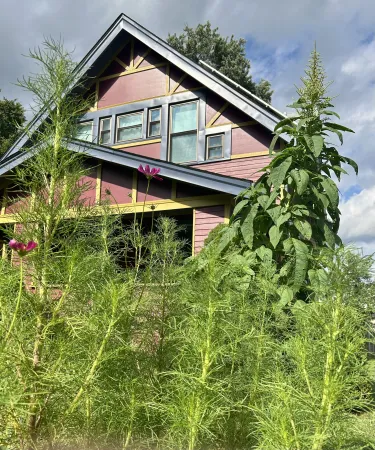
If that green amaranth looks tall, it’s because it is – about 8 feet tall and developing a nice head of seeds. I use the greens like spinach in stir-fries mostly and one could eat the nutritious seeds, but I haven’t yet.
The amaranth and the cosmos are volunteers from last year’s garden. We obviously don’t have a typical front yard, but rarely do we get anything but compliments. Any haters, thankfully, are quiet.
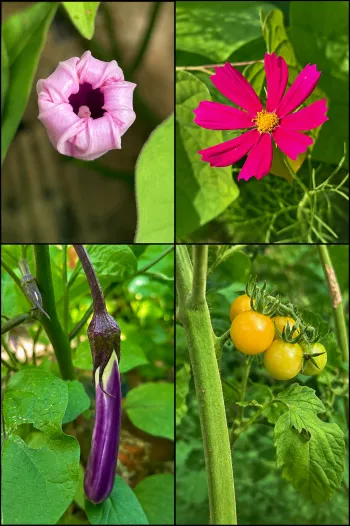
Below is a collage of hopeful happenings in the garden. Going clockwise, we have a late-afternoon sweet potato bloom (doesn’t it look like Turkish taffy), a cosmos strutting its colors, a baby Asian eggplant aspiring toward bigger things, and grape tomatoes that pack a punch.
As summer winds down, I’m grateful for all these reminders that life is constantly adapting, improvising, rebuilding, and finding ways to carry what matters forward.
Enjoy the rest of the summer and see you next week!
“In summer, the song sings itself.”
~ William Carlos Williams
Warmly, andrew
Learn more and donate to the Hunger Program
via our website at pcusa.org/hunger.
You may freely reuse and distribute this article in its entirety for non-commercial purposes in any medium. Please include author attribution, photography credits, and a link to the original article. This work is licensed under a Creative Commons Attribution-NonCommercial-NoDeratives 4.0 International License.