
“At night make me one with the darkness
In the morning make me one with the light.”
- Wendell Berry
Dear lovers of food and justice,
I love the idea of trees seeing!
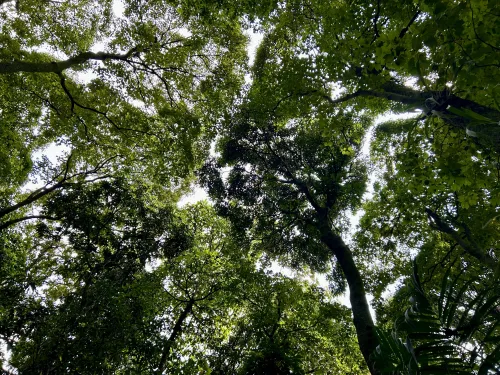
I took the photo on the right of the tree canopy in the Andean Forest area of Medellín, Colombia’s botanical gardens. Notice the elegant gaps between the leaves of different trees?
Botanists have several theories about why this happens. The most prominent is that crown shyness occurs because a tree “reads” the light around it and subtly steers its growth away, leaving those visible gaps.
I only recently learned that plants—and trees—have photoreceptors (light sensors) in their cells that can detect minute changes in light quality. They pick up increases in far-red light that occur when sunlight is filtered through nearby leaves. In this way, a tree senses how close its neighbors are and activates a “shade avoidance” response: it grows away from the light stimulus, avoiding being shaded and, arguably, avoiding shading out other trees. Some botanists even suspect this is a form of cooperative behavior—maybe even altruism!
This idea of a leaf that “sees,” and the deep wisdom embedded in the living world, is something poets help us appreciate. In our home growing up, we had a picture book of Walt Whitman’s Leaves of Grass, and it stirred my appreciation of beauty tremendously. Here is a passage from Song of Myself (from full collection):
I believe a leaf of grass is no less than the journey-work of the stars,
And the pismire is equally perfect, and a grain of sand, and the egg of the wren,
And the tree-toad is a chef-d'oeuvre for the highest,
And the running blackberry would adorn the parlors of heaven,
And the narrowest hinge in my hand puts to scorn all machinery,
And the cow crunching with depress'd head surpasses any statue,
And a mouse is miracle enough to stagger sextillions of infidels.
But the reason I chose this Whitman selection is the resonance I found with something I read last week by Rudolf Steiner about wisdom in the physical world. In Love & Its Meaning in the World, Steiner says:
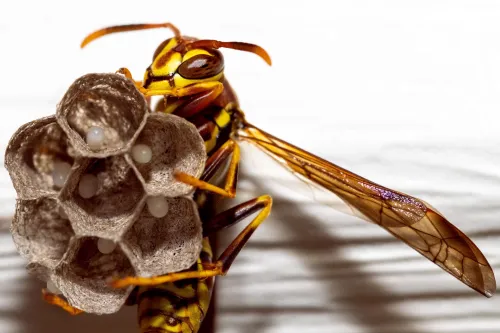
“How it is drummed into the heads of the school children, the great progress humanity has made through the discovery of paper! But wasps had already produced paper many thousands of years ago, for what the wasps build into their nests consists of exactly the same substance as that out of which men now produce paper and it is produced by the wasp in exactly the same way—only by means of a life-process. The wasp-spirit, the group-soul of the wasps, which is a part of divine-spiritual substance, was the discoverer of paper long before men made the discovery. The human being, in fact, always follows along groping his way behind the cosmic wisdom. As a principle, all that men will discover in the course of the Earth's evolution is already present in nature. But what the human being will really give to the Earth is love, a love which will evolve from the most sensuous to the most spiritualized form of love. This is the mission of the Earth-evolution. The Earth is the cosmos of love.”
“Let us ask:—What then is essential for love? What is essential in order that one person love another? It is this—that he be in possession of his full self-consciousness, that he be wholly independent. No one can love another in the full sense of the word if this love be not a free gift of one person to another. My hand does not love my organism. Only one who is independent, one who is not bound to the other person, can love him. To this end the human being had to become an ego-being. The ego had to be implanted in the threefold human body, so that the Earth might, through mankind, fulfil its mission of love.”
(Love & Its Meaning in the World, pp. 68–69; also in Gospel of St. John, lecture “The Mission of the Earth,” 20 May 1908—which explains the “he” and “mankind” language… 😊)
Rudolf Steiner offers profound insights into the esoteric messages underlying much of the Gospels and the life and mission of Jesus Christ. In Steiner’s view of spiritual evolution, humanity first awakened to self-consciousness through the influence of Luciferic forces, gaining the ability to perceive ourselves as individuals and to distinguish between good and evil. This awakening loosened the exclusive bonds of blood and tribe found in the Old Testament, preparing the way for a higher form of love. Through Christ, a new light entered the world—one that transcends family, clan, and ancestry and calls humanity toward universal spiritual love.
This is illustrated by a startling passage from scripture:
“If any man come to me, and hate not his father, and mother, and wife, and children, and brethren, and sisters, yea, and his own life also, he cannot be my disciple.” (Luke 14:26)
The sacrifice of Christ on Golgotha symbolizes the transformation of love rooted in blood relationships into a love that embraces all people.
Christ’s mission, then, is understood as continually pouring divine light and love into the world, guiding humanity toward a future in which the Earth is fully permeated by a spiritual love that unites all beings.
If you’d like to dig deeper into this, check out this lecture from Steiner’s Gospel of St. John.
From the quiet wisdom of leaves and a future of spiritual love, let's turn to another manifestation of light: the brilliant explosion of a dying star whose radiance startled sky gazers nearly a thousand years ago.
Other Things I Love: The Staggering Density of a Neutron Star
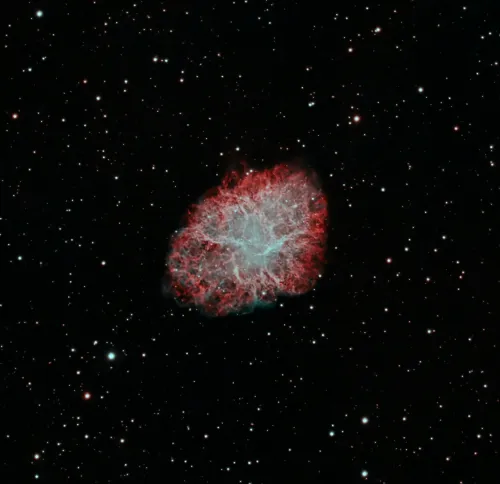
Among the most detailed surviving accounts of the supernova of 1054 are records kept by astronomers in China and Japan. The explosion was so bright that it remained visible during the day for more than three weeks! The remains are the Crab Nebula, in the constellation Taurus.
[Glorious image here: http://bit.ly/crabbynebula]
In the center of that colorful nebula lies a neutron star, also dubbed the Crab Pulsar, which is only 17 miles in diameter – yet it has more mass than our Sun. Once more: this tiny sphere, small enough to fit tidily within the city limits of Chicago, contains more mass than our Sun.
While our planet rotates once every 24 hours, the Crab Pulsar rotates 30 times per second. But what I find even more fascinating is the neutron star's density: a single teaspoon of its material would weigh roughly a billion tons—as much as a massive ocean-going oil tanker or even a mountain. If you were to drop that teaspoonful of neutron star onto the Earth, it would be so heavy that it would punch straight through the planet.
Garden Update
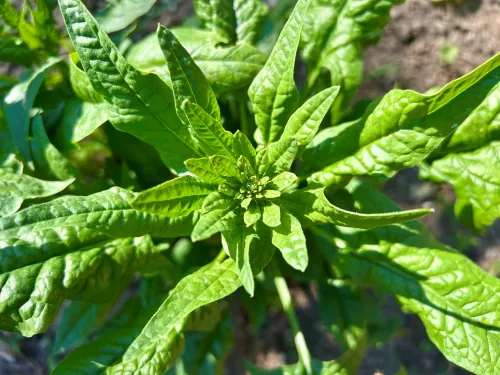
The hot weather is coming, but for now the spinach—with its beautiful array of green solar panels—is happy as a clam.
Those green solar panels are doing exactly what leaves do: reading the light, reaching for the sun, and quietly doing their part in the web of life.
From sensing trees to exploding stars to the spinach in my garden: light, love, and wonder are woven through it all.
Be well and see you next week,
andrew
P.S. More good news: A recent 55-year study of seabird eggs in Canada found that levels of some of the most dangerous PFAS “forever chemicals” have fallen by more than 70% since their peak. This is compelling evidence that environmental regulations and chemical phase-outs can work. These northern gannets celebrate the win!

You may freely reuse and distribute this article in its entirety for non-commercial purposes in any medium. Please include author attribution, photography credits, and a link to the original article. This work is licensed under a Creative Commons Attribution-NonCommercial-NoDeratives 4.0 International License.