Forming an online community while serving on a General Assembly committee
Dustin Wilsor and the Rev. Jenny Wells, who led two committees during GA226, offer a workshop to the current batch of leaders

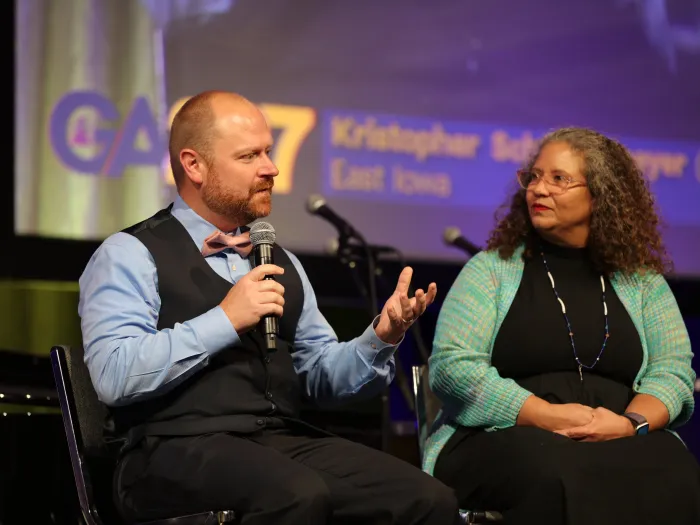
LOUISVILLE — It’s been almost two years since the Rev. Jenny Wells and Ruling Elder Dustin Wilsor moderated a General Assembly committee — truth to tell, at the 226th General Assembly, they led two committees across the finish line.
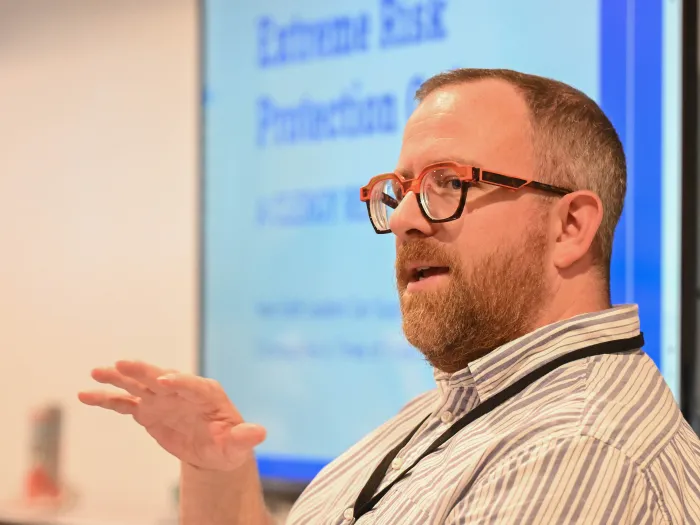
It was fitting, then, that Wilsor, the moderator of Seattle Presbytery, and Wells, pastor of Central Presbyterian Church in Kansas City, Missouri, took committee leaders of the 227th General Assembly through a helpful workshop on what it means to be an online community.
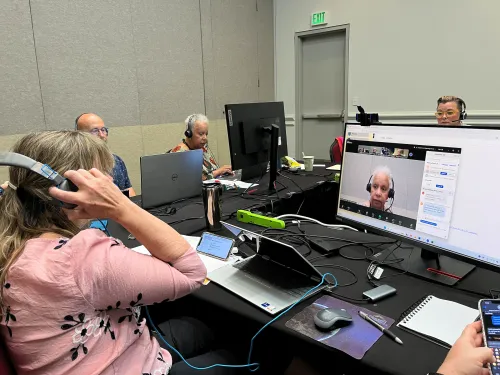
GA227 committees will meet online June 22-24. Wells and Wilsor spoke to 73 committee leaders Tuesday afternoon as part of the General Assembly Leadership Briefing, which concludes Wednesday at the Presbyterian Center in Louisville, Kentucky.
They’ll be hybrid committee meetings, Wilsor explained. “Some of us are in person [at the Baird Center in Milwaukee, Wisconsin] and others are online,” Wilsor said. “Your mom will be watching you online.” In fact, “it’s all being seen by people as nosy as you are,” Wilsor said.
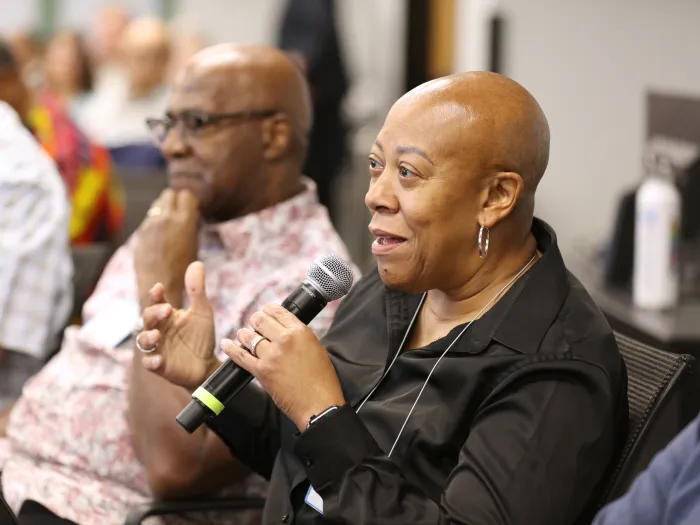
“We’ve all been part of meetings, online or in person, that have gone really well,” Wells said, “and I suspect we have been part of meetings that haven’t gone really well.” Wells asked committee leaders: What are some of the frustrations you’ve experienced?
Spotty internet, said one committee leader. People who leave themselves muted, or, worse, unmuted, “and everyone hears your dog barking,” Wells said.
Another leader mentioned leaders “with a new device they don’t yet know how to use.” Wells suggested a few practice sessions in the weeks prior to the Assembly. “Play with it, and learn how to use it,” she said.
Another committee leader mentioned participants who speak too quickly online. “It’s really important for the translators that we slow down a little bit,” Wells said.
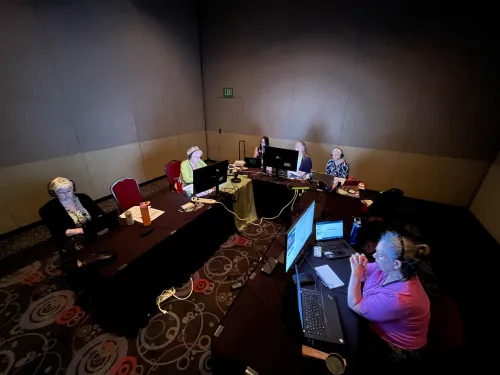
To the notion that people get distracted online, Wells encouraged participants “to be present. I know that can be hard to do on a Zoom call.”
One leader said it can also be difficult “to read the energy in the room.” Another noted that “it can be difficult to make jokes.”
While leading first the Domestic Engagement Committee and then the General Assembly Procedures Committee during the previous Assembly, Wells and Wilsor learned to have one of them moderate the business portion of the proceedings while the other kept a close eye on how the technology was holding up.
“Learn the platform well enough so you can help members of your committee when they don’t understand,” Wells said. In addition, “have the contact information of those who understand the technology really well.”
“Don’t be afraid to ask for help,” Wells said. Wilsor added, “Don’t be afraid to accept help.”
“Let your team do their job,” Wilsor advised. Each General Assembly committee has a moderator and vice moderator, a committee assistant, a parliamentarian, a resource manager, an equity support manager, a recorder and a Zoom manager. “It can be hard for moderators to let go of some control,” Wilsor said, “but it goes much smoother if you allow your committee assistant to do their job.”
“And lean into your parliamentarian,” Wilsor said. “You’re not required to know everything, but they are.”
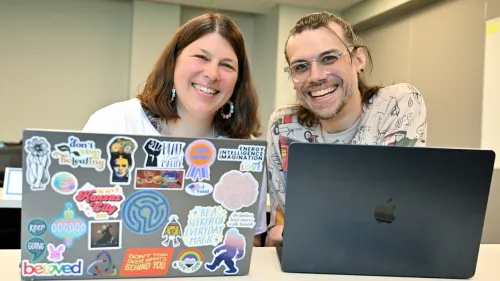
The two offered up some of the important lessons they learned during the 226th General Assembly, including “bring a cushion” and “wear layers,” Wilsor said.
And be flexible. “Your [committee] schedule is a living document. If you’re thinking of changing it, make sure to check with your resource manager,” Wilsor said. “She can help you get the changing schedule in place so it’s working for you and not against you.”
The two offered clips from previous committee work and even a mock script for committees to try out. The script described some of the behind-the-scenes work that helps each committee make its way through all the business before it and helps ensure that all members have the chance to speak and to be heard.
Included in the script is a corresponding member who tells the moderator, “I am going to say something incredibly inflammatory and I hope that other people agree with me or they get out of the church.” Committee leadership then scrambles to a breakout room where they make a plan for how to respond and move the committee forward.
The remainder of the debate proceeds smoothly and the item proceeds to a vote.
You may freely reuse and distribute this article in its entirety for non-commercial purposes in any medium. Please include author attribution, photography credits, and a link to the original article. This work is licensed under a Creative Commons Attribution-NonCommercial-NoDeratives 4.0 International License.