Presbyterians turn out in droves to learn more about Christian nationalism
The Rev. Jimmie Hawkins, the PC(USA)’s advocacy director, delivers the goods during the ‘Presbyterian Advocacy Hour’
LOUISVILLE — As they have been of late, about 400 people tuned into the Presbyterian Advocacy Hour gathering on Wednesday, an event put on by the Presbyterian Church (U.S.A.)’s Office of Public Witness. The PC(USA)’s advocacy director, the Rev. Jimmie Hawkins, offered up some definitions and some things he’s seeing in his travels across the church.

One definition of Christian nationalism is “an ideology that links national identity as coequal with one’s Christian faith,” Hawkins said. “In the United States, Christian nationalism is so deeply embedded in our consciousness that patriotic passion is intertwined with what it means to be a Christian.” He called Christian nationalism “a form of idolatry that empties meaning from religion.”
The Bible has something to say on being subject to authorities, such as Romans 13:1-7, and in rendering to Caesar, Mark 12:13-17. “The Bible informs Christians to be subject to governing rulers and demands obedience — when the state governs with justice and impartiality,” Hawkins said. Especially in the Old Testament, “there is a prophetic call to challenge the state when it misuses and abuses its authority.”
“We must decide what in our lives belongs to the state and what belongs to God. Basically, everything belongs to God,” he said. “We don’t give in order to be compensated. We give back to God what God already owns.”
Political scientists and economists see plenty of signs of the persistence of Christian nationalism, Hawkins said. “Americans, no matter how secular, tend to think of themselves as citizens of a nation with a special divine providence,” wrote economist Paul Krugman. “Americans believe that the United States has been elected by God for the greatest experiment in human history.” wrote political scientist Eric Foner. “The achievement of liberty and its expansion was part and parcel of this providential destiny.”
In history, Christian nationalism is a subset of religious nationalism, and that practice “is as old as civilization,” Hawkins noted. Egypt and other countries enforced the policy that “to oppose the ruler is to oppose God.”
“It’s everywhere,” he said, “and it’s important to study how it’s evolved.”
Hawkins said most people on Wednesday’s call already know about the Doctrine of Discovery and Manifest Destiny. Both “played a major role in Europeans coming to this part of the world, and white supremacy is an outgrowth out of the Doctrine of Discovery,” Hawkins said. “Manifest Destiny became the American form of the Doctrine of Discovery, the control of the continent from the East Coast to the West Coast.”
In the 20th century, Christian nationalism “became a weapon to suppress minority groups” in the United States, Hawkins said. In the mid-1920s, the Ku Klux Klan “was one of the most popular organizations in the country. It had doctors, lawyers and preachers as its members. They talked about how it’s God’s will for whites to dominate” and to “keep Blacks in their place.”
After World War II, the Cold War “significantly fueled Christian nationalism” by “framing the conflict with the Soviet Union as a spiritual battle between good — Christianity and America — and evil, atheistic communism,” Hawkins said.
“The Cold War’s civil religion used religious symbols for national unity. Rarely did a church not have a flag in it,” Hawkins said. “This period shifted Christian nationalism from a fringe idea to a mainstream political force, establishing a precedent for using religious beliefs to define national identity and policy.”
From the 1970s through the 1990s, the Moral Majority “was a foundational, powerful political lobbying group and was a key predecessor to the modern Christian nationalism movement,” Hawkins said. “Many of its core beliefs and organizational tactics are visible in the contemporary Christian nationalism movement.”
Today Christian nationalism can be seen in movements including the New Apostolic Reformation, Hawkins pointed out. Project 2025 “is a result of Christian nationalism rhetoric. Throughout its 900 pages, there is that connection.”
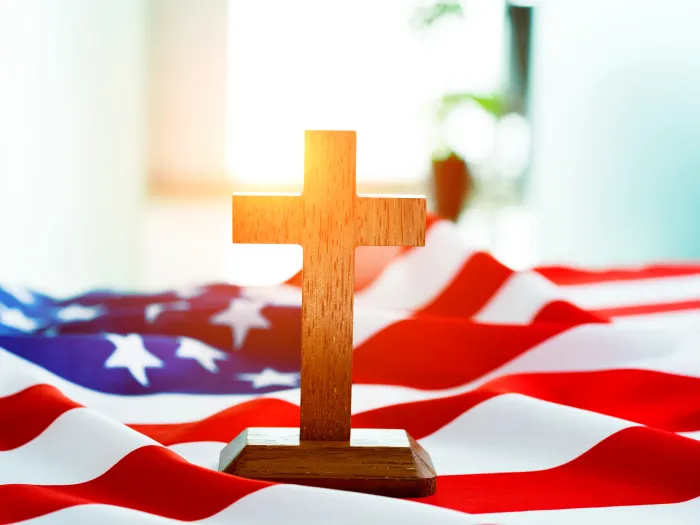
Hawkins showed photos he’s taken of PC(USA) sanctuaries where the American flag is displayed. “What are we saying when we place the flag in our church?” he asked. “I propose it is an element of Christian nationalism.” In the PC(USA), ruling elders and teaching elders “promise to protect the purity of the church,” Hawkins noted. “I think that purity has been threatened by incorporating cultural norms,” including Christian nationalism.
Two groups dominate the headlines of reporting on Christian nationalism, he said — politicians and pastors, “and I don’t know who’s doing it the most.”
There’s also some support for the cousins of Christian nationalism, including Black and Hispanic Christian nationalism. Asian Christian nationalism has a smaller percentage of adherents, and Native Americans have the smallest percentage, Hawkins said. The nation’s Indigenous people “have been the target of violence,” he said, “and Native Americans have the longest history of opposing Christian nationalism.”
For further reading, Hawkins suggested the book “How to End Christian Nationalism” by Dr. Amanda Tyler of the Baptist Joint Committee for Religious Liberty.
“Black and womanist and Hispanic communities have opposed Christian nationalism for a long time,” Hawkins said. “They have been unrelenting in their opposition to the idea that God has favorites and is not on the side of empire and the mighty.”
“As Christians, we are bound to Christ — not by citizenship, but by faith,” Hawkins said. This summer, commissioners and advisory delegates to the 227th General Assembly will consider this overture as well as “Standing Against White Christian Nationalism,” a statement by the Advisory Committee on Social Witness Policy.
During a question-and-answer session that followed his talk, Hawkins pointed out that “there is a whole lot of hateful rhetoric being put out into the public arena, mainly because it gets press.”
“I don’t let this foolishness bother me,” he said. “It has always been part of the human experience.”
“As a person of color, we and Asian and Hispanic folks have always been greeted with Christian nationalism,” he said. “Now, whites are being targeted.”
“If you can find a MAGA person you can have a conversation with, I would engage that person, if people can see that you care and your actions are not judgmental,” Hawkins said, adding, “change takes time.”
“We must love people as they are,” he said, “but we can’t leave them where they are.”
You may freely reuse and distribute this article in its entirety for non-commercial purposes in any medium. Please include author attribution, photography credits, and a link to the original article. This work is licensed under a Creative Commons Attribution-NonCommercial-NoDeratives 4.0 International License.