
TODAY IN MISSION YEARBOOK
Mission Yearbook: Louisville Seminary scholar reexamines Noah’s curse in new book
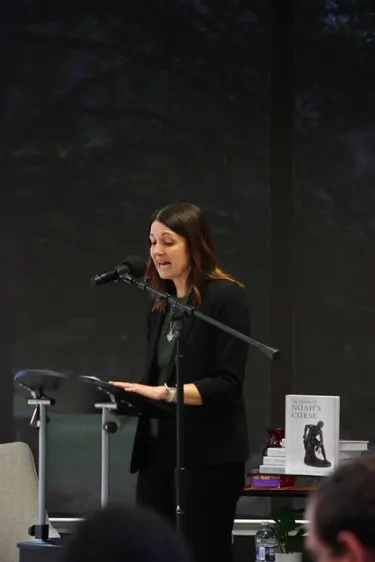
Family, friends, students and colleagues were all smiles helping Dr. Justin Michael Reed, Associate Professor of Old Testament/Hebrew Bible at Louisville Presbyterian Theological Seminary, launch his new book, “The Injustice of Noah’s Curse.”
Faculty members, including Dr. Anna Bowden and Dr. Tyler Mayfield, told a few stories on their friend and colleague following a celebratory meal at the seminary.
Reed’s book, developed from his 2020 dissertation, is based on Genesis 9:18–28, the curse of Canaan, who was Noah’s grandson and the son of Ham. In the biblical account, Canaan does nothing to earn Noah’s curse, which for centuries was used as biblical support for such atrocities as enslaving Black people.
According to one review, Reed’s book “shines light on a different path,” using critical race theory, speech act theory, intertextuality and irony “to make sense of the injustice of Noah’s curse in its literary context.”
“If you’ve ever heard Justin read a poem or recite a children’s story, you know he’s a gifted storyteller,” Bowden said. “When Justin tells stories, he does more than hold our attention. He slows us down, giving us space to notice details. He invites us to sit with complex storylines and characters.”
Tradition has handed us “a simple script from Genesis 9,” she said. “Noah is wronged, Ham is guilty, and the curse [against Canaan] is justified. The verdict is in, the case is closed, and guilt is presumed.” But Reed “dares to tell a different story. What if Noah is in the wrong? With this single question, this de-centering of a biblical hero, the ground shifts beneath us.”
“What I admire most in Justin’s work is he does not resolve the problem by abandoning the text. Instead, Justin reads it with even greater attention to detail,” Bowden said. “The curse is excessive, overblown, misdirected and off-target. The punishment exceeds the offense.” The curse is “a rhetorical construction, a parody, an invitation to keep reading.”
The new book “has deeply shaped my own thinking to re-explore some of my own work,” she said With his tongue lodged firmly in his cheek, Mayfield shared what he called “a remarkable story” while leading a group of seminarians in 2023 on a dig around the caves at Quamran, the site where nearly 900 ancient biblical scrolls have been discovered. “We found a new manuscript. I was finally able to complete a new translation,” he said with the hint of a grin. “Today is its world premiere.”
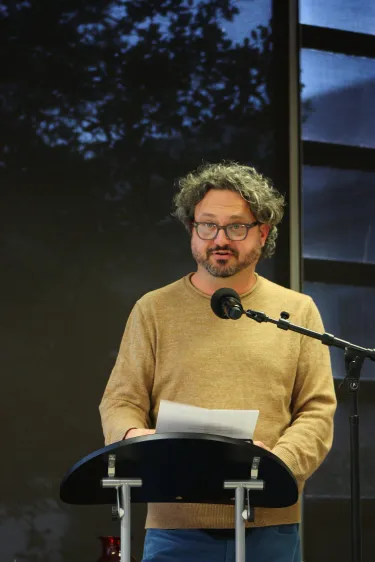
Coincidentally, the fragment the LPTS students “found’ was taken from exactly the same text Reed’s book deals with. “What are the chances?” Mayfield said.
“I found some marginal writing” alongside the fragments, Mayfield claimed. “Some ancient scribe made several important notes,” including, “This is a confusing story and many people will try all sorts of interpretive moves to make sense of it. But don’t worry — a great scholar will come about” millennia later.
“Finally, this ancient scribe rewrites the curse in the Genesis text” and “transforms it into a blessing, a blessing for this astute biblical scholar who is to come one day: ‘Blessed be Reed, greatest of scholars, shall be among those who study Torah, the wisest of teachers shall he be to this Louisville Seminary community, the worthiest of authors shall he be today,” Mayfield said. “Amen.”
After thanking those who’d turned out to celebrate the book launch, Reed recalled using historical criticism to teach a Sunday school class while working on his master’s degree. “For the most part, they were open to it and they liked it,” he said. When they got to Genesis 9, most read the story “with the most agreed-upon interpretations,” including Reed, at the time. Except for one skeptical student.
“She had the vigilance to say, ‘I am not going to eat everything you feed me,’” he said. “That led me to look back at what I was buying into.”
“The big thing to take away is not just for this text,” he said. “It’s a way of approaching things with vigilance, critical thinking and understanding how we are making meaning and whether there’s a better way to do that.”
Mike Ferguson, Editor, Presbyterian News Service (Click here to read original PNS Story)
Let us join in prayer for:
Sheldon Sorge, Field Study Coordinator, Stewardship & Funds Development, Administrative Services Group
Rafaelina Valerio, Housekeeper, Stony Point Center, Presbyterian Life & Witness
Let us pray:
God, bless the hope and the sorrow as we seek peace and opportunity. May Jesus’ prophetic path continue to find a witness in your creative community. Amen.