
TODAY IN MISSION YEARBOOK
Mission Yearbook: PAM’s podcast features choral music educator and justice advocate
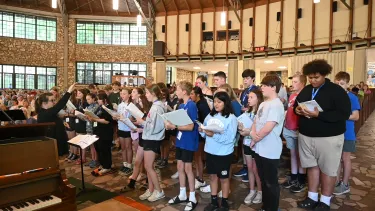
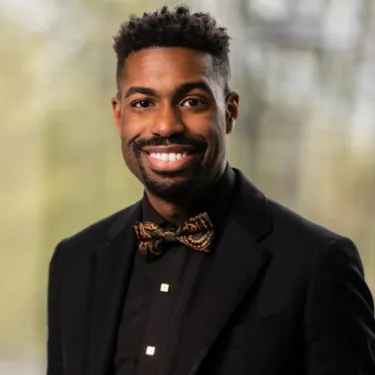
Dr. Arreon A. Harley-Emerson, who teaches choral music at Penn State University and is a conductor, nonprofit strategist and equity coach — as well as the father of a 4-month-old — has plenty on his plate. Still, he recently took the time to speak to Sarah Abushakra and Jeremy Roberts, the hosts of “Sounding Board,” the podcast from the Presbyterian Association of Musicians. Their 68-minute conversation, the second edition of “Sounding Board,” can be seen here. It’s also available on Spotify and Apple Podcasts.
Harley-Emerson directs Penn State’s Essence of Joy, is the president and chief executive officer of Equity Sings and is the artistic director of Elevate Vocal Arts.
He said he started attending church even before he was born. “My church and faith journeys are inseparable from my music journey,” Harley-Emerson told the hosts.
Asked about Equity Sings, Harley-Emerson said he’s always been interested in inclusion work. “I grew up with this rich Black church experience and this really rich children’s choir experience,” he said. Along with his experience sharing ways to be inclusive, part of the work includes teaching groups about fundraising. Organizations ask, “how do we do we do that work and how do we fund it? That’s pretty much the lane we’re in,” he said.
He called himself “fortunate to serve in a lot of capacities and to do a lot of different things. There is a stubbornness,” he said with a smile, “a cheerful insistence that it can and should be better.”
“People ask me how I juggle all the things,” he said. “It’s not juggling. There is one core mission: how are we fundamentally becoming more equitable and more just?”
“It’s having a focus on this destination and being stubborn and cheerfully insistent about the multiple ways it’s possible to reach the destination,” Harley-Emerson said.
Citing Harley-Emerson’s TEDx talk given in Wilmington, Delaware, a decade ago, Roberts asked about Harley-Emerson’s mission not just to teach students, but to fulfill “the real needs singers come in the door with.”
Harley-Emerson called his TEDx talk “The Gang Mentality of Choirs.” While researching another project, he discovered years ago “the mentality that all gangs have — positive and negative gangs — that in this community we can find and have our needs met,” he said, comparing that thinking to Maslow’s Hierarchy of Needs.
“The most successful choirs have a sense of community and are meeting the needs of folks,” he said, needs that might include receiving a sympathy card when there’s been a death in the family or picking up a ride to choir practice. “We’re trying to create these welcoming spaces where everyone has the things that they need and the opportunities that they need to be successful. How do we engineer that? It’s not magic,” he said.
Singing or playing together is the “opportunity to engage with the stories of people different from us, which we do all the time in choral music,” he said. “We begin to be empathetic. We feel with and we suffer along with our siblings who are making music with us and those cultures and traditions from where the art is derived.”
“That compassion, that empathy, is a muscle that needs to be exercised,” he said. “Choir is a gym where we exercise that muscle with intention, and that’s why I love it.” The work of a choir and the person leading the music involves the “unpacking of the text and the understanding of someone’s story and context, working together for the common good” and finding “the emotional connection to the music, the text and to one another. That allows us to flex the muscle of compassion and empathy.”
“I just wish everyone sang in a choir,” Abushakra said. “I think we would become more compassionate and loving human beings.”
According to Harley-Emerson, there’s something about singing together “that builds empathy and that culture of mutual respect. It deepens faith and ultimately emancipates what we think the world can be.”
Mike Ferguson, Editor, Presbyterian News Service (Click here to read original PNS Story)
Let us join in prayer for:
Victoria Shircliffe, Social Media Strategist, Digital Marketing, Presbyterian Life & Witness
Becky Trinkle, Financial Planning & Effectiveness, Operational Planning & Operations, Presbyterian Life & Witness
Let us pray:
Lord, help us to be instruments of your grace constant in our love, unrelenting in pursuing peace, and faithful in working for all. Amen.