
TODAY IN MISSION YEARBOOK
Mission Yearbook: Abundance is a counterbalance to prosperity gospel, speaker says
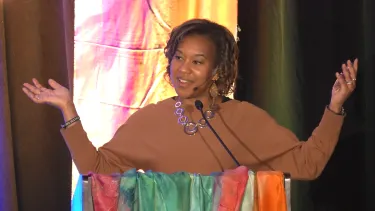
“How do you imagine the abundant life?” the Rev. Ayana Teter opened her plenary at the Luminosity Conference with that simple-sounding question, quoting theologian Dietrich Bonhoeffer.
Teter is the Associate Dean for Students and Formation at Pittsburgh Theological Seminary and a consultant to congregations and nonprofit organizations. She spoke during the plenary on the first day of the Luminosity Conference, a gathering for PC(USA) pastors and church leaders held last spring. The conference was organized and sponsored by the Presbyterian Foundation.
In American consumer culture, we are tempted constantly by the illusion of abundance. But Teter cautioned listeners to beware of the temptations and desires that draw us away from God.
“When we are overtaken by desire,” she said, “our joy in God is being extinguished in us. We seek joy in the other desire, and in that moment God becomes quite unreal to us.”
Teter then reframed this individual distraction in terms of the American economic system, calling it an “arch-temptation” that places us in a constant cycle of sin and suffering. “Our culture and our communities are defined by this undercurrent of competition. Everything that is, somebody owns; everything we can do, we can charge for or have to pay for.”
This economic system, she reminded those in attendance, is one that leads to a scarcity mentality and a zero-sum game. Our culture has developed into one where everyone is trying to hold on to what they have, she noted. Gains are privatized, but losses are socialized.
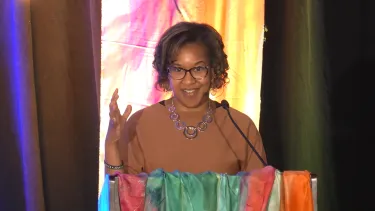
In this mindset, even the “historic virtues of our faith and the fruits of the Spirit are viewed as finite resources.” These virtues “have been distorted and replaced because they represent abundance.” Now, they have been assimilated into our culture of scarcity. Teter argued that this distortion is something the church needs to recover from.
Citing Jonathan Wilson-Hartgrove’s book “God’s Economy,” which was a corrective to the idea of a “prosperity gospel,” Teter explained that in New Testament Greek, the word “oikonomia,” from which we get the word “economy,” relates to the care and management of the family business.
Thus, in his ministry, Jesus instructed his disciples to “travel light.” Such a discipline helps us remember, in Teter’s telling, “What pours forth from God is generous caregiving independent of our ability to give back or even to steward.”
Teter noted that Paul in Ephesians writes about salvation being freely offered not because we have already created communities with righteous living, but because we needed it. And she gestured to the Communion Table as the place where we receive God’s gift of community.
So, how can we rest in the economy of grace? What do we practice if we are to manage and care in God’s family business? Teter offered four practices to cultivate communities reflective of God’s economy of grace:
- Liturgies of gratitude
- Extravagant generosity
- Critical solidarity
- “Communing,” a radical sharing of possessions and resources.
Teter suggested that one way we can practice liturgies of gratitude is to read James 1, then give thanks to the people and the ideas and the things that you see God doing in your life.
She explained extravagant generosity by saying, “Thanksgiving is not a commodity that depletes with use. It is lavish and we need to share it with all; it gives us a new view in what could be possible with God.”
Critical solidarity is a phrase created by the East German church during the Cold War. It is a form of dissent that asserts that freedom and love go together. Freedom in Christ is the freedom to love others as God has loved us, and should lead us to share the goods of the world with everyone, starting with the ones most in need.
The concept of “communing” is related to that sharing. It simply says, “what’s mine is yours.” Teter pointed out that “when we pull things together, we can live more freely in our individual and collective vocations.”
Jody Mask for the Presbyterian Foundation (Click here to read original PNS Story)
Let us join in prayer for:
Angela Duffy, CFO, Trust Services, The Presbyterian Foundation
Lindy Ebbs, Raiser's Edge Data Administration, Funds Development Operations, Presbyterian Church (U.S.A.), A Corporation
Let us pray:
Creator God, thank you that through your Spirit, creative solutions flow. Help us to let go of practices that no longer serve you or your people and to rise in Christ to the new opportunities to which you call us. Amen.