
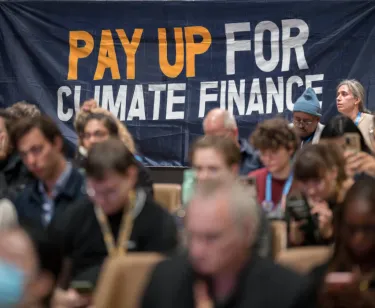
After days of long, intense marathon sessions of negotiation, COP 29 concluded in the early hours of Sunday morning in Baku. The negotiated outcomes included a new $300 billion international climate finance goal, known as the New Collective Quantified Goal (NCQG).
President Biden issued a statement praising the outcome, noting this goal “will help mobilize the level of finance – from all sources – that developing countries need to accelerate the transition to clean, sustainable economies.”
Talking to reporters after 3am in Baku, U.S. Senior Advisor to the President for International Climate Policy John Podesta described the outcome as “a very good result.”
That’s only one opinion though.
Disappointments and Despair
Faith leaders attending as part of the ACT Alliance delegation however expressed profound disappointment with the outcome of COP 29 and the failure to secure even the minimum asks of the poorest and most vulnerable countries. They say that this result is an indication of weak leadership from the COP29 Presidency, which has fallen short of its responsibility to deliver meaningful progress.
The BBC echoed that opinion stating that while “shepherding 200 countries to an intricate deal on climate finance was always going to be a tough task…for host Azerbaijan, a country with no real history of involvement in the COP process, it proved to be almost beyond them.”
Azerbaijan following Egypt and the United Arab Emirates is the third authoritarian state in a row to host COP. And like the UAE, Azerbaijan, has an economy which is built on oil and gas exports. A fact that places them at odds with a process that is meant to be helping the world transition away from coal, oil and gas.
Alethia White, PC(USA) delegate to COP29 shared that her experience at COP29 was quite different in comparison to last year in Dubai for COP28. “There was a similar disapprobation in regard to the conference host as last year, but it took on greater significance this year as a number of country leaders chose not to attend or pointedly left early or announced their intentions to pull out of the Paris Agreement. I talked to a number of delegates from different countries, including some from negotiator teams or political parties, who expressed the same concern that if leaders choose not to come based on discontent with the host, then the chance to discuss these issues face to face is lost.
Privately, according to the BBC, negotiators spoke of their frustration with what some termed the worst COP in a decade.
Even without being there, Trump’s presence was felt across this COP. Many negotiators in Baku were concerned that a second Trump administration would upend years of climate negotiations. Richer nations wanted to commit to raising funding by 2035, believing that date will allow the US to contribute again once Trump has left office. “No-one thinks Trump in the White House will be anything but damaging to the multilateral climate regime,” said Prof Michael Jacobs, visiting senior fellow at the think tank ODI Global. “But this agreement was about trying to limit the damage as much as possible."
New Collective Quantified Goal (NCQG)
After three years of negotiations on the New Collective Quantified Goal (NCQG), the heart of the finance commitments for this so-called “Finance COP,” this outcome is entirely inadequate. The lack of ambition and inadequate support for those most affected by the climate crisis undermine trust in the process and stall the urgent action needed to address the escalating global emergency.
“COP29 has proved to be a colossal disappointment,” said Sostina Takure, coordinator of the ACT Zimbabwe Forum. “The failure to address the demands of the most vulnerable countries is evident across all tracks. There was a very clear regression in terms of ambitious language especially in the gender text. We have failed the women and girls who suffer the consequences of climate change and were pinning their hopes on this process. There is no effective participation of the poor and vulnerable countries without strong financial commitments directly towards them.”
“The lack of real progress during the COP at a time when the planet feels fragile in so many ways signals lack of real care about the issues and the people experiencing the effects of climate damage,” said Alethia White, Regional Liaison for Northern and Central Europe with the Presbyterian Church USA. “At the same time, any agreement is welcome and my respect goes to those governments and negotiators who show up, who stick with it, and who choose to look past disagreements and sit at the same table when it is difficult to do so…”
Loss and Damage
One decision at COP29 was made to ensure the full operationalization of the Loss and Damage Fund, long awaited by developing countries, including small island states, least developed countries, and African nations. The establishment of the Loss and Damage Fund was agreed upon during COP27 held in Egypt. The fund aims to provide financial assistance to countries most vulnerable to the impacts of climate change. During COP28 in the United Arab Emirates, a decision was made to launch the Fund’s operations. The COP29 Presidency has taken significant steps to ensure the Fund’s operationalization, working closely with its Board and the World Bank. In September of this year, during the Fund’s third Board meeting held in Baku, critical measures were taken to commence its operations, including the appointment of Ibrahima Cheikh Diong as the Fund’s Executive Director.
Within the framework of COP29, several important agreements related to the Loss and Damage Fund were signed. These include the “Trustee Agreement” and “Secretariat Hosting Agreement” between the Fund’s Board and the World Bank, as well as the “Host Country Agreement” between the Fund’s Board and the host country, the Republic of the Philippines.
To date, the total pledged financial support for the Fund exceeds $730 million. With these achievements, the Loss and Damage Fund will be able to start financing projects beginning in 2025.
But $730 million is a drop in a very large bucket. And it isn’t enough to touch the impacted communities.
Indigenous and vulnerable communities, including marginalised groups and individuals dependent on their natural resources and livelihood options are among the hardest hit, suffering devastating losses of livelihoods, cultural identity, heritage and practices and in many cases are forced to relocate by climate induced hazards. These are not just measurable losses and damages – they are irreplaceable. COP29 failed to deliver the necessary solutions to truly avert, minimise and address the needs of climate vulnerable communities.
“I am infuriated to come home to the aftermath of six typhoons that have struck the Philippines in the space of just four weeks with basically zero gains from COP29,” said Patricia Mungcal, humanitarian manager with the National Council of Churches in the Philippines. “I will be telling thousands of Filipino families who were devastated by these strong typhoons that world leaders have left us to suffer the heaviest impacts of the climate crisis and disregarded our demands for finance and reparations. This failure to address loss and damage is a grave disregard of our human dignity and rights. We charge this failure of COP29 to the moral bankruptcy of the rich, polluting nations.”
“There must be hope…”
“Between now and the next COP there must be a patient, careful strategy to nurture trust and friendship between participants. God gives us all we need to care for all planetary life,” said Bishop Philip Huggins, of the Anglican Church in Australia. “We just need to better apply our shared learnings on making relationships that are truly wonderful.”
White from the Presbyterian Church, USA agreed. “While it feels hard to feel hopeful after such a difficult COP experience, there must be hope in order for there to be meaningful progress, whether that is on a geopolitical level, international sphere, or within local communities.”
You may freely reuse and distribute this article in its entirety for non-commercial purposes in any medium. Please include author attribution, photography credits, and a link to the original article. This work is licensed under a Creative Commons Attribution-NonCommercial-NoDeratives 4.0 International License.


