At Stewardship Kaleidoscope, the ‘TikTok Pastor’ talks about trust and today’s parables
For the Rev. Bethany Peerbolte, brevity and an open heart are key

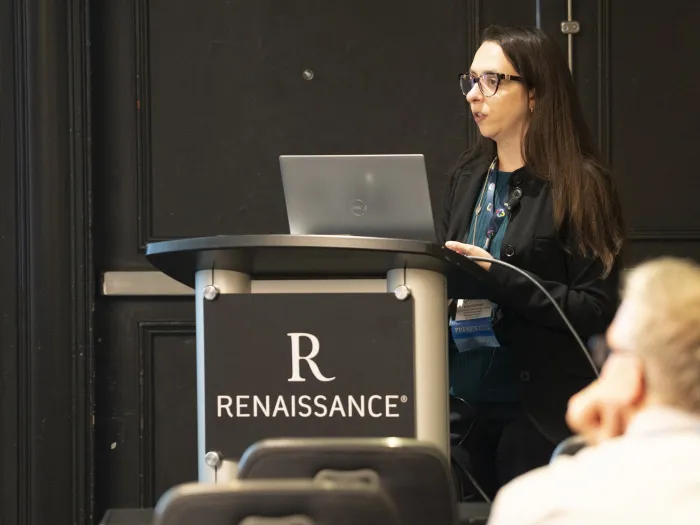
The Rev. Bethany Peerbolte has learned a thing or two about saying more with fewer words, inspiring trust and dealing with haters. In a plenary address at Stewardship Kaleidoscope last week, the “TikTok Pastor” shared insights and tips for fellow church leaders.
The annual conference is presented by the Presbyterian Church (U.S.A.) and Evangelical Lutheran Church in America. Her keynote presentation was on Tuesday, Sept. 22. Ordained in the PC(USA), the Denver-based Peerbolte — @RevBethany as she is known online (on TikTok, YouTube, Instagram, and Facebook) — has 300,000 followers and 5.8 million likes. She is also the pastor of OurTapestry, a community that intentionally meets only in digital spaces. She described it as a place where queer and ally Christians can declutter their faith from toxic theology.
Peerbolte began making humorous videos during a locked-down 2020. When her content went viral, hateful comments and even threats followed. She also got comments such as: "You make me feel so safe. I was seriously struggling because I felt my whole life was a sin, and now I realize it was their lies. Thank you.”
There were also the questions, particularly from young people, about the Bible and sin and whether Jesus could possibly love them. After recommending Marcus Borg’s “Reading the Bible Again for the First Time” several times, she started an online book study.
“I didn't want there to be more people on the Zoom than I could handle on my screen, and I had to create a waiting list because so many people signed up to do this book study with me. At the end of those book studies, people were like, ‘Hey, pastor, what are we doing next?’” she said.
Her followers have followed one another and found mutual support, including someone who posted: “I don't follow you. I have no idea why you're the first person that came up on my feed, but I am just scrolling for the last time. I am not ready to continue my life. I have a plan to end it. I haven't told anybody in my life, but I just feel like I wanted to tell somebody.”
Because it was an online forum with screen names only, Peerbolte had no idea who the person was, where they were or what resources they had, and she panicked. “All I can depend on are the truths that I know,” she recalled responding. “God loves you. You are beloved. This world is better with you in it.” As she was trying to figure out what else to do or say, she noticed other supportive comments coming in. Community was happening.
“These are strangers on the internet who they probably will never see or interact with again, but they're doing community better than some churches that I've seen do community,” she said.
Peerbolte still can’t figure out exactly how people find her. “I believe the only person who really knows what an algorithm is and how to use it is the Holy Spirit,” she said.
Be that as it may, she offered a few tips for church leaders who might be venturing into social media:
- Silence the negative voices in your head. “You can do this. You are already doing ministry that is worth telling a story about. You are already spending time writing sermons and newsletters and curriculum. So you already are making content. You just need to share it. If you have a phone that can record, you are already there. … This is not just salvation work. This is life-saving work.”
- Reframe how a message works, because you have far less time and space to share it. The supporting material you’d include in a sermon or newsletter article doesn’t necessarily need to be in a TikTok post. You can also rely on visuals such as a rainbow stole or flag. Make sure it’s consistent, she urged; wary seekers want to know you and your church are, in fact, open to them.
- Know your audience. (Spoiler alert: It’s not the haters. Peerbolte has developed a flow chart to guide her in whether and how to respond.)
“These short videos are the parables of today,” Peerbolte said. “They can get that conversation started. They can press on someone's assumptions. They can offer a new perspective.”
You may freely reuse and distribute this article in its entirety for non-commercial purposes in any medium. Please include author attribution, photography credits, and a link to the original article. This work is licensed under a Creative Commons Attribution-NonCommercial-NoDeratives 4.0 International License.