Global partners bring insights and broaden the vision for the work of the General Assembly
Seventeen Partner Advisory Delegates make their way to Milwaukee to participate in GA227

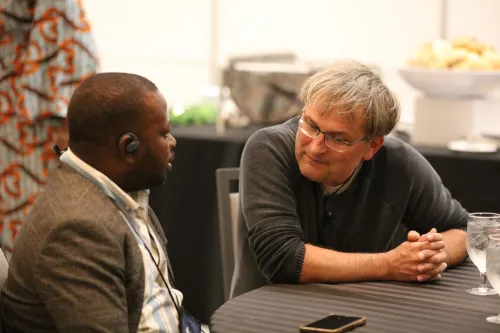
MILWAUKEE — Among those offering input on business to commissioners at the 227th General Assembly of the Presbyterian Church (U.S.A.) were 17 Partner Advisory Delegates (PADs) from around the world.
Dr. Dianna Wright leads the Office of Ecumenical and Interreligious Relations within Presbyterian Life & Witness. Last year, she and others began inviting global partners to participate.
The PADs have listened carefully throughout the proceedings, many of them without English as their first language, Wright said. They each participated in committees in which advisory delegates can speak and vote. In plenary, they can speak to business but offer only advisory votes.
Out of the nearly 20 partners invited to participate in the plenary portion of General Assembly, two were not allowed to enter the U.S.
The Rev. Izett Samá Hernández of the Reformed Presbyterian Church in Cuba had received her U.S. visa and all pertinent paperwork but was not allowed to board her flight. Samá Hernandez participated on the online Gender and Sexuality Justice Committee.
The Rev. Berla Andrade of the National Synod of the Presbyterian Church of Venezuela was prohibited from receiving a U.S. visa. She participated online on the Reformed Identity Around the World Committee.
Both Samá Hernández and Andrade’s seats at plenary were left open.
From the time the partners arrived in Milwaukee, staff from Global Ecumenical Partnerships of Presbyterian Life & Witness accompanied their colleagues from around the world. They ensured that everyone was where they needed to be and shared fellowship with them all.
In the planning for this accompaniment, the Rev. Cheryl Barnes, manager of Global Ecumenical Liaisons, U.S., said this was the most important job.
“We need to make sure we are taking care of them, showing up and making them comfortable,” she told the staff.
Navigating a complicated process in a different language required that attention.
“Some just don’t understand when committees have spent so much time on a piece of business and then in plenary, all their work is changed,” Wright said.
Conrad Harris represented the former World Mission’s Global Partners Roundtable. He is a member of the Ecumenical Disability Advocates Network in Kingston, Jamaica.
He said he enjoyed the committee work, all of which was on Zoom. Harris served on the Racism Justice Committee. “The moderators (the Rev. Patricia Bligen Jones and the Rev. Dr. Steve Watts) were very good. They encouraged everyone to speak.”
The pace of plenary is a bit frustrating, though, he added.
“I’m a little impatient sometimes, but then you realize God is working in it,” Harris said.
Cecilia Ramírez surprised herself when she spoke up in the Racial Justice Committee work.
“That was when I realized my voice is needed,” she said.
Ramírez is familiar with the Presbyterian Hunger Program that partners with Red Uniendo Manos Perú, an advocacy network in Lima, Peru. She is vice president of the network’s board.
“What I never understood was how PC(USA) could be pastoral and also work in social justice,” she said, her words interpreted by the Rev. Rosa Miranda, a Global Ecumenical Liaison who accompanies Hispanic, Latino and Latina congregations.
During a conversation on the resolution for a collaboration and study between entities in Liberia and various offices of PC(USA), Ramírez was compelled to speak. Her comment referenced the impact of racism, an impact she knows as an Afro-Peruvian woman.
She said she could see committee members nodding their heads, but as soon as she finished speaking, Spanish interpretation stopped. She heard commissioners speaking but couldn’t understand what they were saying.
“I didn’t know if what I’d said mattered,” she said. “I didn’t sleep that night.”
By morning she had received texts that indeed her statements had made a difference.
“I felt so satisfied,” Ramírez said.
Jiří Tengler, pastor of Evangelical Church of the Czech Brethren in Polička, Czechia, said he is familiar with the process of Presbyterian decision-making.
“But I was very glad to see there is no difference here. It is the same. Very slow,” he added with a grin.
Tengler and fellow church members have been in relationship with Memorial Presbyterian Church in Midland, Michigan. For more than 20 years, Memorial Presbyterian has sent a delegation to Polička to host a weeklong day camp for ages 7 to 15.
Saturnino Perez, director of the Organization for Human Rights and Action in Monte Plata, Dominican Republic, said he was grateful to be invited to serve, especially because of the deep partnerships between Presbyterian Disaster Assistance and Hunger Program.
The organization spends much of its time serving the many needs of people who lack identity documents. Many thousands of people of Haitian descent living in the DR have not been given Dominican papers, nor do they carry Haitian identification.
People have escaped the violence and terror of their native Haiti, but a Dominican legal ruling in 2013 made the process for having Dominican papers extremely difficult. This has left many people stateless, and recent forceful immigration raids leave them in fear.
“The Presbyterian Church has given us funds to send doctors to communities because immigration officers are at all hospitals,” Perez said.
Having served on the Climate and Environmental Justice Committee, Perez said the Presbyterian way makes sense to him.
“I like how the process gives everyone a chance to speak their thoughts,” Perez said.
You may freely reuse and distribute this article in its entirety for non-commercial purposes in any medium. Please include author attribution, photography credits, and a link to the original article. This work is licensed under a Creative Commons Attribution-NonCommercial-NoDeratives 4.0 International License.