Jess Cook in light and water
The Rev. Jess Cook chats with PHS Archivist David Staniunas about Izzie Rogers, Katie Cannon, and more
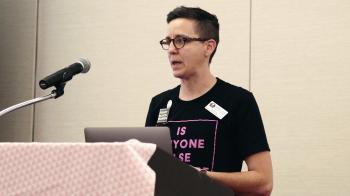
Jess Floyd Cook was the first trans/non-binary person ordained a minister of word and sacrament in the PC(USA). They grew up in Texas, studied art at Baylor University, and eventually moved to Richmond, Virginia, embarking on a path toward ordination. In this oral history interview with PHS, which has been edited and condensed for clarity, we talk about their hopes for the PC(USA), and their formation through light and water.
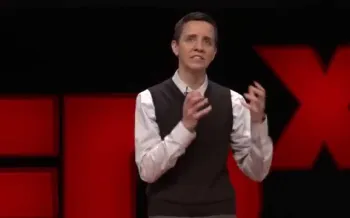
David Staniunas: Jess, why don't you start by talking to me about your process, your call, and your calling to the ministry.
Jess Floyd Cook: I grew up Presbyterian. I was baptized in First Presbyterian Church, Dallas, Texas. I grew up in First Presbyterian Church of Longview, Texas. Looking back, it’s really clear to me that I’m doing exactly what I came here to do. But that wasn’t always clear in the process. I think I always had a deep connection with God.
Summer before ninth grade, I went on a church youth group trip with the First Baptist Church of Longview. And they had the experience where you have the big worship and then at the end, there's the altar call. I can remember calling my parents and telling them I'd been saved. And they were like, “We don't really do that in the Presbyterian church,” you know. There was a sense of earnestness and a sense connection and desire to connect with the Divine.
I studied art and again, had a deep connection with the Divine. I knew I had a nudge toward photography and I think that was really around light, which actually comes to play. So you can talk, like I can talk, about my love of baptism and trace back to ... growing up as a trans kid in East Texas who didn't know, you know, as the eighties and there was no language for non-binary identity. But I grew up swimming competitively. And so I was held by water all my life. One of my best childhood friend's last name was Dove.
DS. Can you tell me more about the significance of playing with light or working with light in photography?
JFC: I mean, it's been learning about how light moves. The story of the Transfiguration, to me, has a completely different feeling when I think about light and ... light as energy and white light as the presence of all light. And that this moment of transformation is one where we're seeing the veil literally thin between what we experience as reality and what it really is. And it's like that, like my dad is always with me. My dad who left his body in 2011. Jesus is always with me.
DS: Growing up, you and your siblings all swam competitively?
JFC: It was a family thing. Like swimming in the city pool and these like floating hairballs and ... dirty [bandages] and whatever that all of a sudden now become like, I had this memory of these specific things. But then there's this way in which now those touchpoints become this light. I was a queer kid without a clear sense of self. I can look at pictures, I was on my high school dance team and I can see pictures where I was clearly expressing a sense of dysphoria. Like I know it now, but I didn't have words for it. And I think about all that time in the water and just, I could be there, you know? ... I was comfortable enough, I was familiar enough in the water, because I started so young that ... by the time I was 13, 14, 15, you know, like, it's just what I've been doing. I think for me being trans has actually been a huge part of that, because it's been about listening to my body and listening to my higher self, who's been saying, “I need to live in this body in a way that doesn't actually make sense, but it will.”
DS: The art and theatre departments at Baylor were maybe one of those familiar spaces?
JFC: They were adjacent. They shared a loading dock, but they were separate. I remember having a ceramics professor when we were talking about the theater department. And he sort of grumbled, “Never trust anybody who spends all their time around mirrors.”
DS: You could see how ceramics combines or embodies water and light. The process of turning something that is extremely wet into something that vitrifies and becomes glass.
JFC: What's wild is ... that I was making things that I use now. Today ... I was doing a ceremony cleansing my house and had a bowl that I made. These sort of bowls that I just kind of made. It’s kind of uncanny: I didn't know how much I knew why I was here.
A lot of it has had to do with some of the more mystical experiences that have happened over the last few years ... I am here to live in this body, but I am not this body. This body is my outfit. This is what I get to wear. I'm here as just part of the infinite consciousness that is all that is. And this body is my temporal vessel. It is also the only way I experience what it is to be created. I'm very aware that like I'm here to be Jess.
And even like, my last name is Cook, right. One of the things that I love about humans, you know, we alchemize in a very specific way. That we cook, I think is a uniquely human thing. That we don’t do it just to serve ourselves, but that this is a source of pleasure and delight. And ... I feel like it's been my job through many lifetimes to learn how to be an expert human.
DS: You moved to Richmond in 2008, and then what happened?
JFC: I had met Jane Spahr in 2008 and Lisa Larges, both on a trip out to California. I went out because I was interested in doing a photography project, photographing people who couldn't be ordained. But I met Jane Spahr and leaving her house, I think was the first time I said like, “Oh, I have to actually go to seminary.”
In the spring of 2009, I audited a class at Union Presbyterian Seminary with Katie Geneva Cannon [in] her womanist, feminist and mujerista ethics class. And on day one, I sat and said, “Oh [my], I am going to seminary.” Dr. Cannon was just, she was a teacher. She made space for those who wanted to be there and do the work. She made so much space. She's on my altar right next to me now. And I get actually choked up just thinking about what a gift she was. [Emeritus President] Brian Blount was another big mentor of mine. I did a directed study with him for a semester looking at a couple of chapters of the Book of Mark, which was really lovely.
My last year of seminary, I did an internship at an organization in Richmond for LGBTQ youth, and it was called ROSMY at the time, which was Richmond Organization for Sexual Minority Youth. But it changed its name and is now called Side by Side. I loved working with the youth. It was really helpful clarifying my sense of call, and also just having the experience of sitting with people who have been told by the church that they were unworthy based on their very existence.
DS: You said in your experience at First Longview that the kind of Presbyterian habit of unpacking stuff or discernment was significant to you growing up. Can you reflect on like Presbyterian discernment and taking a long time to figure stuff out?
JFC: I love Presbyterians because there are so many ways that we have pulled so many of the very strict ... all those structures, but there's so much room still. In a way the intent is to create the structure for the movement. Even looking at how long it takes for decisions to be made back and forth, I find myself grateful for the willingness to stick with it.
We are at a very decisive pivot point that I think has been coming for a long time. But I think there's also something within the denomination — there is something moving here still. I think our structures actually help us to do that.
Watch the Rev. Jess Cook's full-length oral history in Pearl.
Enjoy this glimpse into the lived experience of the Rev. Jess Cook? Donate to the PHS Annual Fund, which supports the efforts of the Presbyterian Historical Society to collect, preserve, and share the past in order to transform your current perspective on church history.
You may freely reuse and distribute this article in its entirety for non-commercial purposes in any medium. Please include author attribution, photography credits, and a link to the original article. This work is licensed under a Creative Commons Attribution-NonCommercial-NoDeratives 4.0 International License.