Faith-based leaders call for dignity, protection at global migration forum
International Migration Review Forum 2026 side event highlights frontline role of faith communities and urgent need for rights-based systems
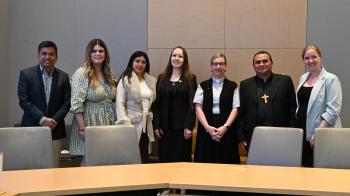
NEW YORK — Faith leaders and migration advocates gathered Wednesday at the United Nations offices of the Baha’i International Community to call for more humane migration systems and to highlight the ongoing, often underrecognized role of faith-based organizations during the International Migration Review Forum 2026.
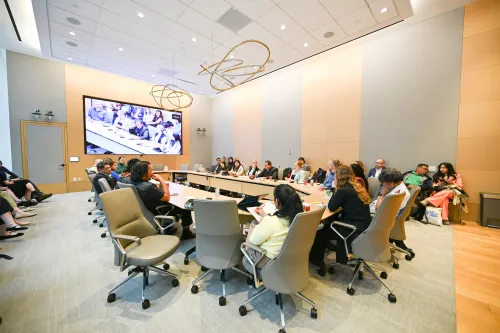
The event, “Compassion Across Borders: Faith Responses to Migration in a Changing World,” was co-hosted by ACT Alliance, the Lutheran World Federation, the Evangelical Lutheran Church in America and the Presbyterian Church (U.S.A.).
Opening the event, the Rev. Sonia Skupch, regional secretary for Latin America, the Caribbean and North America for the Lutheran World Federation, grounded her remarks in a biblical narrative of migration. “We often remember that Jesus himself, together with Mary and Joseph, were refugees. They had to flee … and find refuge to Egypt,” she said, connecting ancient displacement to modern realities.
Skupch said the gathering was meant to assess global progress while centering people on the move. “We are gathered at this event to highlight the importance of faith-based organizations in their capacity to address the current risks of migration within an increasingly challenging migration policy environment,” she said.
She emphasized both the scale of global displacement and the policy challenges shaping it, noting that current conditions are “marked by wars, conflicts, the climate crisis, economic crisis and the lack of prospects,” alongside “increasingly restrictive and exclusionary migration process.”
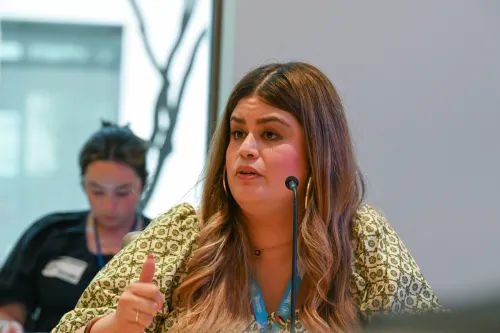
Karol Arámbula of ACT Alliance situated the conversation within a shifting global framework. “We gather in a moment when the very idea of multilateralism, of shared responsibility … is being strained, contested and in some places, deliberatively dismantled,” she said.
Arámbula also pointed to the collaborative nature of the event, noting, “Along with our colleagues from the Lutheran World Federation from ELCA, as well as the Presbyterian Church (U.S.A.), we invited our colleagues who are on the ground showing us how that information can take place.”
Speakers from Colombia, El Salvador, Ukraine and Bangladesh described how faith communities respond when systems fail. Across contexts, churches and local organizations were described as trusted actors able to provide sustained care.
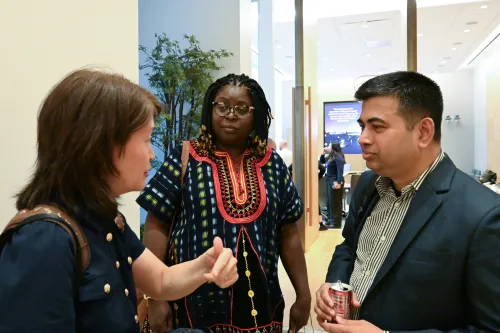
Pervez Siddiqui, founder of the Films 4 Peace Foundation in Bangladesh, outlined systemic barriers migrants face, beginning with his own experience. “It takes four years to come here, because I applied in 2022 for the visa,” he said. Siddiqui is part of a delegation of 15 persons supported by offices across Presbyterian Life & Witness, an agency of the Presbyterian Church (U.S.A.). Staff members from the PC(USA) offices for Global Ecumenical Partnerships, Immigration Advocacy, and the Presbyterian Ministry at the United Nations accompanied these delegates through out the week of the International Migration Review Forum. As a Muslim, Siddiqui felt the Presbyterian church did a great job of creating a "very welcoming, family environment," especially staying at the Church of the Covenant guesthouse and collaborating with the other delegates, most of whom were in attendance at his panel and offered responses from their own contexts.
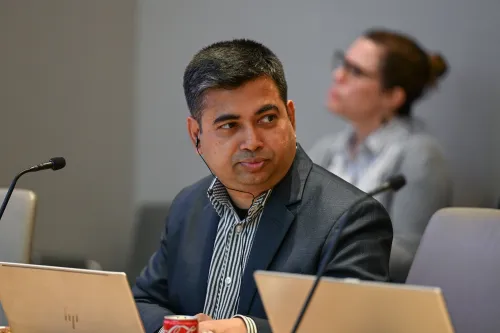
Siddiqui described migration in Bangladesh as driven by necessity. “Migration is not just an economic pathway, but often the only option for survival and dignity,” he said, while also pointing to “limited opportunities, shrinking regular pathways and systematic government failure.”
Siddiqui highlighted the Rohingya refugee crisis as a moment when faith-based organizations stepped in. “During the initial influx in 2017 it was local communities and faith-based [organizations] who responded fast. There were no international organizations, no United Nations,” he said.
He also pointed to the dangers migrants face globally, including thousands of deaths along migration routes, driven by the lack of safe pathways.
“Most important, we must listen to migrants, because migration should never be a journey where people lose their lives. It should be a journey of dignity, safety and opportunity,” Siddiqui said. “Let us move from the system that fail people to system that protected.”
The Rev. Kate Parsons, program director for migration policy at the Evangelical Lutheran Church in America in Washington, D.C., summarized the discussion by emphasizing both the strengths and limits of faith-based responses. “Faith-based organizations and churches are filling gaps that state international cooperation either cannot or will not cover,” she said.
She described those organizations as “not just service providers, but also trusted bridge builders,” while cautioning that governments must remain accountable. “Access to rights should not depend on the existence of churches and solidarity organizations, but should be guaranteed by public systems,” Parsons said.
The forum closed with a theological reminder of shared responsibility and hope. Skupch cited Matthew’s Gospel: “For I was hungry and you gave me food. I was thirsty, and you gave me something to drink, and I was a stranger, and you welcomed me,” she said, urging participants forward with faith and resolve.
You may freely reuse and distribute this article in its entirety for non-commercial purposes in any medium. Please include author attribution, photography credits, and a link to the original article. This work is licensed under a Creative Commons Attribution-NonCommercial-NoDeratives 4.0 International License.