Panel calls for more help for people facing eviction, homelessness
Discussion follows Louisville screening of PC(USA) documentary
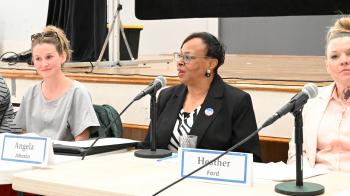
LOUISVILLE — A recent screening of “Evicting the American Dream” in Louisville, Kentucky, brought together a panel of community leaders and advocates to discuss the obstacles facing families at risk of homelessness and how to better support them.
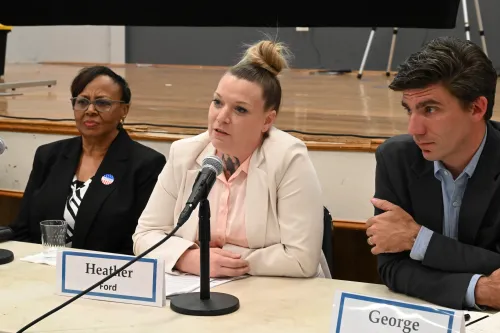
“A lot of people make assumptions that individuals facing eviction are irresponsible, lazy, or unwilling to work, but what I try to help people understand is that many families are actually doing everything they can to survive,” said panelist Heather Ford, a peer support specialist at the Americana World Community Center, who urged taking the time to hear people’s stories. “… They are overwhelmed, under-supported and surviving systems that were never designed to protect vulnerable families.”
Ford’s comments reinforced themes highlighted in the 2025 documentary, “Evicting the American Dream,” which was shown prior to the panel discussion. The film from Counter Stories Productions and Presbyterian Disaster Assistance (PDA), explores the systems that lead to families being evicted and notes that being evicted can leave them with a scarlet letter ‘E’ on their records that can hinder their ability to get decent housing.
“At the time of making this film, and this is something most people are surprised to learn, it is legal in many states in the United States to put a kid's name on a rental lease, so that when the eviction is filed, those kids get listed on that filing, so when they turn age 18 and go to rent, they have an eviction record,” said Katherine Rowell, a sociologist and co-executive producer who collaborated with writer/director David Barnhart to develop the film. “… Ohio has recently passed legislation that you can no longer list someone under age 18 on the eviction filing.”
Positive change is what the organizers of the film screening are hoping for as the documentary is seen by more and more people in grassroots screenings and through streaming.
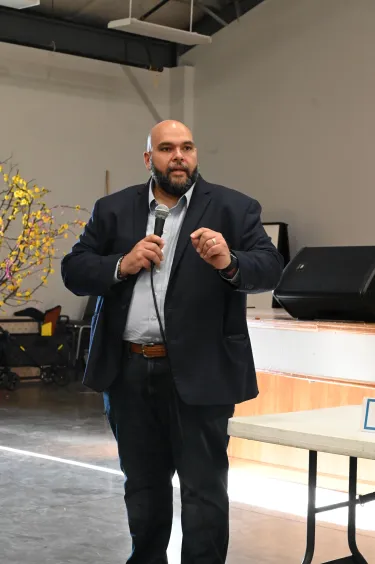
“Let's advocate, let's make calls, let's move around in our communities, so people can benefit from a better home and live in a better house,” the Rev. Edwin A. González-Castillo, who manages PDA, said during the screening at St. John Vianney Catholic Church.
People should be able to “live under a roof, to be able to welcome family, to be able to have a safe place,” he said. A roof “comes with better health systems, it comes with a better education for our children, it comes with so many things in addition to just that house.”
After the film showing, attendees heard from Ford and fellow panelists:
- Clare Wallace, executive director of South Louisville Community Ministries
- Jonet Wright, peer support & housing specialist for South Louisville Community Ministries
- George Eklund, director of education and advocacy for the Coalition for the Homeless
- Moderator Angela Johnson, pastor of Smoketown’s Grace Hope Presbyterian Church and co-president of Citizens of Louisville Organized and United Together (CLOUT).
Wallace discussed StopMyEviction.org, a hub for people facing eviction and how it came about during the covid-19 pandemic to make sure people could access rental assistance and other services.
She also noted that “we have created a centralized intake for the entire city, so that we can at least walk with people as they are facing this to make sure that they have the right to counsel, make sure they have access to whatever rent assistance is available, but then also make sure that any person with a 0 to 5 year old in their home, we will do literally anything to keep them in their home, and we have worked now with more than 25 partners who are also committed to this.”
Wright and other panelists noted that families living on the margins struggle to overcome numerous obstacles, including lack of transportation.
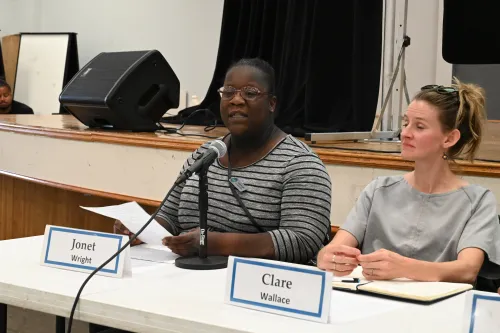
“If I don't have the means of transportation, it will hinder me in a lot of different areas,” including getting to appointments, she said. “If I can't get to childcare, I can't go to work. If I can't go to work, I lose my housing. If I lose my housing, I can lose my kids. If I lose my kids, I give up, and then the cycle repeats. I see this affecting so many (people), especially women with children and seniors.”
Wright also offered many potential solutions related to housing and eviction such as improving certain aspects of eviction court, creating a fund for moving costs and fees, and having “a community worker work closely with the individual to see what the barriers are. … Walk the journey with them, not for them.”
Ford spoke of the need to be more proactive to help families and other vulnerable populations.
“We need more supportive housing programs, especially for families, single parents, and people who suffer from substance use disorders or mental health disorders,” said Ford, who identified herself as a single parent. “We need affordable childcare, so parents can work and attend school. We need trauma-informed care and shelters and housing systems, and we need to expand rental assistance. … Why are we spending more money responding to family crisis after trauma occurs instead of investing earlier to keep families stable and together in the first place?”
Eklund talked about strides made during a recent session of the Kentucky General Assembly when a housing package got farther than expected. Among other things, it would have provided for expungement of records in eviction proceedings that are dismissed and included some protections for minors.
“The bad news is it didn't pass, but the good news is that we got so close,” and in fact, “we were able to pass the Kentucky House 90 to nothing, which is a huge step for us,” Eklund said.
He said the film motivates him to go back to the General Assembly “for next session to actually get something done” and to tell lawmakers “we need to rethink how we're addressing evictions and housing insecurity. How can we prevent eviction before it starts?”

Eklund also expressed a desire to see Louisville’s Metro Government create a stabilization fund of flexible money for organizations to use to help out families in crisis. For example, it might be used “to do things like pay deposits to get people out of the shelter and into housing” or to repair someone’s car for $500 to keep their finances from spiraling out of control, he said.
Ford lamented how children are traumatized when their families are constantly struggling to survive and worried about where they’re going to sleep. She also called for compassion.
“People facing eviction are not personal failures,” she said. “They’re parents, children, workers, survivors, veterans, and members of our communities. Many are one emergency away from homelessness. I think compassion begins when we stop asking, ‘Why can't they figure it out?’ and start asking, ‘What barriers are standing in the way, and what support will allow them to succeed?’”
Organizers of the film screening and panel discussion included PDA, the Presbyterian Committee on the Self-Development of People, the Presbyterian Hunger Program, the Presbyterian Investment & Loan Program Inc., Mid-Kentucky Presbytery of the Presbyterian Church (U.S.A.), the Association of Community Ministries, the Americana World Community Center, the Coalition for the Homeless, and See Forward.
Advocacy opportunities
These advocacy links were provided after the program:
If you live in Louisville, consider emailing your Louisville Metro Council member to advocate that housing and eviction prevention are prioritized. Learn more by reading about the “Safe and Stable: Housing for All” campaign.
You can also fill out the official Louisville Metro Budget Comment Form to emphasize the urgent need to invest in housing and eviction prevention.
You may freely reuse and distribute this article in its entirety for non-commercial purposes in any medium. Please include author attribution, photography credits, and a link to the original article. This work is licensed under a Creative Commons Attribution-NonCommercial-NoDeratives 4.0 International License.