Global delegation heads to UN migration forum to amplify global partner voices
PC(USA)-convened group prepares for advocacy, worship and civil society engagement at International Migration Review Forum
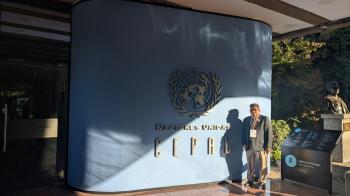
A delegation of Presbyterian Church (U.S.A.) leaders and global partners will travel to New York over the weekend to participate in the second International Migration Review Forum (IMRF), a major United Nations gathering focused on global migration policy and advocacy from May 4-8.
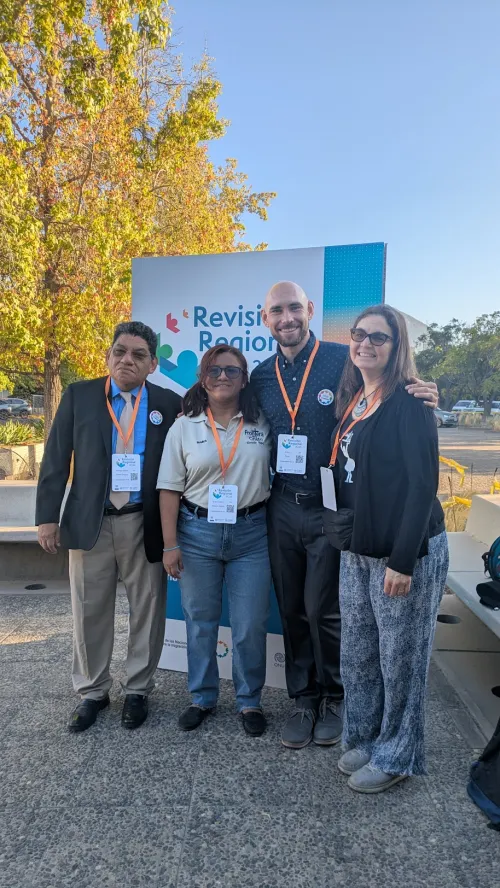
Held every four years, the IMRF evaluates progress on the 2018 Global Compact for Migration and produces a negotiated declaration, while incorporating regional input and shaping international policy priorities. The process allows civil society organizations to attend the proceedings, facilitate side events, submit questions, reports and speak on their own expertise while helping shape global migration priorities.
For the PC(USA), the delegation reflects collaboration across Presbyterian Life & Witness, including Global Ecumenical Partnerships, Immigration Advocacy and the Presbyterian Ministry at the United Nations and Presbyterian Disaster Assistance. According to the orientation document produced by Clare Balsan, associate for advocacy at the Presbyterian Ministry at the United Nations, “The general objective of the PC(USA) IMRF 2026 Delegation is to strengthen multilateral collaboration on advocacy on migration issues around the world pertinent to the GCM and beyond.”
Joseph Russ, a U.S.-facing Global Ecumenical Liaison within Global Ecumenical Partnerships, described the forum as both a policy space and a platform for lived experience. “The IMRF is when the United Nations come together to discuss the Global Compact for Migration,” said Russ, “but it’s also a great opportunity for organizations working on the ground and people of faith to share their own feedback and ideas for the process.”
Grounded in global partnership
The delegation includes partners from Asia, Latin America, Africa, Europe and the U.S. border with Mexico. Many bring firsthand experience of migration. International Global Ecumenical Liaison the Rev. Cathy Chang emphasized the invitational and mutual nature of the collaboration, saying, “Our partners invited us to accompany them.” Partners from Latin America and Asia had already been engaged in regional IMRF reviews and advocacy processes and invited Presbyterian colleagues to accompany them in bringing those perspectives to the global forum. In turn, PC(USA) staff and networks organized a broader delegation connecting partners across regions and expanding representation to include additional advocacy voices while continuing relationships already rooted in years of collaboration.
Partners say faith communities play a vital role in responding to migration. David Bonilla, a Mennonite pastor and social manager with Frontera de Cristo, said they offer “accompaniment, hope, and a support network, in addition to concrete help. Churches are often spaces of welcome and dignity.”
Bonilla also stressed the realities that drive migration. “Forced migration is a necessity, not a choice,” he said, adding that communities of faith can support migrants through “hospitality, practical support, and advocacy for human rights.”
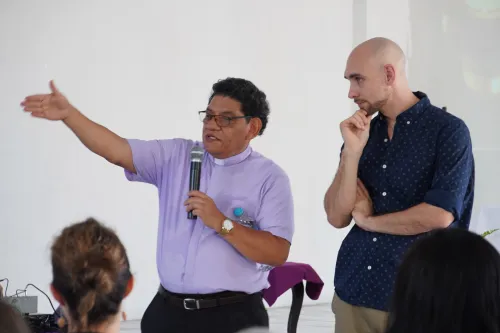
The Rev. Santiago Flores of the Reformed Calvinist Church of El Salvador echoed that perspective. “It is important to understand that these people have objective and real reasons that compel them to leave their homeland and loved ones. They do not do so for pleasure, nor are they criminals, but rather workers seeking to provide for their families because they lack opportunities in their countries of origin.”
Flores also pointed to a theological vision of shared belonging. “The world is our common home, oikos, and no one should be a stranger in our shared home.”
Preparing and finding ways for voices to be heard
In the weeks leading up to the forum, Presbyterian Life & Witness staff and partners have focused on planning, coordination and aligning advocacy priorities. Delegates gathered virtually for orientation at 8 p.m. Eastern time on April 27, bringing together participants across time zones. “Good evening, good morning,” said the Rev. Ellen Sherby, manager of Global Ecumenical Partnerships, greeting participants joining from Hong Kong to Cameroon. She encouraged bold engagement at the United Nations. “My prayer and hope is that you find ways for your voices to be heard,” Sherby said, urging participants to engage decision-makers and share their experiences.
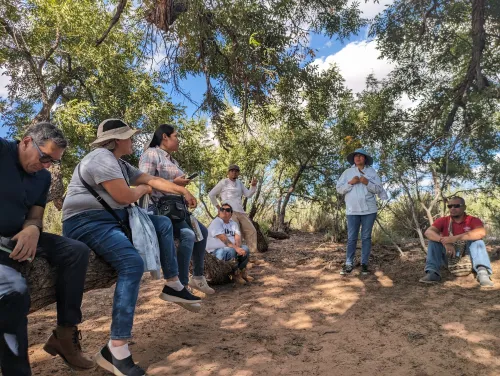
Throughout the orientation, staff emphasized coordination and shared advocacy. Amanda Craft, manager for Immigration Advocacy, encouraged delegates to bring the realities of their communities into the global conversation.
“Our hope really is that you will also represent that voice … bringing those resources, experiences, talking points, questions and critiques into the space,” Craft said.
At the same time, leaders highlighted the importance of common messaging. Chang encouraged delegates to engage both formally and informally, noting that “there are different access points” for advocacy.
Returning IMRF participants emphasized the value of relationships formed outside formal sessions. Vicky Tzannetis of Lesvos Solidarity noted that delegates often “bump into people” in shared UN spaces, creating opportunities for meaningful, informal conversations.
Rey Asis of Asia Pacific Mission for Migrants underscored the importance of preparation for formal moments. He encouraged delegates to develop shared talking points so they can “echo or reinforce each other” during official interventions.
A week of advocacy and witness
During the forum, delegates will participate in UN plenary sessions and a May 4 multi-stakeholder hearing where civil society voices can help shape discussions. A key ecumenical moment will come May 5 at the Baha’i International Community with “Compassion Across Borders: Faith Responses to Migration in a Changing World,” co-sponsored by the PC(USA). While not part of the formal IMRF proceedings, the gathering serves as a meaningful side-event where faith-based organizations can share experiences and connect with decision-makers.
Additional side events throughout the week will focus on migration governance, human rights and the participation of migrants themselves in shaping policy. Sessions such as “With Migrants, for Migrants: Discussing Issues, Gaps and Opportunities in Actualizing Meaningful Participation of Grassroots Migrants in the GCM” will highlight how those with lived experience can influence implementation of the Global Compact. Other events will address issues including deportation agreements, family unity and labor rights.
Delegates will also participate in worship and community gatherings, including a service at Lafayette Avenue Presbyterian Church in Brooklyn.
Bearing witness together
For PC(USA) leaders and partners, the IMRF is both an advocacy platform and a faith witness. “These spaces need the moral clarity people of faith can bring to these conversations,” Russ said. By centering lived experience and strengthening global partnerships, the delegation seeks to influence migration policy while affirming the dignity and leadership of migrants themselves.
You may freely reuse and distribute this article in its entirety for non-commercial purposes in any medium. Please include author attribution, photography credits, and a link to the original article. This work is licensed under a Creative Commons Attribution-NonCommercial-NoDeratives 4.0 International License.