Coffee and spirituality
During a Leader Formation webinar, the Rev. Amos Méndez serves up tasty cups of each

LOUISVILLE — During a Leader Formation webinar offered last week, the Rev. Amos Méndez offered up a talk on spirituality while pausing frequently to sip coffee from his favorite mug. The message was unmistakable: Méndez was blending two of his favorite topics, coffee and spirituality.
Since 2010, Méndez has served as pastor at Iglesia Presbiteriana Juan Calvino in Quebradillas, Puerto Rico. He’s also Stated Clerk of the Presbytery of the Northwest in Aguadilla, Puerto Rico. Martha Miller, manager of Ministry Education and Support within Presbyterian Life & Witness, hosted the webinar.
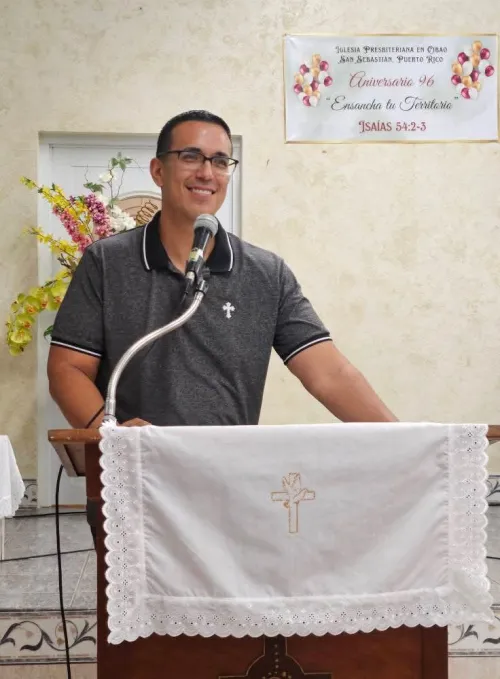
Méndez condensed his presentation from an eight-part Bible study he offered at the church he serves and an abbreviated version he’s taken on the road. He and Miller discussed connections between coffee and spirituality during this 2025 Along the Road “Nourish” podcast.
“What we have today is a talk about a journey. It involves coffee, which I love, and Puerto Rican culture,” Méndez said. “I hope you will get inspired to make your own connections, because spirituality is not something that is constrained.”
Méndez invited those in attendance to think of themselves as “the coffee mug in which God pours spirituality into you.”
“As coffee mugs, we may be broken ourselves — broken by trauma, broken by guilt,” he said. “We need to recognize we are broken and need to be fixed.”
God intends healing for those who are brokenhearted, he said. “In our brokenness, we need to put ourselves in the hands of the Lord,” the potter “who reshapes and reconstructs us.”
Méndez is a relatively recent convert to coffee’s almost medicinal properties. During a tour of a coffee plantation in the Dominican Republic, he was offered a cup of joe, which he turned down because he was sure it would be bitter.
The guide told him rather than a bitter taste, Méndez would be enjoying a sweet one. “You’ve just been having bad coffee,” the man told Méndez. The coffee was indeed sweet, and Méndez asked the man if he’d put sugar in it. “You’ve been with me the whole time,” he told Méndez. “That’s when I learned the problem wasn’t that I didn’t like coffee,” Méndez said. “I didn’t like how coffee had been made for me.”
As there are different ways of making coffee, we all have different ways of experiencing God in our lives, Méndez said. “I would go to different churches in Puerto Rico and explain how I like using my French press” to make coffee, he said. “People would say, ‘It takes too much time,’ and they were right. You can’t just do it just to get it done.” And as coffee is valuable for many people, spirituality is “an important part of life, development and growth. You need to know yourself.”
Coffee farmers make their beans more diverse and richer by planting different trees to attract a range of pollinators, Méndez noted. People who are passionate about their coffee, as Méndez is, take care not to overheat the water, a deal-breaker that contributes to bitterness.
“When people experience the church as something bitter, is it because the work of the church is bitter, or is it because we just made it that way? Did we burn it?” he asked. “Maybe we have dealt with people who have made our spirituality a little bit bitter. I do think churches and spirituality are meant to be sweet.”
Throughout his talk, Méndez cited biblical passages, including benefits identified in Psalm 3:5 and Isaiah 40:29, to help make his point. “Some people say I have a coffee addiction, but I like to call it a symbiotic relationship in the same way I need the presence of the Lord every moment,” Méndez said.
We might add sugar, milk or cream to our coffee. “What we add to the coffee isn’t coffee. It just makes our coffee more agreeable to us,” he said. In the same way, “some of our practices aren’t spirituality, but they help us experience God and strengthen our spirit.”
“It took me years to enjoy black coffee without sugar, and knowing how long that took is very important to me,” he said. At a coffee shop, “when someone next to me orders a [flavored] latte, I remind myself we are not in the same part of our journey with coffee.”
“I’m not there to judge. I could sit and listen to an artist talk for an hour and not understand a thing,” he said. “But that’s how they experience God.”
The impact of prayer on our spirituality is well known, he said. The Lord’s Prayer is laced with collective language, including “our” and “us.”
“If each of us tonight prayed in a community way, that means everyone else on the call would be praying for you,” he said. “If we pray in an individual way, it means only one person is praying for you.”
Meditation, including this mention in Psalm 77:12, is among his favorite spiritual practices. Méndez enjoys watching the clouds from his backyard vantage point with a cup of coffee in hand. “Sitting down and just resting in the Lord and waiting on God is one of the best things I can do for my spiritual life,” he said. “I meditate on the things that God is calling me to do and which ones God is saying, ‘Wait — I will do those for you.’”
The fast that the prophet speaks about in Isaiah 58:6 is more than just not eating, he said. “Fasting is breaking the chains that bind us to things that keep us from growing in our spirituality,” including “the injustices and inequalities of the world,” he said. “What is God calling you to untie or to break?”
Méndez described the 3 o’clock coffee break many people in Puerto Rico practice. “If you come to my house, I will not pretend that you like coffee like I do. I will not serve it with no sugar or no milk,” he said. “When you are offered coffee in Puerto Rico, you will get a lot of questions: Do you want milk? What kind of milk? How much? Do you want sugar? What type? Puerto Ricans like to be great hosts.”
“That got me to ask myself — what about the church? Do we think about what others want before we prepare everything — yearly program, worship liturgy — or do we think about what they like?” Méndez asked. As Presbyterians, “we have a beautiful Reformed theology, but these practices are not spirituality in the same way that adding sugar or milk is not coffee.”
“We have a good theology,” he said, “but we need to be good hosts.”
Learn more about Leader Formation resources here.
You may freely reuse and distribute this article in its entirety for non-commercial purposes in any medium. Please include author attribution, photography credits, and a link to the original article. This work is licensed under a Creative Commons Attribution-NonCommercial-NoDeratives 4.0 International License.