Human rights organization explains its operation in Israel-Palestine to the PC(USA) delegation
HaMoked offers free legal services, including connecting families with loved ones in detention
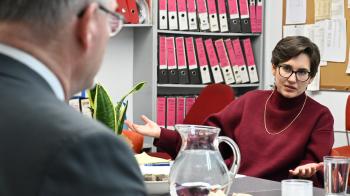
JERUSALEM — Each month HaMoked, the Center for the Defense of the Individual, assists hundreds of Palestinians from the West Bank, East Jerusalem and Gaza to reunite with family members, cultivate their farmlands, visit their detained loved ones, and more. Earlier this month, the six-member delegation from the Presbyterian Church (U.S.A.) met with members of the HaMoked staff, including the organization’s new director, Tal Steiner, its fundraising director, Areen Touma, and Tehila Meir, a staff attorney.
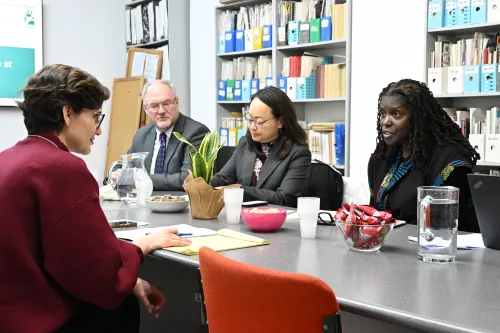
Steiner, also an attorney, has served as director for only a few weeks. “I started my legal career here out of law school,” she told the visitors, who were led by the Stated Clerk of the General Assembly and Executive Director of the Unified Agency, the Rev. Jihyun Oh. “This is a homecoming.”
Steiner said that while HaMoked is “all about the individuals we serve,” it’s also focused on “the community’s ability to persevere in what is probably the worst time we have seen in the Palestinian-Israeli conflict. We want to believe political solutions will be found, but until that day comes, HaMoked is here.”
The human rights organization provides free legal assistance to what Touma called “Palestinian victims of human rights violations living under Israeli occupation” and challenges “discriminatory policies and practices through litigation.” Since its founding in 1988, HaMoked has provided direct assistance to more than 140,000 beneficiaries.
HaMoked works in four areas, she said:
- Residency rights in East Jerusalem, including family unification and residency revocation, as well as help for stateless persons.
- Freedom of movement and travel abroad. Before Oct. 7, 2023, that included access to and from Gaza.
- Detainee tracing, prison visits, and reporting on conditions of detention, violence and torture
- Efforts to combat collective punishment and punitive home demolitions and residency revocations.
In 2024, HaMoked handled more than 22,000 cases. Most involved tracing requests from families in Gaza. It filed 381 legal proceedings that year, Steiner said, “to demand respect for individual rights and to challenge harmful laws and practices.”
Tracing is a service that families commonly need. Steiner said that when a Palestinian person is arrested, family members are often not notified who took them and who is representing them. HaMoked works to locate the person and visit them in prison. “Not many people can do that,” she said. “We have to reach out to the military. Torture and ill treatment are still an issue, and starvation, overcrowding and violence remain at high levels.”
More than 10,000 Palestinians are currently in detention. Many spend months there without knowing what they are charged with, Steiner said. “Our work has never been easy,” and the work has “become more difficult over the past two years.”
International attention is being diverted by current events in places such as Iran and Venezuela, Steiner said. “It affects the levels of diplomatic pressure that can be applied. There needs to be a viable solution and a renewed human rights push.” She said HaMoked “appreciates the fact that [the delegation] is here.”
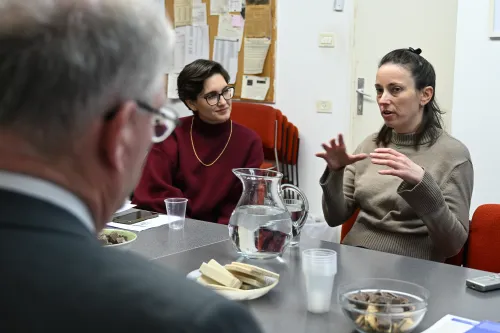
Meier explained some of the history of the Seam Zone, the area of the West Bank east of the Green line and west of Israel’s separation barrier. Palestinian communities petitioned Supreme Court of Israel, which determined the wall was legal but that the military is obligated to allow Palestinians access “if they have a connection to the land behind the wall,” she said. That was the situation for about 20 years until the war between Hamas and Israel began and Israel’s military closed off the area. That impacted “people who worked there, owned land there or had an urgent need to be there,” she said.
Eventually, business owners and workers were allowed back into the Seam Zone, but only a small number of farmers who grow specialty crops that need daily care can access the area.
“The neighbors can see you don’t have access anymore, and so it makes it easier to grab the land,” Meier said. “We are hoping that the Supreme Court will grant a hearing.”
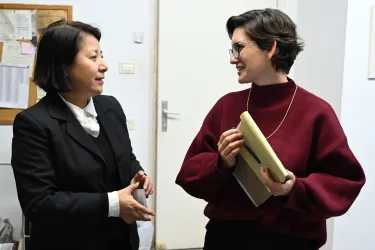
Dr. Dianna Wright, the PC(USA)’s director of ecumenical and interreligious relations, asked if there’s “a sense that the religious community is supporting [HaMoked’s] work.”
It depends, Steiner said. “I grew up a religious Jew,” she said, and among many of those folks, “it is hard to differentiate between nationalism and religion. I am sorry to say religion has been used to harm people.” There are voices for peace in Israel, of course, and sometimes that translates into accompanying Palestinian farmers during the harvest. “We have seen that trend in the faith-based left, a movement looking to realign Jewish values with human rights,” he said.

Oh said voices within the PC(USA) have also organized for peace. At General Assembly every two years, “they continue to point out what’s happening here and try to keep that before people,” she told the hosts. The General Assembly has directed staff to study and to hold conferences on the dangers posed by white Christian nationalism and Christian Zionism, she noted. “We [in the United States] are also dealing with immigrants disappearing. Our government keeps pushing toward military actions,” she said. “They have done so in several cities.”
Steiner said that as of this month, Israel has de-registered 37 international non-governmental organizations, including Oxfam and Doctors Without Borders, from operating in Gaza and the West Bank.
“Blocking humanitarian aid to Gaza is unthinkable,” Steiner said. “They are sowing an environment of chaos and unpredictability.”
You may freely reuse and distribute this article in its entirety for non-commercial purposes in any medium. Please include author attribution, photography credits, and a link to the original article. This work is licensed under a Creative Commons Attribution-NonCommercial-NoDeratives 4.0 International License.