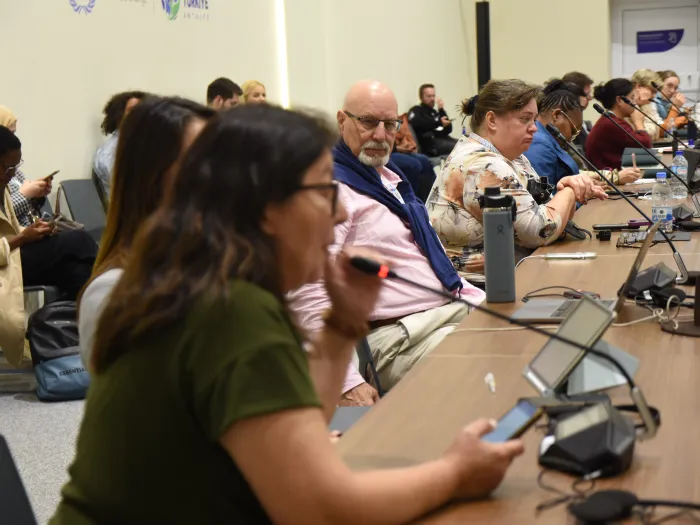
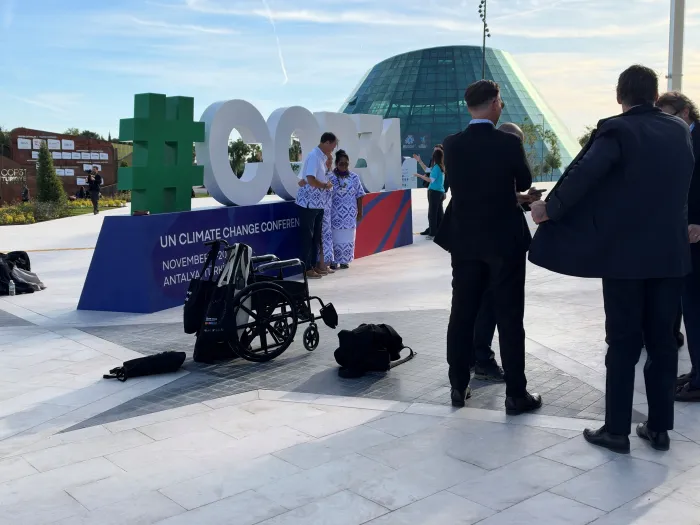
I attended the 31st COP in Antalya, Turkey (COP stands for Conference of the Parties to the U.N. Framework Convention on Climate Change) as a member of both the PC(USA) and ACT Alliance (WCC) delegations. During the second week of the conference, the Catholic Laudato Si’ Movement and the World Council of Churches issued a press release celebrating a number of faith groups (33) that had announced decisions during the past year to sell their fossil fuel stocks. These decisions have now brought the total to over $40 trillion dollars since the divestment movement began sixteen years ago. This celebration gave those of us from the PC(USA) a chance to recall our own church’s divestment decision during last summer’s General Assembly and the twelve years of failure that preceded it.
This reflection was especially significant in the context of the ultimate stalling and failure of the COP “Cover decision” due, in large part, to its lack of any mention of fossil fuels as the key cause of climate change. Several petro-state delegations had worked throughout the negotiations to achieve the impasse. In the midst of this failure in our efforts to bring the world to actions on behalf of climate justice we ask, “Why does change take so long?” and “How does this serve us for the next leg of the journey?”
The Human Factor
I believe much of the denial and false information about how humans cause climate change comes from a failure of imagination. We find it hard to picture that nature, which we as a human race have fought against throughout history, could be changed by anything we do. Yet this is what scientists have found. They have measured the “greenhouse gas” pollution we have released into the air, without much thought, over the past one hundred years. These gases keep building up and trapping the heat of the sun in the atmosphere. It is hard to imagine, but sadly it is true, and we are slowly coming to accept it.
People also tend to stick with what is cheap and familiar. History shows this again and again. For example, people hunted whales for their blubber to burn in lamps and light their homes. That ended only when fossil fuels came along as a cheaper and easier choice.
Greed is another problem. It bends our systems to serve its own needs. It takes on a life of its own and motivates people to resist efforts at change. On November 11, only two days after the conference began, U.N. Secretary General Antonio Guterres spoke to national leaders. He said, “Fossil fuels must go the way of the dinosaurs. But that will not happen on its own. The dinosaurs did not have a lobby. But fossil fuels do. And their strategy is simple: Distort the science. Delay policy. Delay action. Delay accountability. It is time to kick the habit – and end the fossil fuel addiction.”
We did not know how true those words would prove to be. The UNFCCC does not make people reveal which companies they work for. So watchdog groups compared the early list of people allowed into the “Blue Zone,” where negotiators make decisions. The group Demand Climate Justice shared the results as part of its “Keep Big Polluters Out” campaign. The list included people from 60 fossil fuel industry groups, 16 major fossil fuel lenders, 6 industrial farming and food groups, 3 big tech groups, and 20 groups that work across several fields. ExxonMobil alone had thirteen people registered under its name!
The Fossil Fuel Lobby
To see how strong this lobby is, look at the history. A COP decision first mentioned a fossil fuel only in 2021, at COP 26 in Glasgow, Scotland. There, countries agreed to “phase down” coal power that has no pollution controls. Two years later, at COP 28 in Dubai, nations called for "transitioning away from fossil fuels in energy systems, in a just, orderly and equitable manner, accelerating action in this critical decade, so as to achieve net zero by 2050 in keeping with the science."
Two years after that, at COP 30 in Belem, Brazil, a plan for a specific “roadmap” for this transition failed to pass. The Brazilian presidency and a “coalition of the willing” made up of several countries picked it up instead. They moved the work forward at a special conference in Santa Marta, Colombia, in April 2026.
When negotiators arrived in Turkey, the countries committed to the Santa Marta process were ready to be welcomed. This process is also called TAFF, for Transition Away from Fossil Fuels. This COP had been described as an “implementation” COP, unlike earlier COPs that focused mainly on building structures and rules. A major event took place with former U.S. Secretary of State John Kerry, who helped win the Glasgow promise to phase down coal. Several former COP presidents also took part. At the event, the official TAFF roadmap was handed to the U.N. Secretary General and the COP 31 president.
At one press conference, national representatives announced they would adopt the TAFF process. Panama’s Environment Minister, Juan Carlos Navarro, spoke on November 18. He said: "Life isn't fair, and then you die. But in the meantime, you love your kidnapper: the petroleum industry. We have been stricken by Stockholm disease. We are in love with our kidnappers. We love the petroleum guys. We cannot live without them, and they are so smart they have convinced us that they are doing this for our own good. They torture us for our own good, they destroy our planet for our own good. They destroy nature to help us, and they demand our unrequited, endless, unlimited, boundless love."
No Decision
So it surprised no one when the COP failed to mention fossil fuels even once. Negotiators looked at four drafts of the presidency’s Cover Decision, which pulls together all the major decisions. Talks ran an extra forty-five hours, making this the longest COP in history.
Many delegates came from countries struggling with climate-fueled drought and floods, deadly heat, and the threat of war over scarce water. Fish stocks are shrinking, coral reefs are dying, and many species are going extinct. Scientists link much of this to the way people make and use fossil fuels. For these delegates, a document that did not even name fossil fuels was unacceptable. Representatives of 130 countries refused to accept it. The COP works by consensus, so this meant everyone would go home with nothing to show for all their hours of work. This would be only the third time the COP process ended in failure. The other two were in The Hague, Netherlands, in 2000 and in Copenhagen, Denmark, in 2009.
But sometimes no decision is better than quietly going along with a lie. This COP did fail to reach consensus. Yet it may also have succeeded. More and more nations are gathering around the need for a fair and orderly move away from fossil fuels, using the new TAFF Roadmap process.
Moving Forward
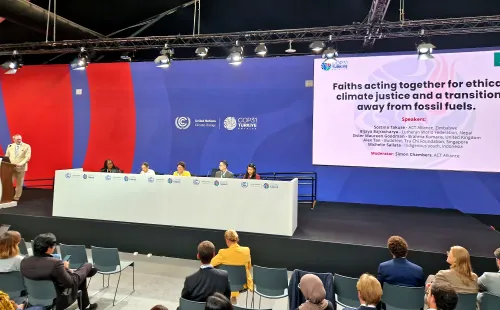
Before we left Antalya, the GreenFaith organization announced a new effort backed by many faith groups. These include our own Presbyterian Hunger Program, Presbyterians for Earth Care, and the newly formed Creation Action Network of Presbyterian Young Adults. The effort is called Faiths for a Fossil Free Future. It will organize over the coming year. Its goal is to build support before the next TAFF event in Ireland this spring and the follow-up conference in Tuvalu. It hopes more nations will adopt their own roadmaps to move away from fossil fuels and reach net zero greenhouse gas emissions by 2050, or sooner.
Those of us in the interfaith community come to these meetings in growing numbers. We may not make the decisions. But we do bear witness to the pain and loss of millions of people who cannot be there, and to their hope for a future in which they and their children and all creation will flourish in justice. We also share the faith that, with God’s help, humanity will one day come to its senses and one day soon break our addiction to power, greed, and violence, which is destroying our common home and overcome the fear, lack of imagination and complacency that impedes faithful action for the sake of the planet for which we were created to care.
The Rev. Fred Milligan, H.R., is co-facilitator of the Presbyterians for Earth Care Advocacy Committee and a member of the PC(USA) delegation to COP 31.
The views expressed in this post belong to the author.
You may freely reuse and distribute this article in its entirety for non-commercial purposes in any medium. Please include author attribution, photography credits, and a link to the original article. This work is licensed under a Creative Commons Attribution-NonCommercial-NoDeratives 4.0 International License.