Waking up ghosts
The Rev. Dr. Christine Hong of Columbia Theological Seminary discusses her upcoming book on ‘A Matter of Faith: A Presby Podcast’
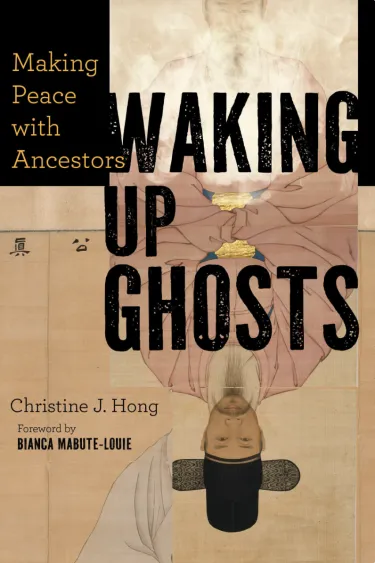
LOUISVILLE — An Associate Professor of Educational Ministries at Columbia Theological Seminary, the Rev. Dr. Christine Hong, has of late found herself waking up ghosts — so much so that she wrote a book about it. “Waking Up Ghosts: Making Peace with Ancestors” is set for publication by Broadleaf Books on Nov. 17.
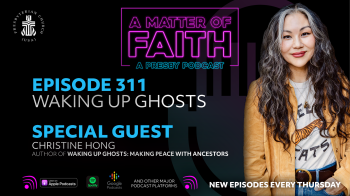
Hong’s engaging conversation with the hosts of “A Matter of Faith: A Presby Podcast,” the Rev. Lee Catoe and Simon Doong, can be heard here.
The hosts started off the 56-minute conversation with this question: “What does it mean to decolonize our faith, especially for immigrant communities? How can [immigrants] navigate reclaiming ancestral spirituality amidst histories of displacement, cultural loss and conversion to Christianity?”
“Regardless of who we are — unless we are a Palestinian Christian — Christianity arrived to us from another source, from another place,” Hong said. “We were people before we had beliefs and understandings about the Divine, about our peoplehood and ancestors, and we have relationships with them.”
Immigration “severs us” from community, she said, “not only immigration but displacement, which happens through war or asylum-seeking, some sort of violence.” Immigration “can be a form of severing that makes it hard to travel or cross borders with the things that you held dear.”
In her book, Hong features her maternal grandparents, who converted to Christianity “largely because our Korean indigenous spirituality, Korean shamanism, is a land-based religion,” she said. “When they had to run from the northern part of the Korean Peninsula to the farthest end … they could no longer venerate their ancestors because the veneration happens at the gravesite.”
“When you can’t tend to the graves of your ancestors … when you can no longer harvest from the places where your ancestors have harvested, what is the point of spirituality? You are also a ghost at that point. Your ancestors are ghosts, but so are you. There is this deep severing. They are dead,” Hong said, “but you are also dead to them.”
Adhering to a new religion “becomes your only lifeline,” Hong said. “Religious communities in new lands become a safety net” for many immigrants. “It becomes a place where you preserve language and history, where your children learn who they are, where you preserve human dignity when people in the outside world refuse to even see you.”
“You can be someone who’s dignified, where outside you’re someone who is oftentimes violated and put down,” she said. “We see that all the time today.”
According to Hong, decolonizing the faith involves reclaiming “the people we were before we crossed those borders” and reconnecting “the severed tissue to wake up the ghosts of our ancestors.”
Catoe asked how that healing work comes about.
“That belief system for me comes from Korean indigenous religion. We believe that when we cross over, there is some sort of magical perfection that happens,” Hong said, which is akin to beliefs that some Christians adhere to “that when you cross over … that somehow God perfects you. My mom describes it as Jesus putting a white robe on you and somehow everything is washed away.”
In Korean indigenous religion, “when you get to the other side, your ancestors meet you,” Hong said. “Depending on what you did in your life, the consequences and rewards in that life meet you. There has to be healing based on how you’ve led your life. Before you can be a good ancestor — before you can give back to your descendants and be a guide to them — you have to heal. You have to mend what was broken in you.”
Part of the way we help our ancestors to heal “is by being a living witness and living differently,” Hong said. “Our ancestors are watching us. Not only are they guiding us and empowering us by being on the other side from that healing that they do, but as we choose to live differently, it heals a part of them, too. We make different choices than they were able to make.”
“It’s also about listening to their story,” she said. “We have a lot of stories that we kind of refuse to tell or [stories that] have gone untold because they are incredibly painful to tell.” Hong spent years digging up the stories around what her ancestors experienced. Some of her ancestors “blamed themselves for the loss of lives, for poverty, for the things they couldn’t give their children,” she said.
When she sits at the altar with her late grandmother, “one of the greatest senses that I get from her spirit is that she forgives herself for this thing she had blamed herself for her entire life,” Hong said.
“It’s literally a folk magic ritual,” Hong said. “I’ve been telling everybody that when you read [the book], you’re invited into that folk magic ritual and you’re participating in it. It’s a spell that’s been cast.”
In response to a question by Doong, Hong said that one way to decolonize faith is by “allowing faith to integrate with our lived experiences.”
“That’s what’s beautiful about ancestor veneration,” Hong said, contrasting veneration with worship. “Those wisdoms get fed back to us. Death is a transformation, but if we wish to engage them, their stories are available to us.”
Hong said she returns to scripture “when I think about how ancestors show up. It’s in the Bible and it’s so human.” When Jesus asks for his ancestors to show up, “their presence is so real that Peter asks Jesus, ‘Can I build a tent for you?’”
“We tend to deny it for ourselves when Jesus clearly experienced it,” Hong said. “The relationships with human beings wasn’t enough. He needed relationships with the ancestors, too.”
“I think about how God incarnate needed relationships with spirit beings on the other side to survive human relationships,” Hong said. “If Jesus needed that, then so do I.”
New editions of “A Matter of Faith: A Presby Podcast” drop every Thursday. Listen to previous episodes here.
You may freely reuse and distribute this article in its entirety for non-commercial purposes in any medium. Please include author attribution, photography credits, and a link to the original article. This work is licensed under a Creative Commons Attribution-NonCommercial-NoDeratives 4.0 International License.