Giving voice to those who have long been silenced
During Wednesday’s Chapel Service, the Rev. Irvin Porter remembers Dr. Charles Eastman, an Indigenous physician and author
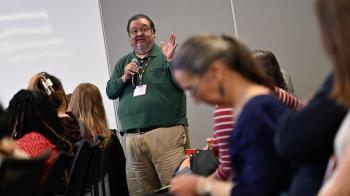
LOUISVILLE — Ahead of next week’s observance of Native American Day, the Rev. Irvin Porter delivered a sermon on Wednesday titled “Listening to Voices Long Silenced” during the online Chapel Service.
Porter is a Global Ecumenical Liaison for Native American Support. On Wednesday, his preaching texts were Ephesians 4:1-6 and 14-16.
Porter spoke about Dr. Charles Alexander Eastman (Ohiyesa), the renowned Santee Sioux Dakota physician and author.
Eastman taught that Indigenous people saw their oral traditions as their own “Holy Book,” “a living compilation of history, poetry, morality and philosophy that was just as sacred to them as the Bible was and is to white settlers,” Porter said.
In the Scripture passage at hand, Paul teaches the church at Ephesus “to live a life worthy of our calling by holding Christian unity, using our distinct spiritual gifts and building up the church in love,” Porter said. “Unity is a gift to accept, not just a task to finish.”
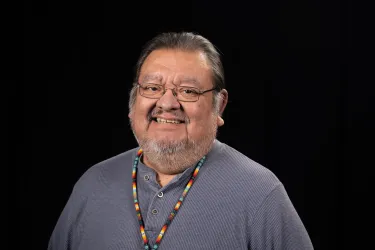
The church and its people “have refused to listen to the voices of those long silenced” for centuries, Porter pointed out. Eastman earned his medical degree in 1890 and began his service in the Office of Indian Affairs later that year. He served at the Pine Ridge Reservation and was an eyewitness to the events leading up to and following the Wounded Knee Massacre on Dec. 29, 1890.
According to Porter, Eastman argued that the American Indian had “neither a national army nor an organized church,” and that “no holy person was authorized to come between a person and the Creator of the Universe.”
The first Christians to be among Indigenous people in the Americas “branded the people as pagans or heathens, demanding they reject their ancient beliefs in favor of Christian salvation,” Porter said. Porter noted that in December 1890, the church at Wounded Knee that was used to triage the wounded survivors was still decorated for Christmas. A banner decorating the church proclaimed, “Peace on Earth, Goodwill to Men.”
Porter said that Eastman settled this contradiction by writing that “Christianity is not at fault for the sins of the Christian, but rather at fault for the sins of the Christian people.”
“He believed, and many Indigenous peoples today also believe, that society preached the gospel but failed to practice it themselves,” Porter said. “In Eastman’s view, a true follower of Jesus was deeply aligned with the traditional virtues of Indigenous people — valuing peace, community and an unmaterialistic lifestyle over the greed and industry of the modern Western church.”
The question becomes, will we, the church, listen? “Is the church willing to hear the stories of people whose voices have long been silenced?” Porter asked. “Clearly, we need to do more to build a more inclusive, just and merciful nation. But the process begins by listening to those who haven’t been and are still not welcome to the table.”
“Thank God the Holy Spirit has our backs,” Porter said, “because it’s not an easy task we are called to do.”
Porter noted that the Rev. Dr. Henry Fawcett, a Tsimshian Alaskan Native from Metlakatla, Alaska, was on the committee that wrote A Brief Statement of Faith. It was Fawcett — Porter’s mentor — who suggested adding the phrase “to hear the voices of peoples long silenced.”
“The Indigenous peoples of this hemisphere have rarely had voice in the creation of this country,” Porter said. “They have been credited with sharing the example of a governmental confederacy from northeastern tribes later adopted by the United States. Many crops never known to European settlers were first shared by the Indigenous peoples of this land.”
God’s Spirit “is presenting us with a new way for life in America and in our church,” Porter said. “The time for this holy work of listening is long overdue. May the church begin by hearing those voices long silenced.”
“It’s a step in the healing of our nation, inclusivity in our church, and peoples who are praying for a new reality,” Porter said. “Thanks be to God! Amen.”
Global Ecumenical Liaisons Cindy Corell and Joseph Russ joined to offer the benediction, which included these words:
“We go out to correct what has been done wrong and to sometimes take the blame for another’s mistake, as Jesus did for us.”
“Thank you for this ceremony of peace, love and joy instructed by Jesus Christ, who gave his life for us, and in whose name we pray. Amen.”
Porter concluded the service by singing a verse of “God Be With You Till We Meet Again,” in Nez Perce, the language of his mother. Those in worship joined Porter to sing the second verse.
You may freely reuse and distribute this article in its entirety for non-commercial purposes in any medium. Please include author attribution, photography credits, and a link to the original article. This work is licensed under a Creative Commons Attribution-NonCommercial-NoDeratives 4.0 International License.


