Revisiting Milwaukee's historic Big Red Church
Calvary Presbyterian Church was designed by the same architect as Milwaukee's City Hall
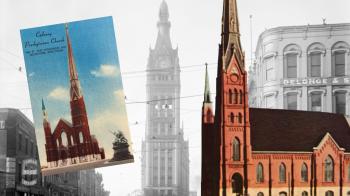
On Sunday, June 28, commissioners and advisory delegates of the 227th General Assembly of the Presbyterian Church (U.S.A.) scattered across Milwaukee to attend worship services at local congregations. One of the churches that opened its doors to the hundreds of commissioners that descended upon downtown Milwaukee that week was Calvary Presbyterian Church — or, as its members and the surrounding community lovingly refers to it, the Big Red Church.
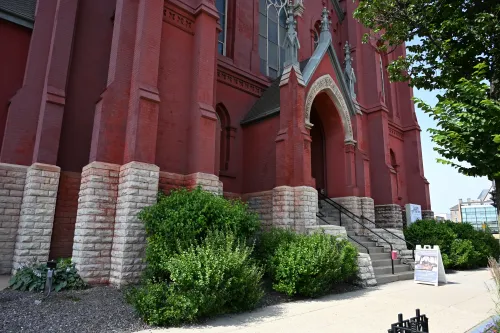
In her article recapping the welcome and worship held within the sanctuary of the Big Red Church, Cindy Corell makes mention of the building’s history, sharing that "It is apparent from the architecture that Calvary was designed and outfitted during the city’s Gilded Age. Back when Wisconsin Avenue outside was called Grand Avenue. Back when mansions lined the broad street." She also shared the story of the 1947 fire that destroyed the pipe organ and part of the chancel. Today, we’re diving a bit deeper into the history of the Big Red Church, designed in 1870 by Milwaukee master architect Henry C. Koch.
Koch is perhaps best known for designing Milwaukee’s City Hall, as well as the historic Pfister Hotel — but both of those projects were years in the future when he started working on the Big Red Church. City Hall would be completed in 1895; the Pfister Hotel two years earlier. From the nomination form submitted to the National Register of Historic Places, we learn that the structure "sits on a raised foundation of rock-faced, coursed ashlar limestone," and that the "nave is one continuous space that rises 85 feet." Built in the Victorian Gothic style, the church is believed to have been Koch’s first major independent project.
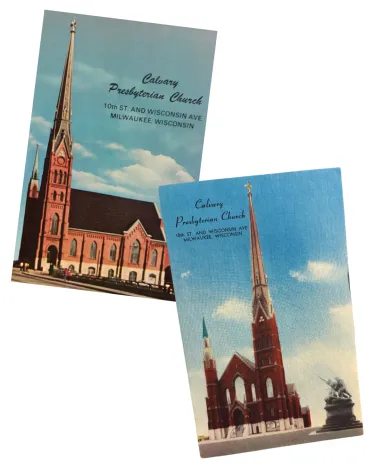
Koch, a German American architect, had apprenticed under G.W. Mygatt, "the most prolific of the city’s pre-Civil War architects," from 1856 to 1862, when he enlisted in the Union Army at age 21. Koch served as a topographical engineer for Major General Philip Sheridan, creating and illustrating battlefield maps. At the end of the Civil War, Koch returned to Milwaukee and to Mygatt’s firm, where he remained until 1870, the year he set off to launch his own firm. That same year, he designed the church building that would become the home of Calvary Presbyterian Church.
Visitors to downtown Milwaukee cannot avoid taking notice of Calvary Presbyterian Church. It’s all in the nickname — the Big Red Church is certainly big, and very red, and is "one of the bestpreserved Gothic churches in the city from the period immediately following the Civil War. It is the second oldest extant church building on the West Side and one of Milwaukee’s oldest in continuous use." This is also gleaned from the 1986 nomination form to the National Register, upon which the sanctuary is listed.
Made of Milwaukee cream brick, and trimmed with Ohio sandstone, the sanctuary’s exterior is painted an eye-catching red. The bricks that make up the church were originally a yellowish-cream color, though they have since been painted crimson. The bricks, produced from the clay embedded along the shore of Lake Michigan which contains high amounts of lime and sulfur, took on a creamy yellow color after being fired in a furnace and earned Milwaukee the nickname Cream City.
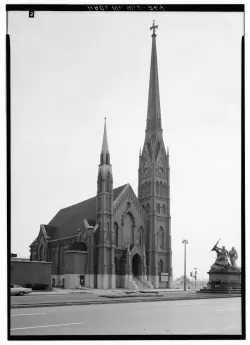
In the nomination form, the mason of the structure is noted to have been Hirim Bond. In 1875, Hirim Ransom Bond — who’d arrived in Milwaukee in 1846 — created a partnership with William H. Hanchett to manufacture bricks. Bond and Hatchett operated a facility at 13th Street where about "125 hands" were employed, according to an account of the Bond family history. "The yearly output of bricks totaled nearly six million."
It’s true that Wisconsin Avenue was once known as Grand Avenue, and that it was once "an exclusive residential area," just as Corell wrote — back when mansions lined the avenue.
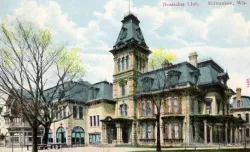
The Alexander Mitchell mansion across the street from Calvary is a living testament to that period. Mitchell began by building a modest brick house in 1848. As the years passed, he bought property after property, until he acquired the entire block — he then expanded his home, and in 1858, had it remodeled in the Italianate style. From 1872 to 1877, the home was transformed — wings added to both sides, the porch extended, bay windows installed, a third floor ballroom added, a library and conservatory, too — into the French Second Empire mansion it is today. By that time, Alexander Mitchell controlled the banking and insurance industry in Milwaukee; he owned the Milwaukee Railroad; and he was serving as a member of Congress. Mitchell’s mansion was one of the most prominent along Grand Avenue.
Calvary Presbyterian Church was organized on March 30, 1869, with 51 members from the First Presbyterian Church and 12 from North Presbyterian Church coming together to create the first congregation in the west side of Milwaukee. Although the cornerstone is dated 1870, it was laid on May 10, 1871 — construction was a bit behind schedule. The building was dedicated in a ceremony held on March 3, 1872. During the edifice’s construction, the Calvary congregation worshiped in the sanctuary of the St. James Episcopal Church, a historic building itself designed in the Greek Revival style. Calvary sold the building back to St. James after the Big Red Church was completed.
John Plankinton, James B. Bradford, and Samuel C. West were elected the first officers of the church — all three were wealthy businessmen. This and the size and opulence of the newly constructed church building are testaments to the affluence of the new congregation. Calvary in the mid-20th century, however, was an entirely different story.
The sanctuary was damaged by a three-alarm fire in January 1947, a fire that destroyed the pipe organ and chancel. This did not sway the congregation — they rebuilt, and carried on. However, as the decades passed, Calvary’s membership dwindled, until by 2018 there was only a dozen members. Around the same time, the pastor of the church left —but instead of forming a nominating committee, members of the session began to lead community members through worship each weekend. The congregation, as of 2026, is welcoming and warm; the sanctuary has a labyrinth to walk through, and the church rents out the building to theater groups and comedy clubs. Read more in the PNS article that recounts the worship shared on June 28, 2026, when General Assembly was just kicking off.
Enjoy these glimpses into Presbyterian history in years past? Donate to the PHS Annual Fund, which supports the efforts of the Presbyterian Historical Society to collect, preserve, and share the past in order to transform your current perspective on church history.
You may freely reuse and distribute this article in its entirety for non-commercial purposes in any medium. Please include author attribution, photography credits, and a link to the original article. This work is licensed under a Creative Commons Attribution-NonCommercial-NoDeratives 4.0 International License.