
Heritage Sunday
Every year, Presbyterians recognize Heritage Sunday, a day to reflect upon and learn more about the long and rich history of the Presbyterian Church in America.
Heritage Sunday always falls on the Sunday closest to May 21, the opening date of the first General Assembly of the Presbyterian Church in the United States of America in 1789. Use the resources below to plan activities for your congregation, download free bulletin inserts, and learn more about Presbyterian history.
May 24: Heritage Sunday 2026
John Witherspoon
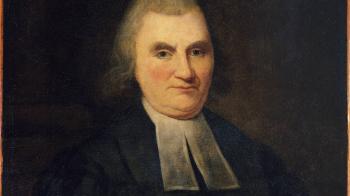
John Witherspoon was many things: the only active clergyman to sign the Declaration of Independence, the leading Presbyterian of the Revolutionary era, a Scottish immigrant, president of the College of New Jersey (now Princeton University), an active politician, and a slaveholder.
Remembering Witherspoon
John Witherspoon was many things: the only active clergyman to sign the Declaration of Independence, the leading Presbyterian of the Revolutionary era, a Scottish immigrant, president of the College of New Jersey (now Princeton University), an active politician, and a slaveholder.
Witherspoon was born in Scotland in 1723, the oldest child of a pastor. He attended the University of Edinburgh and then served two parishes as a Church of Scotland minister. He was 45 years old, a husband and father, when two Americans he met in Paisley—Benjamin Rush and Richard Stockton—persuaded him to emigrate to America in 1768 to head the College of New Jersey.
By most accounts, Witherspoon was an excellent choice for the College. He built a reputation as a dynamic preacher, an engaged teacher, and a colonial leader—not just in Presbyterian, religious, and educational circles but increasingly in politics as well.
In May 1776, two months before he began serving in the Second Continental Congress, Witherspoon preached a sermon titled “The Dominion of Providence over the Passions of Men.” This sermon became one of the most well-known and influential sermons of the Revolution.
1776 was just the beginning of Witherspoon’s prominence. Over the next 15 years, he continued to lead as a Presbyterian, an educator, and an American patriot: he served in Congress until 1784, he signed the Articles of Confederation, and he supported ratification of the U.S. Constitution. He would head the College of New Jersey until his death in 1794.
And, like many other Founding Fathers, he was also an enslaver. While some compatriots like Benjamin Rush argued openly for abolishing slavery, Witherspoon did not. While he did not believe, as some did, that enslavement was a benevolent practice supported by the Bible, his political leadership kept people enslaved in New Jersey longer than any other northern state. Thus, we remember his many accomplishments but also recognize and reflect on how his leadership limited opportunities for enslaved people in America and others who had little access to church structures, educational institutions, or the politics of the new nation.
Hope for a Broken World: Fahed Abu-Akel
Lois Stair: First Woman GA Moderator
Christian Responsibility for Environmental Renewal
Henry Highland Garnet’s Vision of Justice
Fred Rogers Before the Neighborhood
Isabella Graham & The Power of Faith
Faith in God: Abraham Lincoln's Funeral Sermon
Christian Education for the Now Generation
The Presbyterian Historical Society at 160
Dr. Adelaide Woodard, Missionary to India
Stephen and Mary Riggs and the Lac qui Parle Mission
Chinese Immigrants to California
The Spirit of Missionary Enterprise
The Beginnings of "One Great Hour of Sharing"