A danger to the church and democracy
The Rev. Jimmie Hawkins, the PC(USA)’s Director of Advocacy and Witness, speaks to New York Avenue Presbyterian Church in Washington, D.C.
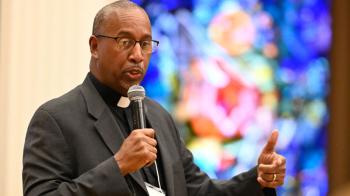
LOUISVILLE — Calling Christian nationalism “an issue of vital importance for the nation and the church,” the Rev. Jimmie Hawkins pushed for greater dialogue and cooperation among people of faith.
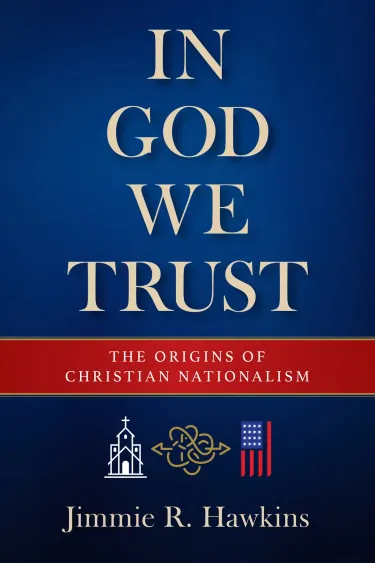
Hawkins, the PC(USA)’s Director of Advocacy and Witness, spoke online last week as part of New York Avenue Presbyterian Church’s McClendon Scholar in Residence Program. His most recent book is “In God We Trust: The Origins of Christian Nationalism,” published last month by Friendship Press. Listen to Hawkins’ talk and a Q&A session with New York Avenue Presbyterian Church’s Theo Brown and Ruth McDonald here.
There’s ample reason to continue to discuss the scourge of Christian nationalism, according to Hawkins. Foremost among those reasons is the need to protect democratic principles.
“Christian nationalism promotes the idea that a specific religious identity — primarily Christianity — should dictate public policy and national belonging,” he said. Scholars and civic groups warn that Christian nationalism “can erode democratic norms, such as the separation of church and state and the equal participation of all citizens, regardless of their religion or faith.”
“Many faith leaders argue that blending state power with religious authority harms religion itself,” Hawkins said. “It corrupts spiritual convictions and it marginalizes minority faith or non-religious Americans.”
Organizations including Christians Against Christian Nationalism “emphasize that true religious freedom protects everyone’s right to believe or not believe without government favoritism,” he said. “It is key for understanding social and political tensions that exist today.”
Research by organizations including the Public Religion Research Institute (PRRI) shows “strong correlations between Christian nationalism views and heightened political polarization,” he said, as well as “support for authoritarianism and exclusive attitudes toward immigrants and racial minorities.”
Hawkins said he wrote the book in part to explore Christian nationalism beyond the U.S. context. In fact, religious nationalism “is as old as civilization. If you can convince people that your religious authority is of a divine nature, you can minimize resistance to your rule.”
Hawkins’ research turned up religious nationalism among the Sumerians and Mesopotamians as well as among Egyptians and Greeks. The Romans “talked about their rulers not only having a divine mandate to rule, but it also evolved to the point where they themselves were considered to be divine.”
“Christian nationalism promotes the supremacy of your nation, your culture and even your race as the greatest in the world,” and that “God is on the side of your nation, and your opponents are opposing God,” he said. “We know this is contrary to the teachings of Scripture, which teaches us God is not partial toward any nation or toward any people, and even held the biblical Hebrews in the judgment of God when they themselves were too much like the other nations and did not reflect God’s love and God’s grace toward all people.”
Christian nationalism “exists within every racial group,” Hawkins said, including white, Black, Hispanic, Asian American and Native American people, “with the caveat that Native Americans have the lowest percentage of being Christian nationalist.”
A recent PRRI report indicates nearly one-third of Americans “qualify as Christian nationalist adherents or sympathizers,” Hawkins noted. States in the South and the Midwest — including Arkansas, Mississippi, West Virginia, Oklahoma, Louisiana and North Dakota — had the highest rates, with more than 50% of residents qualifying. The states with the lowest support are in the West and the Northeast, including Massachusetts, Oregon, New York, Maryland, Washington, Nevada and New Jersey. In those states, 20% or fewer hold Christian nationalist views, Hawkins noted.
“The rejection of Christian nationalism is vital to the integrity and purity of the Christian faith,” he said. “It is also a threat to democracy.” Christian nationalism can erode the separation of church and state. It seeks to merge religious and political authority, Hawkins said, and it leads to the marginalization of minorities. “It fosters an ‘us versus them’ cultural mindset that can lead to systemic discrimination, book bans, mandatory school displays or prayers, and restrictions targeting religious minorities and LGBTQ individuals, especially in the trans community.”
“It undermines pluralism, and it is indeed spiritual idolatry,” Hawkins said. During the 227th General Assembly, “we declared that Christian nationalism is destructive to the well-being of the church and to the nation.”
Christian nationalism also results in the loss of the prophetic voice, Hawkins said. “When the church aligns itself too closely with state power, it compromises its moral independence and alienates people from the gospel.”
“As people of faith and even no faith,” Hawkins said, “we have to appreciate the gift that religious freedom has been to this nation.”
Brown, who directs the McClendon Scholar in Residence Program for New York Avenue Presbyterian Church, asked Hawkins a few questions, and McDonald voiced questions that viewers had asked.
Hawkins noted that research by PRRI and others points out that moderate and progressive congregations “also display elements of Christian nationalism.”
He said he admires how the nation’s founders approached religious freedom. “They resisted tremendous pressure to not say this is a Christian nation,” Hawkins said. “I think they learned a lot from the mistakes of Europe in the merger of church and state.”
“People’s hearts aren’t changed by having the Ten Commandments in classrooms,” he said. “They’re changed by engagements, through relationships with one another.”
“The danger of thinking God is on our side is what I hear you pointing out,” Brown told Hawkins, who replied that the most problematic realm is U.S. foreign policy, which “needs greater scrutiny by Christians in this country.”
Christian nationalism “has a presence in the Black church,” he said. “Our fight has always been for civil rights, but there are theological questions we also need to ask. The Black church has a way to go on issues of misogyny, homophobia and transphobia, and we also see Christian nationalism, especially in times of election.”
He said white Christian nationalism “is the most dangerous form of Christian nationalism. They are prone to justify violence and isolation, and they’re against immigration.”
“The church has a poor history of confronting racism, but we’re beginning to turn the corner,” he said. “We have to make sure the prophetic voice of the church is heard.”
In his book and during Wednesday’s webinar, Hawkins encouraged churches to form ecumenical or interfaith alliances within their community. “We also need to find ways to utilize our denominations,” many of which can offer resources on fighting Christian nationalism.
“Speak up!” he urged. “We can have a calm conversation and still disagree. As Christians, we should be able to talk about anything.”
View previous McClendon Scholar in Residence Program talks offered by New York Avenue Presbyterian Church here.
You may freely reuse and distribute this article in its entirety for non-commercial purposes in any medium. Please include author attribution, photography credits, and a link to the original article. This work is licensed under a Creative Commons Attribution-NonCommercial-NoDeratives 4.0 International License.