Burnout is not a badge of honor
Physician offers a session for ministry leaders and caregivers at the Presbyterian Older Adult Ministries Network conference
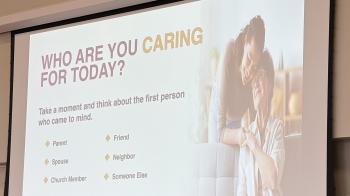
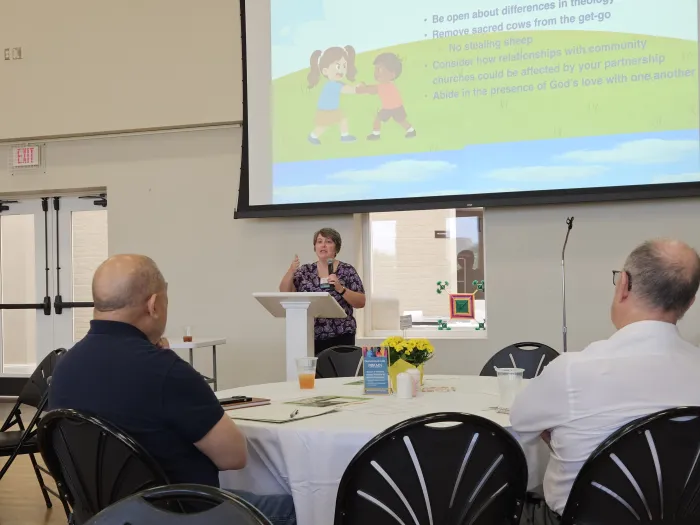
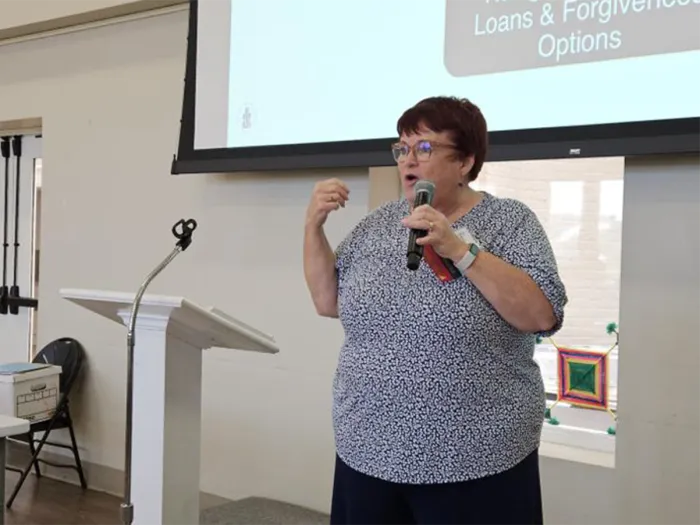
LOUISVILLE — For the leaders who serve older adults and caregivers who carry emotional, spiritual and physical responsibilities that accumulate over time, Dr. Renee Sunday, an Atlanta-area anesthesiologist, offered a session last month during “Rooted in Love,” the conference of the Presbyterian Older Adult Ministries Network. First Presbyterian Church of Knoxville, Tennessee, hosted the conference. View Sunday’s slides here.

Sunday, a physician for 26 years, is also a certified AI consultant, certified behavioral specialist, international speaker and licensed minister. She created the REST Framework (for Reflect, Explore, Support and Take Action), a structured approach designed to help individuals continue to serve effectively without losing their capacity to lead and care.
Burnout goes beyond being tired, she noted. Rest no longer feels enough. Burned-out caregivers have lost their joy and feel overwhelmed.
She asked attendees to reflect on these questions: What has been asking for my attention? Where I have I placed my own well-being last? What do I hope God will reveal during today’s session?
God created rest, she noted, and Jesus modeled it. For Sunday, one question changed everything: How can caregivers continue serving faithfully without losing themselves in the process?
Sunday learned the hard way, caring weekends for her aging parents who lived three hours away. Her mother died in May 2022 and her father died 18 months later. “I would do it again,” she said of her caregiving, “and you would, too.”
Then Sunday asked participants to discuss what it means to be a caregiver. Answers included “dedication,” “patient” and “putting your life on hold.”
“We’re not created to do things alone. We need to have at least two people we can talk to, people we can vent to,” Sunday said. “Recognize what’s going on in your body. Recognize God gave us emotions.”
When Sunday asked how many people in the room keep a journal and why they write in it daily, one woman said the practice “gets stuff out of my head and makes me accountable, because I have to see it and I feel it when I write it out.”
That’s biblical, Sunday said, citing God’s instruction to the prophet Habakkuk.
“The part of our brain in the back gets stimulated when we write our thoughts out,” Sunday said, adding this homework assignment for those in workshop: Write 25 things you love about yourself. She called the exercise “positive reinforcement because it reminds us of our identity in God.”
One thing Sunday realized during her time as a caregiver is, “I need to stop acting like Jesus. There’s only one Savior, and you can’t be a little ‘s’ savior.”
She recommended taking a brief five-question survey on the risk of burnout from the restleader.com website. She then divided the room into those with greater risk and those with moderate risk. No one in the room was rated low risk.
One workshop participant worked two jobs and had “no time for breaks.” A man said during the years that he worked, “stress didn’t get to me. I think I’m just wired that way.” A walk along the river each morning helped, he said.
Start with a once-a-week approach to finding rest, Sunday suggested. “My assistant does this better than I do. She communicates with the team better. She gets stuff done, and then she gives me the report,” Sunday said.
A clergywoman taking Sunday’s workshop said she often falls “into the trap of feeling like I get paid to do the work. Others are volunteering their time, and sometimes I feel bad putting things on them.”
“They want to do the work,” Sunday replied. “They want to be there. … You do a lot of things, but you’ve got to rest, too.”
As she led participants in a walking exercise, Sunday asked why God gives so many people an appreciation for walking. “God gave us two personal physicians,” said one participant, “our left leg and our right leg.”
As they walked together, one participant said, “I feel surrounded by good people. I feel like we’re on the same page and moving in the same direction.”
“Thank you for being vulnerable,” Sunday told workshop participants. “I know this is a sensitive topic, but I want to say God bless you and thank you.”
You may freely reuse and distribute this article in its entirety for non-commercial purposes in any medium. Please include author attribution, photography credits, and a link to the original article. This work is licensed under a Creative Commons Attribution-NonCommercial-NoDeratives 4.0 International License.