Working toward a blessed tomorrow
Presbyterians join other faith groups for Blessed Tomorrow’s helpful and hopeful webinar

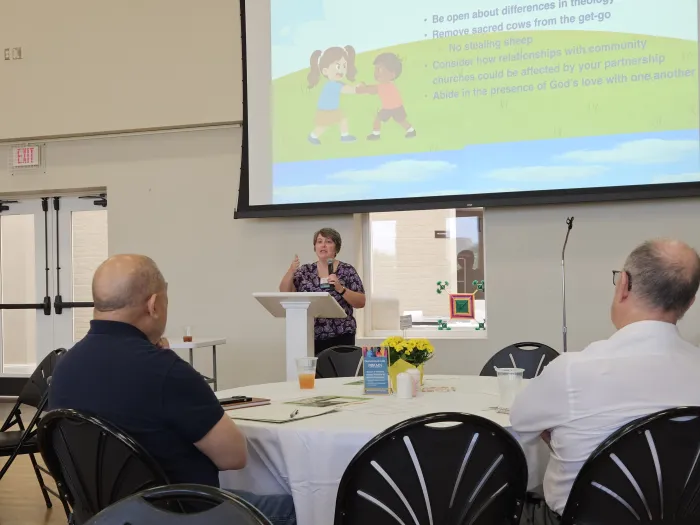
LOUISVILLE — Blessed Tomorrow, a coalition of partners including the Presbyterian Hunger Program working to advance climate solutions in faithful service to God, offered an informative three-hour webinar on Saturday. Speakers included the Rev. Carol Devine, senior director of Blessed Tomorrow, the faith component of ecoAmerica, and Eric Marquez, ecoAmerica’s program manager. About 70 people attended.
“There’s never been a more important time for us to know how our climate is being impacted,” Devine said, citing as a devastating example the 2022 floods in Eastern Kentucky that killed 43 people. “My actions may be small, but they grow out of living out my faith.”
“More people are more concerned than you think,” Devine said, noting ecoAmerica research that indicates more than 70% of Americans are concerned about climate change. Among the faithful, “we have a responsibility to do what we can to care for each other and our precious planet.”
Marquez spoke Saturday morning from Washington, D.C., where he was awaiting the coming nor’easter.
The primary cause of climate change is the burning of fossil fuels, Marquez said, from five main sources: transportation, which is responsible for 28% of climate change, electricity production (25%), industry (18%), commercial and residential (13%) and agriculture (10%).
The good news is that many of the solutions needed to slow or halt climate change are already available, according to Marquez.
Devine said our changing climate impacts multiple facets of living, including water, migration, poverty, gender, health, hunger, peace, race, children and the economy. “Climate change exacerbates existing inequalities; therefore, climate change is an issue of justice,” she said.
About half the congregations in the U.S. offer some sort of food program, she said, in part because climate change is “an injustice multiplier.”
Marquez pointed out what he called “big-picture solutions.” Those include reducing emissions to limit warming and increase resiliency. America Is All In is one organization bringing together cities, states and businesses, he said.
“We are seeing record investment in climate solutions,” Marquez said. Nearly two in three Fortune 500 companies have committed to climate action, and climate action plans are in place in 45 states.
Marquez noted that nationwide, three million families saved $8.4 billion last year from clean energy tax credits.
How individuals and congregations can get involved
In our homes, we can expand our climate knowledge, center plant-based foods, reduce waste and compost, talk to our neighbors and friends, engage our political leaders and vote, Devine said.
In our churches, a variety of options are available. We can:
- Offer gratitude for Creation, and pray for Creation during worship
- Assemble a Creation care team
- Make a public commitment
- Preach and teach
- Host Blessed Tomorrow’s Climate Ambassador Training.
Twice during Saturday’s webinar, participants met in breakout rooms according to their denominational affiliation. Jessica Maudlin, Associate for Sustainable Living and Earth Care Concerns in the Presbyterian Hunger Program, spoke with PC(USA) members on the call.
“A lot of solutions we are seeing come from congregations like yours,” Maudlin said. “You’re using intelligence and creativity and passion to change your congregation and change your community.”
One PC(USA) congregation swapped in battery-powered lawncare equipment for its gas-powered equipment, and some church members clearly took notice. “That Christmas, six or seven families got electric snowblowers,” she said.
Maudlin said more and more PC(USA) churches are adding composting to their offering of, for example, a community garden. One church got its preschool on board. The director sewed a composting captain apron which rotated from child to child, “and those kids talked it up at home,” Maudlin said. The preschool helped the church to offer composting workshops.
Later in the webinar, Maudlin discussed avenues for advocacy, including the PC(USA)’s Office of Public Witness and Presbyterian Ministry at the United Nations.
To date, 373 PC(USA) churches have qualified as Earth Care Congregations, “helping not only to reduce their own buildings’ carbon footprint but advocate as well,” Maudlin said.
In response to a question, Maudlin noted that in many churches, one step can lead to the next. “They realize they care about hunger, and that it makes sense to write some letters about the Farm Bill,” Maudlin said.
Devine noted that Blessed Tomorrow now has an award-winning series of brief films on its website called “Caring for the Earth: Stories from Faith Communities.” The trailer is here.
“Your leadership matters. Your voice as a faith leader is needed at all levels,” Devine told participants, adding the 9 in 10 clergypersons say that climate change “is personally concerning.”
She offered up a template for communicating on climate and faith. Steps include:
- Start and stay with people
- Make your communication about your audience
- Connect on common values of faith and beliefs, compassion and care for Creation, health and community
- Acknowledge ambivalence. “Some of us are more concerned than others about climate change in our community,” Devine said.
- Focus on solutions and personal advantage, and emphasize benefits such as budgets, health and community
- Ditch the doom and gloom and focus on hope and opportunity. “Tell stories of congregations taking action and the successes they’ve had,” Devine suggested.
- Activate. “Follow this sequence and end with your ask,” she said. “Turn awareness into action.” Make the ask accessible, she said, and “stay above the fray.”
Participants were then invited to write and share their pitches.
Marquez discussed some of the benefits available with becoming Climate Ambassadors, training that more than 5,000 people have already embraced. “It means having impactful climate conversations, inspiring others to get involved and taking steps to act and to advocate for climate solutions,” he said. “It’s free, and it helps you connect with your faith tradition.”
You may freely reuse and distribute this article in its entirety for non-commercial purposes in any medium. Please include author attribution, photography credits, and a link to the original article. This work is licensed under a Creative Commons Attribution-NonCommercial-NoDeratives 4.0 International License.