
Preachers can use two-minute tales to strengthen their sermons
Dr. Laura von Wallmenich of Alma College puts on a storytelling webinar for the Synod of the Covenant
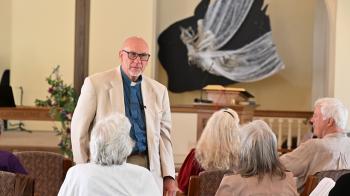
LOUISVILLE — Dr. Laura von Wallmenich, an Associate Professor of English and the Associate Provost at Alma College in Alma, Michigan, led a webinar earlier this month for the Synod of the Covenant on how preachers can employ two-minute tales to strengthen their preaching.

Watch the 88-minute webinar she put on with help from the Rev. Dr. Chip Hardwick, the Synod of the Covenant’s executive, here.
She described the preacher’s task: “Take a story you want to share and chisel it down to around two minutes,” von Wallmenich said. Unfortunately, “most of us overtell our stories, go on too long, or elaborate too much.”
Hardwick asked participants how they use stories in their preaching. One identified personal stories as “connections, ways of taking a larger message we might have and building a bridge to the everyday.”
von Wallmenich called biblical parables “a really good example of the two-minute tales I’m talking about.” That style of storytelling is a way of “finding yourself in the claim of the gospel,” Hardwick said. “It’s an entry point and a way to show and not tell.”
Hardwick used a real-life example to demonstrate a two-minute tale he’s told in several pulpits. While attending seminary, Hardwick dropped his laptop computer, damaging it. “I looked at the warranty which said, ‘Does not cover accidental damages,’” he said. “I slinked to the computer store wondering what the repairs would cost.”
Eventually he would talk on the phone with a store manager. Hardwick explained his plight. The manager told him to return the next day and the store would give him a loaner.
“The next day she said, ‘They told me I couldn’t give you a loaner, and so I said fine, I’m going to give this guy a new computer,’” Hardwick said, a computer even more powerful and speedier than his damaged one.
As she processed his paperwork, she told Hardwick, “This is your lucky day.” He’d also be receiving $300 as part of the transaction.
“That’s a completely true story,” Hardwick said, “and I hope a completely true glimpse of God’s grace for us.”
Why two-minute tales?
Two or three minutes “is about the span of working memory where the listener will remember the beginning by the time you are at the ending,” von Wallmenich said. It’s also “short enough to illustrate a larger point without displacing it.” It’s “long enough to be a story, but short enough to protect the sermon’s proportions. It makes you concentrate on your choices for impact.”
She then relied on the work of Robert McKee in “Story: Substance, Structure, Style and the Principles of Screenwriting” to discuss McKee’s idea of story beats. A practiced storyteller can fit three beats in a two-minute tale, she said.
- Beat 1, lasting 20-30 seconds, is “The World Before.” “Establish just enough that the listener knows whose story this is and what is at stake,” she said.
- Beat 2, lasting 45-60 seconds, is “The Rupture.” Something — an event, encounter, question or discovery — happens to break open the world of Beat 1. It has to be irreversible, von Wallmenich said. “After this moment, the character cannot go back to not knowing what they now know and not having experienced what they just experienced,” she said. “The Rupture is the heart of the tale.”
- Beat 3, lasting 20-30 seconds, is “The World After.” “Show, don’t explain, what has changed,” she advised the preachers on the call. “The contrast between Beat 1 and Beat 3 is where the meaning lives. Let the listener feel the distance between where the story started and where it ended.”
von Wallmenich offered her own two-minute tale. “It’s the story of how I learned about the power of story and how I learned from the power of a ghost who lives in a box of photographs in my basement,” she said.
His name was Eddie, and he was her uncle. “He was dead, and we never, ever spoke about him. He was a mystery and he called to me because he was also the mystery of my mother,” Eddie’s older sister, who “lived in a world of fierce rationality” and raised her younger brother “from the day he was born.”
When von Wallmenich was 16, she blurted out in rush-hour traffic, “Mom, whatever happened to Eddie?”
“My mom froze, pulled over to the shoulder of the highway, took a breath and told me,” she said. One afternoon just before high school graduation, Eddie was playing in the backyard and reached for a ball that rolled under a bush. He lost his balance and fell, and a freshly-pruned branch caught in his eye and lodged in his brain. “Weeks in a coma turned into a decision no family should have to make,” she said. Three days after Eddie’s death, von Wallmenich’s brother was born.
“Her grief was immense, and she buried it so it wouldn’t cast a shadow on her children — and it didn’t,” she said. “My brothers and I grew up. We took risks. We went after balls. We were scraped by thousands of bushes and we never knew fear.”
In the moment her mother told her that story, “resentment became wonder. A story can do that,” von Wallmenich said. “I realized the core of my mother was this fierce love. She spent all her love building a shield over her children, and she gave me the thing that she couldn’t afford: the freedom to feel openly, to imagine without fear and to pass on a story she didn’t know how to tell.”
von Wallmenich outlined five elements present in a well-told two-minute tale:
- Start late. “Enter as close to the moment of tension or change as possible,” she said.
- One point of contact. “The story should touch the sermon at one precise place,” she said, “not gesture broadly at the general theme.”
- One inhabitable character, because “complexity of cast is the enemy of the two-minute tale.”
- A turn. Something must change — a situation, a perception, perhaps a relationship. “Without a turn, you have an illustration, not a story,” she said.
- A clean landing. “End the story and resist analyzing or editorializing,” she said. “If your story is good, you do not need to explain it.”
She suggested this five-question story audit:
- The “so-what?” test: Can I complete this in one clause, such as, “This story shows that …”
- The “who’s the hero?” test: Who comes out looking good in the story?
- The “would they know it?” test: Would someone from my congregation recognize the world this story comes from?
- The “clock” test: If I told this aloud right now, would it land in under two minutes?
- The “trust” test: Do I feel the urge to explain this story after I tell it?
She invited preachers on the call to take with them two questions for consideration: What is one thing from today that you want to carry into your next sermon? What story is your congregation waiting for you to tell — the one only you can tell?
Learn more about the Synod of the Covenant’s monthly preaching workshops here.
You may freely reuse and distribute this article in its entirety for non-commercial purposes in any medium. Please include author attribution, photography credits, and a link to the original article. This work is licensed under a Creative Commons Attribution-NonCommercial-NoDeratives 4.0 International License.


