PC(USA) Co-Moderators offer church-wide online series on politics and public witness
The free three-part Zoom series will take place on three Fridays in October
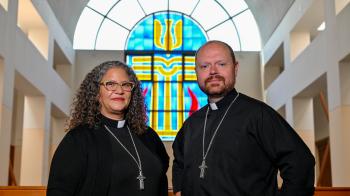
A new church-wide series promises to tackle “Why ‘Presbyterian’ will never be a political party.” The free series will be facilitated by the current Co-Moderators of the General Assembly of the Presbyterian Church (U.S.A.), the Rev. Marta Pumroy-Cordero and the Rev. Dr. Kris Schondelmeyer, who said the key question for the series is not which political party is Presbyterian, but “how does being Presbyterian shape the way we participate in public life?”
The series is open to all, including church leaders, clergy, staff, mid council leaders, and congregation members, and will take place over Zoom at 1 p.m. Eastern Time on Friday, Oct. 2, Friday, Oct. 16, and Friday, Oct. 30. Each session will have a different focus and feature guests from denominational leadership. Participants can register for each online session individually.
“Our Reformed tradition has never required Christians to withdraw from public life. Quite the opposite,” Schondelmeyer said. “Our faith has something to say about justice, peace, poverty, racism, human dignity, violence, care for Creation, immigration, economic life and the use of political power. At the same time, the church must resist allowing the gospel to become captive to any political ideology, candidate, party or nation.”
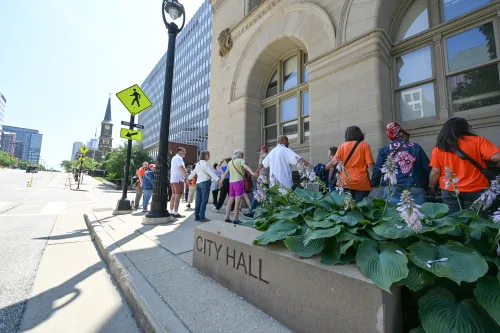
The series builds on a resource of the same name, which was developed by the Rev. Dr. Aimee Moiso, manager of social policy witness for Presbyterian Life & Witness, and shared at the 227th General Assembly of the PC(USA) in Milwaukee, Wisconsin.
“Reformed Christians have long affirmed that God is active and present in all aspects of life,” said Moiso. “Because God is working toward justice, freedom and healing everywhere, we as Presbyterians seek to be faithful to God everywhere — including in our politics, economics and other systems of shared life together.”
The resource is based on an excerpt from a policy called “God Alone is Lord of Conscience,” adopted in 1988 by the PC(USA)’s 200th General Assembly, and highlights five “strikingly relevant” points made in the nearly 40-year-old policy:
- No political party or system can embody God’s will
- God alone is Lord of the conscience
- True faith requires freedom
- We need civil government for life together in community
- Our obedience to civil governance is conditional.
Each online event will focus on one of the resource’s three main sections.
Part one of the series is “Religious Liberty” (Oct. 2) and will focus on what it means to say “God alone is Lord of the conscience” and the denomination’s commitment to religious liberty. It will feature the Rev. Denise Anderson, director of Restorative Justice Ministries for PL&W and Moderator of the 222nd General Assembly (2016), and Flor Velez-Diaz, a ruling elder and manager of judicial process for PL&W.
Part two is called “State and Citizen: Their Mutual Responsibility” (Oct. 16) and will explore how Presbyterian Christians understand responsibility to and for the government in a democracy. It will feature Moiso and the co-chairs of the General Assembly’s Advisory Committee on Social Witness Policy, the Rev. Jeromey Howard and the Rev. Sue Trigger.
Finally, part three is called “The Church’s Role in Civil Society” (Oct. 30) with both the Rev. Jimmie Hawkins, director of Advocacy and Witness for PL&W, and the Rev. Jihyun Oh, Stated Clerk of the General Assembly and Executive Director of PL&W, as guests. The session will engage participants in the question, “what does faithful Presbyterian public witness actually look like?”
Schondelmeyer said that he hopes participants come away from the series discerning not what the PC(USA) is telling them to think, but asking, “How does my Reformed faith help me discern faithfully?”
Though the resource was not an official item of business for the 227th General Assembly, it was distributed to GA participants through the online MyGA website and also lifted up by Oh during plenary. The Co-Moderators are encouraging Presbyterians to engage with it, especially in the lead-up to midterm elections, a time when “people are surrounded by messages telling them that political identity must determine nearly everything else about them.”
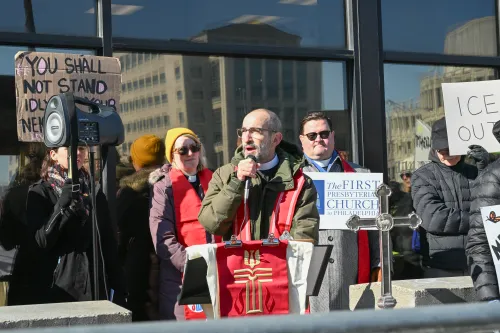
Schondelmeyer said, “I hope this series offers a different possibility: that our deepest allegiance belongs to God, that Christians are called to participate responsibly in public life, and that faithful Presbyterians may sometimes reach different political conclusions while remaining accountable to Scripture, conscience, community and our shared theological tradition.”
Moiso said the resource was part of many efforts across the denomination to engage with the nation's 250th anniversary, including preaching and worship materials from the journal Call to Worship and events sponsored by the Presbyterian Historical Society. She is grateful to see it being used to engage the church broadly.
“I’m thrilled that the Co-Moderators are encouraging the wider church to talk together about religion and politics,” Moiso said. “The Reformed tradition has rich theology for thinking through the relationship between church and state and the responsibilities of citizenship for Christians.”
Though people are welcome to participate individually, the Co-Moderators said they hope sessions, congregations, small groups, campus ministries and other communities will coordinate so they can experience the series together.
Reading the print resource that the series is based on is strongly encouraged, but is not required for participation.
Anyone needing Spanish or Korean interpretation is asked to contact Meg Rift so that can be made available.
The Co-Moderators emphasized that they want to create space for conversation rather than prescribing a particular outcome.
“One of the gifts of our office is that we get to listen to Presbyterians across the breadth of the church,” Schondelmeyer said. “We know there are deep disagreements among us. But perhaps our Reformed tradition gives us something far richer than agreement: it gives us a way of discerning together, respecting conscience, speaking courageously, listening humbly and remembering that our ultimate allegiance belongs not to a party or a nation, but to God.”
You may freely reuse and distribute this article in its entirety for non-commercial purposes in any medium. Please include author attribution, photography credits, and a link to the original article. This work is licensed under a Creative Commons Attribution-NonCommercial-NoDeratives 4.0 International License.