Who will be a witness?
Union Presbyterian Seminary President Emeritus Dr. Brian Blount joins the ‘Sounding Board’ podcast to discuss preaching and biblical interpretation

LOUISVILLE — Fresh off his experience preaching for two weeks during the Presbyterian Association of Musicians’ Worship & Music Conference this summer, Dr. Brian Blount spoke with Sarah Abushakra and Jeremy Roberts, the hosts of “Sounding Board.” View their 70-minute conversation here. Blount joins at the 8:30 mark.
Blount is president emeritus of Union Presbyterian Seminary. In response to a question from Roberts, he spoke of his faith journey growing up in a “closeknit congregation in a small town” where “Sundays were filled with preaching and singing and prayer.”
During the summer, “we had revival with powerful preachers, and the choirs were a tremendous complement to the word preached.”
“I’m used to preachers working very closely with choirs, because that was part of my growing up,” he said. “I was delighted with the PAM worship team that we had a long planning process of 18 months so we could coordinate music and preaching, because I’m used to that.”
Asked by Abushakra about his experience in the Worship & Music Conference pulpit, Blount said there was “a great deal of excitement connecting with the community in Anderson Auditorium” at Montreat Conference Center. “The way people responded to the sermons was awesome to me. It built my energy level up.”
Blount grew up with the call and response model during worship where “the minster fed off the response that came from the congregation. That tended to amplify the way the preacher was preaching, in terms of style and the energy that was given to the content of the sermon. I felt exactly that at Anderson Auditorium.”
“They’re responding even before I get up to preach. I think they’re responding before the worship service even starts,” he said. “For me, there was high energy from the very first moment, and that carried through the entire conference. It was a continuous process of discovery for me seeing how people were discovering the information from the sermon and me discovering their excitement and anticipation and joy. That carried us through to the next worship service.”
Although it was Blount’s first Worship & Music Conference, “I felt like I was part of a community that’s a continuation from what’s happened before, and I know I’ll be part of the community as it extends into the future,” Blount said. “It’s that sense of the whole cloud of witnesses coming to life for those two weeks.”
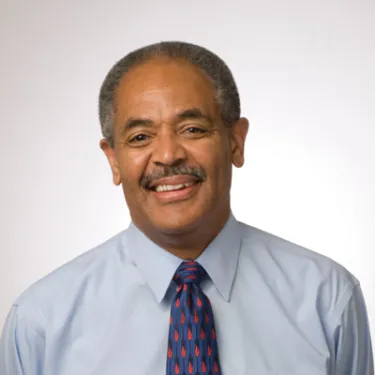
Blount especially resonated with the theme “Who Will Be a Witness” because “that’s a theme I’ve been living into for some time.” He wrote a 2005 book on the witness language in the final book of the Bible: “Can I Get a Witness: Reading Revelation Through African American Culture.”
In Revelation and other Apocalyptic books and in Mark’s gospel, “there is this expectation we are witnesses to God’s future in our present moment and how we can best do that.”
“Jesus is the model witness, and we are to follow in that witness,” he said.
During a planning meeting about 18 months ahead of this summer’s conference, ideas for sermon installments on biblical witnesses were discussed, including the Hebrew midwives, Shipra and Puah. “I’ve loved that story, and I’ve never preached on it,” Blount said. “Here was an opportunity to explore how they were witnessing.”
During the conference, Roberts said it occurred to him that some of the witnesses in our own lives “are not necessarily the people we expect. Instead, they’re characters like those midwives. It reminded me of the ways God works in the world” and “not only through those we see as the most powerful.”
A great example is the widow’s offering as recorded in Mark’s gospel, according to Blount. Jesus had to call the disciples over to explain the significance of her generous act.
“We often miss seeing moments of heroic witness right before our eyes, hiding in plain sight,” Blount told the hosts. “We need to be, as Jesus said, ready, always ready, always watching for when God is moving in our life or in someone else’s life to realize how God is breaking into the world.”
When he was about 10, Blount heard a phenomenal preacher during revival one summer. His mother took him the next day to meet the preacher so that Blount could ask him what enabled him to preach so powerfully. Busy preparing for that evening’s service, the preacher chuckled and told young Blount, “It’s a lot of hard work and a lot of prayer,” then rushed off.
“I told my mother, ‘that’s an insufficient answer. That’s not enough to help me do what he does,’” Blount said. “But over time, it came to me that hard work and the prayer that goes with the work means something significant. I use it today — the spiritual discipline that goes with engaging the text and the prayer that goes with that spiritual discipline, the textual exegesis. Those things work together and they come alive as you think about the text in relation to a particular group of people. I continue to return to that moment.”
Roberts asked Blount about a career that has included parish ministry, seminary instruction and, finally, administration. “They are similar and yet different callings,” Roberts said.
“That’s a very astute observation,” Blount told Roberts. Pastors try to thread a needle between preaching “in ways that uplift and challenge a congregation, and at the same time being pastoral,” even when “you’re trying to be prophetic.”
Blount then went through the “solitary experience” of studying for a doctorate, allowing for reflection and for ways to be “deeply prophetic in ways I’d always wanted to be, engaging in social, biblical, theological and community issues. It opened up a vista.”
As a professor, “you’re an agent of horizon expansion,” Blount said. “I loved the freedom of thought movement.” As an administrator, “I moved back into the pastoral realm. The horizons are larger in a theological institution, and yet you’re expected to be the person who helps nurture and develop and set the agenda and the strategic vision for the community.” That once again requires balancing the prophetic and the pastoral “to push boundaries knowing you need to have everyone come along with you, to be diplomatic in your thinking and your preaching.”
“So I started as a pastor and ended as a pastor,” he said. “In the middle, I had academic opportunities to push people to uncomfortable places. Now, being retired, I’m trying to pull all those together to be someone who pushes and recognizes pastoral needs and concerns.”
“We live in a time when we need prophetic voices more and more,” Blount said. “I have felt God’s movement in all of those spheres.”
Abushakra asked Blount to explain Revelation to her.
“My elevator speech is there are many visions and one revelation,” Blount said. The many visions of angels, the dragon and others “all point to and amplify and testify to the one revelation, that Jesus Christ is Lord, and the expectation is that you will witness to that lordship no matter the cost.”
“Witness to that revelation because the time is short,” Blount added. “That’s the Book of Revelation in a nutshell.”
She then asked him about interpreting scripture through a cultural lens.
“I have built my academic career by talking about how we read the biblical material through our own cultural lens, who we are, what we are and what we’ve been through in life. That has been going on through the history of biblical interpretation,” Blount said. “It’s important to be open to people who think differently than we do about biblical texts.”
Communal conversation “opens up the possibility that we might be able to see something in the text we have not seen before because someone has been engaging it from their cultural and life perspective and communal history that enabled them to see something that we missed.”
Blount said that for him, “cultural hermeneutics — the study and interpretation of texts from the cultural standpoint I come from as I engage the text — is one of the richest ways of looking at biblical materials and doing biblical interpretation, and it’s one of the most communal ways.”
“It holds promise for us as a church as we go into the future being less divisive than we have been in our recent history.”
When we are in conversation over biblical interpretation, “we have to be incredibly intentional and bring with us a significant amount of grace to such a conversation,” he said. “Ultimately, I think we’re just going to have to be assertive within the church, knowing it’s difficult but reaching out to communities of folk who think differently than we do, inviting conversation and realizing sometimes we’ll be hurt by the rejection and other times we will be mystified by the opportunity.”
As part of a cloud of witnesses, “we are not alone. A baton has been passed to us and we want to run with it for as long as we can,” Blount said. “We are part of a progression of hope and possibility, and we have seen that hope and possibility come to fruition in the past.”
“We have to believe it can come to fruition in the future, and that’s why we’re running.”
Watch previous editions of “Sounding Board” here. Listen to them here or here.
You may freely reuse and distribute this article in its entirety for non-commercial purposes in any medium. Please include author attribution, photography credits, and a link to the original article. This work is licensed under a Creative Commons Attribution-NonCommercial-NoDeratives 4.0 International License.


