Office of Public Witness' May Advocacy Hour webinar addresses gun violence prevention
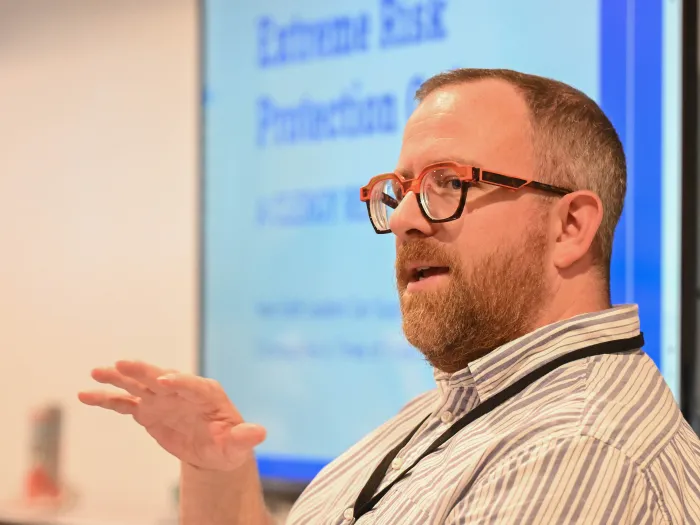
The webinar focused on Extreme Risk Protect Orders and secure firearm storage

In advance of Gun Violence Awareness Month in June, the Office of Public Witness (OPW) within Presbyterian Life & Witness (PL&W) dedicated its May Advocacy Hour webinar to the topic. The webinar, called “God, Guns, and Building Safer Communities: Safe Storage, Extreme Risk Protection Orders, and Church-based Advocacy” took place on Thursday, May 28 via Zoom and brought in partners from Everytown for Gun Safety's Be SMART program and Johns Hopkins’ National ERPO Resource Center.
The Rev. Christina Cosby, OPW's representative for domestic and environmental concerns, welcomed more than 100 webinar attendees before introducing Dr. Andrew Peterson, OPW's representative for Peacemaking and a program called The Decade to End Gun Violence.
Peterson mentioned two timely resources for Gun Violence Awareness Month: a new prayer book called "How Long, O Lord" and a grant program for churches and faith communities looking to host gun violence prevention programs.
Peterson also noted the “odd title” of Gun Violence Awareness Month, pointing out that in the United States, gun violence is so prevalent that its hard not to be aware of it all the time. He emphasized his point with sobering statistics, including that there are more guns than U.S. citizens and that the nation's per-capita gun violence rates are among the highest in the world.
Peterson went on to say that, as people of faith, we have a “thick understanding of what awareness can be,” describing it as a call to remembrance, holy anger, action, and witness. He offered a prayer from "How Long, O Lord," which drew inspiration from the famous prayer of St. Francis about being an “instrument of peace” before handing the program off to
Spencer Cantrell and Sarah McTyiere from the Johns Hopkins Center for Gun Violence Solutions.
Building on the statistics Peterson mentioned, Cantrell said that in 2023 more than 46,000 people in U.S. lost their lives to gun violence, further noting that more of those deaths were due to suicide than homicide. While gun-related death numbers are ultimately trending downward, Cantrell said, it’s still very much an epidemic.
Cantrell and McTyeire said that Johns Hopkins works on a number of evidence-based solutions to address the issue, including safe gun storage, firearm relinquishing, firearm purchaser licensing, and community violence intervention. They then introduced the concept of Extreme Risk Protection Orders (ERPO), which were first developed in the wake of the 2012 Sandy Hook shootings and are policies and practices that seek to remove firearms from anyone presenting a clear danger to themselves or others.
ERPOs are civil orders modeled off of domestic violence protection orders, and there are ERPO laws in place in 22 states as well as Washington, D.C., and the U.S. Virgin Islands. In every state that has an ERPO policy in place, law enforcement can petition for such an order, and in some states other people, including family and household members, educators, and healthcare providers, are also allowed to petition.
Cantrell then went on to describe when the use of an ERPO is appropriate. She said they’ve been used many times when a person is threatening self-harm and various types of community violence.
ERPOs are granted by judges based on risk factors identified by petitioners, including concrete threats, recent acquisition of a large number of firearms, and compounding factors like alcohol or substance abuse. Cantrell emphasized that mental illness on its own is not considered a risk factor, since data shows individuals with mental illness are more likely to be victims of gun violence than perpetrators.
Currently, there are no states where clergy are allowed to petition for an ERPO. However, Cantrell cited research showing that “increased awareness of ERPO among professionals like yourselves who respond to people in crisis is really critical to implementation.” McTyeire also let participants know about a guide for faith leaders developed in partnership with OPW and Faith United to Prevent Gun Violence. Peterson said the guide would be available soon and would be posted on the PC(USA) website and sent via email to webinar participants.
Cathi Geeslin and Meg Beauregard from Everytown for Gun Safety then discussed the importance of secure gun storage, which they defined as the practice of locking away firearms when they're not in use and not on your person. They noted that secure gun storage has been proven to significantly reduce the frequency of four major types of gun violence: unintentional child shootings, youth suicide, school shootings and gun theft.
Beauregard invited participants to guess how many children in the U.S. live in homes with an unlocked and loaded firearm before revealing the answer to be a staggering 6.7 million. She then said that there is no federal law that requires secure gun storage, though there are secure storage laws in 26 states and in Washington, D.C. These laws, she said, have varying degrees of severity and effectiveness, but that overall secure storage policies are crucial for mitigating gun violence.
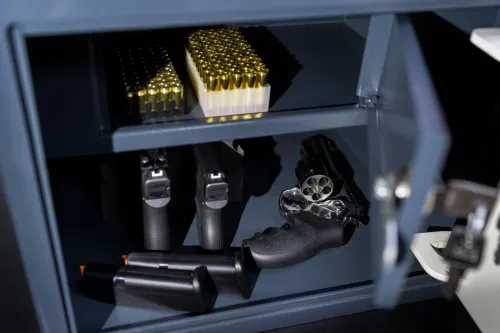
She noted that one study found that households that locked both firearms and ammunition were associated with “a 78% lower risk of self-inflicted firearm injuries and an 85% lower risk of unintentional firearm injuries among children and teens.” She later noted estimates that secure gun storage could save 251 lives a year—around a third of all youth suicides and unintentional deaths.
Beauregard said that faith leaders play an important role in pushing for secure gun storage through both legislative and educational efforts before inviting Geeslin to share about Everytown’s Be SMART program.
Geeslin noted that an average of six children per day were killed by guns in the U.S. in 2024 and that Black and Latinx youth are disproportionately impacted. Among other efforts, the Be SMART training program was developed to address these realities. Geeslin also noted that the PCUSA's 226th General Assembly passed an overture in 2024 to partner with the Be SMART program.
SMART is an acronym that stands for secure, model, ask, recognize, and tell. It encourages people to secure firearms safely, model responsible behavior around guns, ask about unsecured guns in other homes, recognize the role of guns in suicide, and tell your peers to be smart. Geeslin said faith leaders can help by naming realities of gun violence in their communities and talking about the importance of interventions like secure gun storage.
Both Johns Hopkins and Everytown encouraged participants to reach out with any questions and linked to a number of resources in the chat.
In addition to partners from Johns Hopkins and Everytown for Gun Safety, the Rev. Courtenay Willcox was also scheduled to present on how congregations can become centers of advocacy, education, and community healing. However, a technical issue cut the webinar off prior to Willcox’s presentation. Organizers are hoping to record that portion of the webinar separately to be shared with attendees.
You may freely reuse and distribute this article in its entirety for non-commercial purposes in any medium. Please include author attribution, photography credits, and a link to the original article. This work is licensed under a Creative Commons Attribution-NonCommercial-NoDeratives 4.0 International License.