Young adults carry the leaves of justice into the world
Closing worship and public witness at conference connect faith, creativity and advocacy
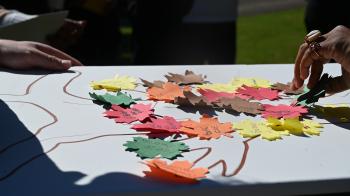
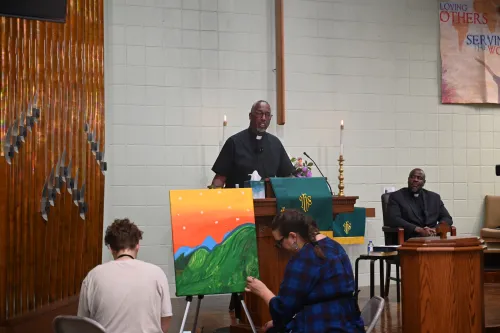
ATLANTA — As autumn leaves turn and election ballots are cast, Christians in the United States and classic rock fans are reminded of Ecclesiastes' wisdom: “To everything there is a season and a time to every purpose in heaven.” The turning of leaves and leadership in the cycle of our natural and political ecosystems was on full display as the 2026 Jesus and Justice Young Adult Advocacy Conference concluded Sunday with worship at Hillside Presbyterian Church.in Atlanta.
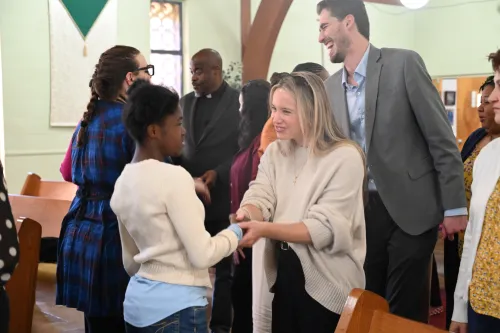
Young adults gathered with church members, denominational leaders and advocates to celebrate a week of learning, community building and faithful action rooted in justice. Sponsored by the Office of Public Witness, the conference brought together young adults from across the Presbyterian Church (U.S.A.) for worship, policy discussions, organizing training and theological reflection.
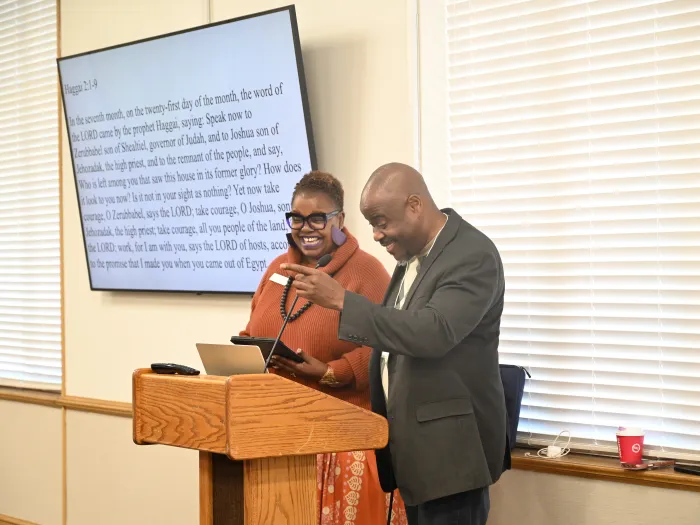
The closing service at Hillside returned participants to the biblical foundation that had guided the gathering from the beginning: Micah 6:8’s call “to do justice, and to love kindness, and to walk humbly with your God.” The service was led by the Rev. Dr. Alonzo Johnson, manager of the Presbyterian Committee on the Self-Development of People and part-time pastor of Hillside. The Rev. Jimmie Hawkins, director of Advocacy and Witness for Presbyterian Life & Witness, preached the closing sermon.
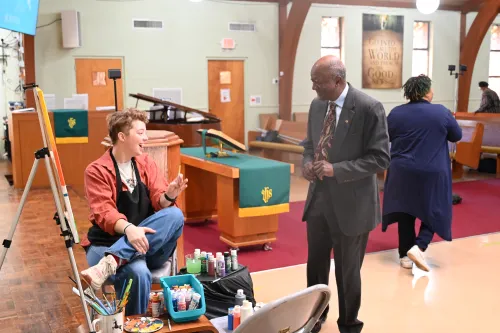
Throughout worship, live paintings created by conference participants Lauren Christian and Jeff McAllister took shape alongside the liturgy, reflecting the conference's conviction that advocacy, faith and creativity belong together.
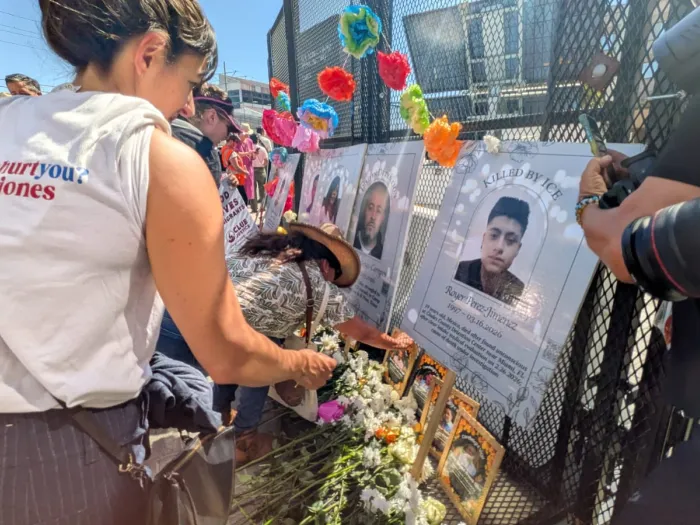
Preaching from Matthew 23 in a sermon titled “What the Lord Still Requires,” Hawkins challenged participants to connect Christian faith with the realities facing their communities. Quoting Jesus’ rebuke of religious leaders for neglecting “the weightier matters of the law: justice and mercy and faith,” Hawkins argued that discipleship cannot be confined to church walls. “We've got to remember there’s a life outside of the church,” Hawkins said. “There are children right now who are hungry. There are people right now who are going out to the store and tomorrow will go to their child's school and won't ever come back home again, being picked up by ICE agents simply for being here.”
Linking public witness directly to Christian identity, Hawkins continued: “We’ve got to understand that justice is an intimate part of who we are in our Christian identity, and it is important that we continue to do the work to make a difference in this community.” The sermon repeatedly connected Jesus’ ministry with present-day concerns, including poverty, immigration, healthcare and economic inequality. “Jesus also expanded our outreach to say we've also got to deal with this system, the injustice of this system,” Hawkins said. “People deserve healthcare. No one should have to go to the emergency room in order to take their child who is sick. No one should have to worry about whether the insurance company is going to pay for their sick child.”
Following worship, participants and members of Hillside moved to the church’s front lawn for a public witness ritual led by the Rev. Christina Cosby of OPW alongside Johnson, Hawkins and conference participants. They gathered beneath a tree with weeping branches and leaves beginning to show the first signs of fall, a fitting backdrop for a conference that had challenged young adults to “be the leaves” and carry the work of justice into their communities. Scripture framed the gathering’s reflections. Wyatt Betler read Isaiah 58:6-12, including the prophet's call to “loose the bonds of injustice” and become “the repairer of the breach.”
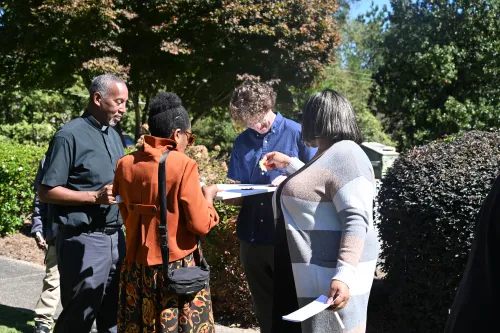
Jeff McAllister followed with Luke 4:16-21, where Jesus proclaims good news to the poor, release to captives and freedom for the oppressed. Lauren Christian read Micah 4:3-5, envisioning a future in which nations “shall beat their swords into plowshares” and “neither shall they learn war anymore.”
The public witness ritual also provided space for participants to connect the week’s conversations with current events and policy debates. During remarks outside, Hawkins shared a personal story about his family’s experience navigating the healthcare system after his son contracted bacterial meningitis at 9 months old. Although he and his wife had strong health insurance, he recalled the staggering cost of treatment and how insurance coverage made the difference between financial devastation and recovery. Hawkins connected that experience to the Presbyterian Church (U.S.A.)’s advocacy on the national level for universal healthcare, arguing that access to healthcare is a matter of justice rather than privilege in the United States, where roughly two-thirds of personal bankruptcies are due to medical expenses and illness-related loss of work.
His comments carried particular resonance for Hillside’s church members in Georgia, where healthcare remains a prominent issue in public policy discussions. As Election Day approaches, Georgia gubernatorial candidates have been debating competing approaches to expanding healthcare access, parsing rhetoric like “full” versus “intelligent Medicaid expansion.” Advocates continue to point out that previous efforts have often become entangled in administrative requirements that limited enrollment among eligible residents. Against that backdrop, Hawkins presented healthcare not as a partisan issue but as a theological one rooted in human dignity and the church’s commitment to care for neighbors.
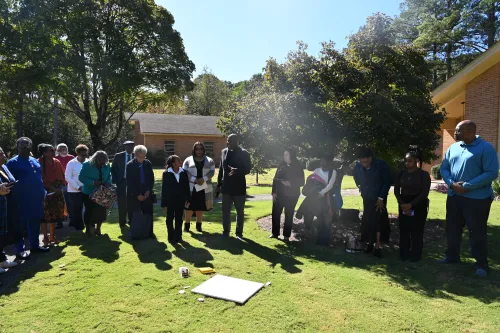
Through prayers, communal art and spoken commitments, church members and young adults named justice concerns affecting their neighborhoods and the communities they serve. The concerns ranged from poverty and healthcare access to environmental justice, education and racial equity. The ritual brought the conference full circle, returning participants once again to a theme introduced at the opening gathering by the Co-Moderator of the 227th General Assembly (2026), the Rev. Dr. Kris Schondelmeyer: “Be the leaves.”
As the gathering concluded, Johnson offered a final prayer of commissioning, sending participants back to their homes and ministries with a renewed commitment to public witness. “Our call to action is to love each other, to walk together in this world, to advocate for the poor, to stand at the gates, to make sure our voices are heard,” Johnson prayed. “Send us to be your people of hope in Christ.”


You may freely reuse and distribute this article in its entirety for non-commercial purposes in any medium. Please include author attribution, photography credits, and a link to the original article. This work is licensed under a Creative Commons Attribution-NonCommercial-NoDeratives 4.0 International License.