Second session of Co-Mods' religion and politics webinar series to focus on being Christian and a citizen
The session will build on the theological groundwork for the PC(USA)'s stance on religious liberty established in session one
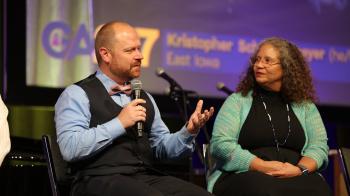
When the Rev. Marta Pumroy-Cordero and the Rev. Dr. Kris Schondelmeyer were elected at Co-Moderators of the 227th General Assembly this past summer, they knew part of their work would be helping Presbyterians discern how their faith intersects with politics and public witness … and how it doesn’t. A resource GA participants received during the assembly laid the groundwork for a new webinar series the Co-Moderators are facilitating this month called “Why ‘Presbyterian’ will never be a political party.”
With the series’ first session, which took place on Friday, Oct. 2, yielding powerful conversation about Presbyterian theology around religious liberty, the Co-Moderators are excited to carry the dialogue forward with a second session on Friday, October 16, called “State and Citizen: Their Mutual Responsibility.” That session will focus on helping Presbyterians dig into their responsibility to and for the government.
Schondelmeyer said the first session left him feeling "encouraged and hopeful."
"It was clear to me that people are genuinely curious about how our faith should inform our politics," Schondelmeyer said. "That curiosity gives me hope, because it tells me people are willing to wrestle with difficult questions, listen to one another and seek to live out their faith in meaningful ways."
The webinar series draws both its name and its themes from a resource distributed to participants at this past summer’s General Assembly, which itself draws on a 1988 General Assembly policy called “God Alone is Lord of the Conscience.” The resource was developed by the Rev. Dr. Aimee Moiso, manager for Social Witness Policy within Presbyterian Life & Witness, as part of a larger effort within the denomination to recognize this year’s 250th anniversary of the founding of the United States.
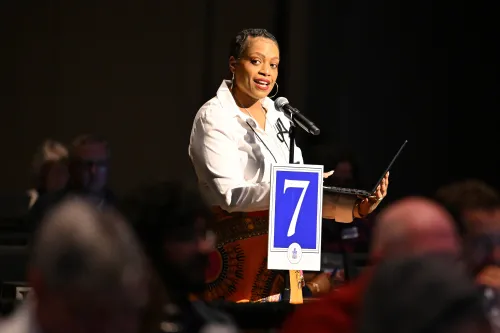
Moiso also one of the featured guest speakers for the series’ upcoming second session along with the co-chairs of the General Assembly’s Advisory Committee on Social Witness Policy, the Rev. Jeromey Howard and the Rev. Sue Trigger. ACSWP is the permanent committee of the Presbyterian Church (U.S.A.) responsible for developing and recommending social witness policies. Its members are elected by the General Assembly and are supported by denominational staff.
Moiso emphasized that, while the title “State and Citizen” focuses on the relationship between citizens and their government, the second session of the series is really “about being a Christian and thinking about citizenship.”
The first session sought to give participants background on both the history and the theology that inform the PC(USA)’s claim that God alone is Lord of the conscience, as well as what that means for the denomination’s engagement in public witness and in politics. The “Religious Liberty” session featured a conversation between the Co-Moderators and two other denominational leaders: the Rev. Denise Anderson, who is the director of Restorative Justice Ministries for PL&W, and Flor Vélez-Díaz, a ruling elder and manager of judicial process for PL&W.
Both Anderson and Vélez-Díaz emphasized that, since its inception, Presbyterianism has resisted government influence over the operations of the church, with Anderson pointing out that modern social witness policies objecting to Christian nationalism stem directly from this historical commitment.
Describing the idea of “freedom of conscience,” Anderson said, “in short, what forms and disciplines a Christian conscience is the teachings of Jesus Christ.”
Referencing the 1988 General Assembly policy, Vélez-Díaz added that Presbyterians recognize “freedom is Spirit's way as well as the Dpirit's gift,” and that religious liberty is not only about freedom from government interference in our beliefs, but also “freedom to listen to the Spirit loving within us and where that will lead us to act as followers of Jesus Christ.”
Schondelmeyer also referenced the 1988 policy, pointing to the way it describes “freedom of conscience” as not only an individual reality, but also a communal one.
“We are shaped by the institutions that we are part of,” Schondelmeyer said, "and I can't just go and do whatever I want, particularly if it infringes upon the rights of other people.”
The conversation went on to discuss how this communal element also demands that Presbyterians recognize the ways that liberty, and religious liberty in particularly, are experienced differently — and inequitably — by different groups of people in the United States, particularly along the lines of race, gender, ethnicity, sexual orientation and class.
Pumroy-Cordero said that it’s important to recognizing that saying the Presbyterian Church is not a political party does not mean that Presbyterians are not called to advocate in accordance with our beliefs. She talked about her own work with immigrants on the U.S.-Mexico border and her sense of call to seek not just her own liberation, but the liberation of others as well.
The webinar leaders emphasized that part of believing in collective liberation means understanding that others deserve the same freedom of conscience and religious liberty as we do, even when they believe differently.
“Jesus respects our agency,” Anderson said. “What is it about us that we can't respect the agency of somebody else to believe differently than we do? Because they are only you are only as free as they are.”
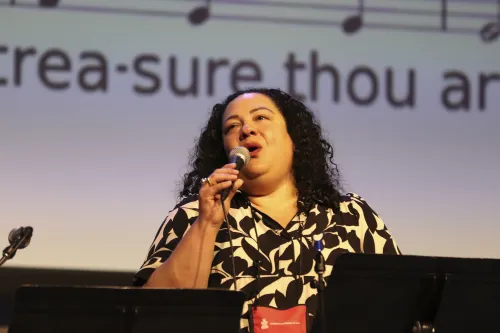
As the webinar drew to a close, Anderson told participants that these ideas cannot remain abstract and intellectualized. Vélez-Díaz agreed, saying that people of faith have to be brave in living out their own freedom of conscience, as well as advocating for that freedom for all whenever and wherever it is at risk.
The Co-Moderators assured webinar attendees that the tangible and practical applications of these theological convictions would make up the substance of the second session of the series.
“If we're a free people of conscience, then what responsibilities do we have to one another?” Schondelmeyer asked, describing the focus of the second installment in the series. “What responsibilities does government have towards its people? And what happens when these responsibilities come into conflict?”
Part 2 of “Why ‘Presbyterian’ will never be a political party” will take place at 1 p.m. Eastern Time on Friday, Oct. 16. Anyone interested can register for the Zoom call. Engaging with the accompanying resource is encouraged, but not required.
While the second session will dive into the implications of religious liberty for individuals, the third and final session, which takes place on Friday, Oct. 30, will explore what faithful public witness for the church looks like. The Co-Moderators have said their hope for the series is that it will help participants discern for themselves how their Presbyterian faith compels their engagement, and the church's, in public witness.
You may freely reuse and distribute this article in its entirety for non-commercial purposes in any medium. Please include author attribution, photography credits, and a link to the original article. This work is licensed under a Creative Commons Attribution-NonCommercial-NoDeratives 4.0 International License.