PRRI study explores correlation between religious views and stance on immigration policies
Results suggest those who believe in divine election and duty to support Israel are more likely to support certain anti-immigrant policies

In June of this year, the migration cohort of Public Religion Research Institute’s fellowship program conducted a survey exploring attitudes toward immigrants and immigration policies. While the study covered a broad swath of related topics, some of its questions specifically asked respondents about their position on specific religious and theological issues and compared those responses to attitudes expressed about immigration.
Dr. Will McCorkle, who drafted the religion questions, said the survey, which garnered about 1,000 responses, “examined the beliefs of the American public on immigration policy, and then we also asked a few questions related to theological beliefs.”
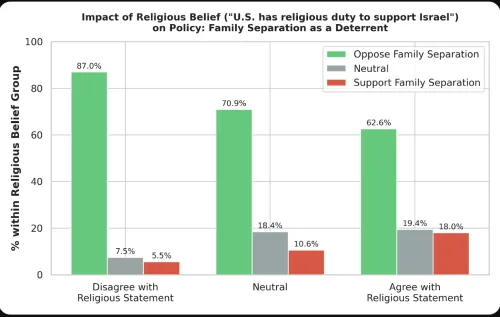
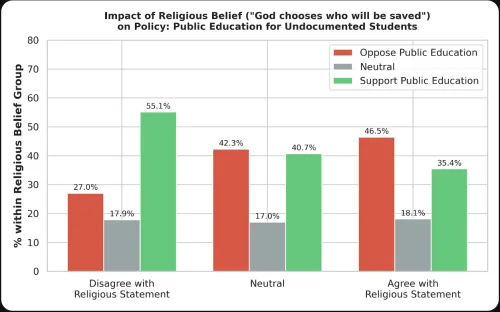
“We specifically analyzed the belief on election and the idea that the U.S. has a religious obligation to support Israel,” McCorkle said. “We then examine how these beliefs aligned with beliefs on access to public education for undocumented immigrants, the recent reduction in refugees, the policy of separating children from their parents to deter illegal border crossings, and the prioritization of white South African refugees.”
The survey also asked respondents about their beliefs on divine election and salvation.
McCorkle is a Professor of Education at the College of Charleston in Charleston, South Carolina and a member of Parkside Church, a recently chartered PC(USA) congregation in downtown Charleston. Parkside has actively engaged in faith-based immigration advocacy efforts in the city. McCorkle himself also does a lot of advocacy and support work around immigration, having traveled to the U.S./Mexico border a number of times.
He said his research team was curious if they could identify a clear correlation between more theologically conservative religious values and anti-immigrant positions on policy. In some cases, survey results did point to a statistically significant correlation, though in other cases it was less clear.
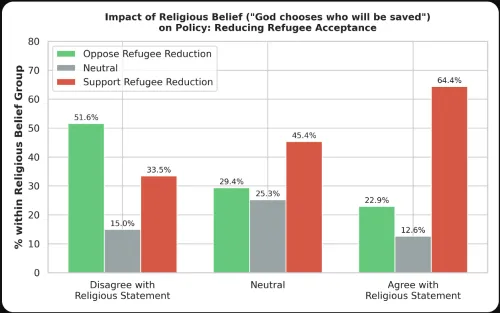
Survey result graphs demonstrate that there was a higher percentage of respondents said they do believe in “divine election” — or the idea that God chooses who will be saved — who also supported efforts to reduce the number of international refugees in the U.S. as compared to those who don’t believe in “divine election.” The survey also demonstrated a higher percentage of opposition to public education for undocumented students among those who believe in divine election than those who don’t.
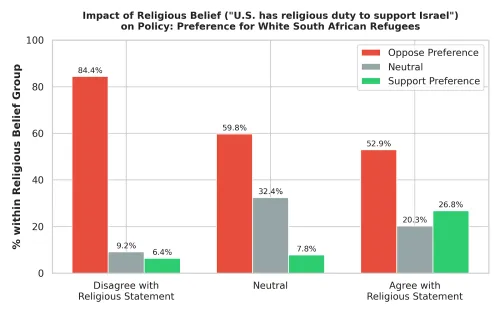
Meanwhile, a majority of respondents across the board opposed family separation as a deterrent for unauthorized immigration, but that majority was smaller among respondents who reported they believe the United States has a religious duty to support Israel. Across the board, a minority of respondents supported preference toward white South African refugees, but a significant higher percentage of those who believe the U.S. has a religious duty to support Israel also expressed preference for white South African refugees.
“Though this study cannot definitively prove causation, it does show some troubling correlations between certain exclusive, religious ideologies, and the stances towards immigrants,” McCorkle said. He particularly pointed to the seeming inconsistency between the Presbyterian Church (U.S.A.)’s historic alignment with theological positions like divine election and predestination and the denomination’s outspoken support of immigrants and refugees through its ministry work and its official General Assembly policies.
“Even though Presbyterians may have a heritage that includes beliefs and areas like divine election, the study seems to indicate that these attitudes often are paired with a harsher view towards immigrants,” McCorkle said, suggesting that the theological link might be “If the love of God does not cover all, why, then, should our love extend to those outside of our borders particular, those who might be perceived as coming in illegally?”
McCorkle also clarified that even when researchers controlled for political party affiliation, the correlations between immigrant policy attitudes and theological claims persisted.
The Presbyterian Church famously derives from the reformer John Calvin and his Calvinist theology, which traditionally includes the doctrine of election. In more recent history, the PC(USA) has been active and vocal around immigrant rights and protections, leaning on biblical messaging around “welcoming the stranger” and “loving your neighbor” in both the Old and New Testaments.
The denomination’s General Assembly has voted in favor of pro-immigrant policies for decades, and was a significant part of the Sanctuary Movement of the 1980s. Denominational ministries like the Immigration Advocacy Office, the Presbyterian Hunger Program, Presbyterian Disaster Assistance, and others provide material and spiritual support for migrants and refugees in the U.S. and beyond. The Office of Public Witness regularly puts out action alerts calling for Presbyterians to urge their political representatives to make policy decisions that benefit immigrants and honor their humanity. The Stated Clerk of the General Assembly and Executive Director of Presbyterian Life & Witness, the Rev Jihyun Oh, has published several statements decrying anti-immigrant policies and actions taken by the government, and joined other faith leaders earlier this year in signing on to an amicus brief in support of asylum seekers at the U.S. border.
Notably, the denomination has also historically supported peace efforts between Israel and Palestine and taken General Assembly action to divest from certain companies benefitting from Israel’s anti-Palestinian actions. At the 227th General Assembly this June, commissioners voted to identify the current violence in Gaza as genocide.
McCorkle said the results of their survey should challenge clergy and faith leaders, Presbyterian and otherwise, to thoughtfully and prayerfully consider how the theologies they express might implicitly inform other moral values and policy positions.
PRRI’s migration cohort is continuing to analyze and publish their survey results. PRRI is a DC-based nonprofit, nonpartisan research and education organization that conducts public opinion polls on a variety of topics, specializing in the quantitative and qualitative study of political issues as they relate to religious values. PRRI founder Robert P. Jones was the featured speaker at a breakfast hosted by the Presbyterian Foundation at the 227th General Assembly in June.
You may freely reuse and distribute this article in its entirety for non-commercial purposes in any medium. Please include author attribution, photography credits, and a link to the original article. This work is licensed under a Creative Commons Attribution-NonCommercial-NoDeratives 4.0 International License.