
'Jesus Loves Me, This I Know'
Exploring the origins of the American Sunday School Association and a favorite children's hymn
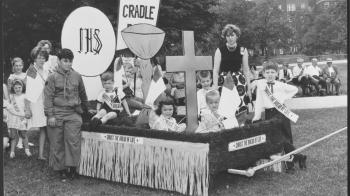
The first Sunday school was founded in 1780 in Manchester, England, by Robert Raikes, whose goal was to provide free instruction to poor children on Sundays. After visiting Scotland with her husband in 1801 and observing a Sunday school there, Joanna Graham Bethune tried to garner interest among clergymen in New York to start similar institutions in the city.
In 1816, with the support of her fellow women, Bethune helped found the Female Union Society for the Promotion of Sabbath Schools in New York. The purpose of this new group was “to stimulate and encourage those engaged in the education and religious instruction of the ignorant; to improve the method of instruction; to promote the opening of new schools; to unite in Christian love, persons of various denominations engaged in the same honorable employment.”
Meanwhile in 1817 in Philadelphia, Alexander Henry, a Presbyterian layman and merchant, formed a similar city-wide association called the Sunday and Adult School Union. The nondenominational organization which resulted had two main objectives: to promote the establishment of Sunday schools and to provide libraries and supplies for their use.
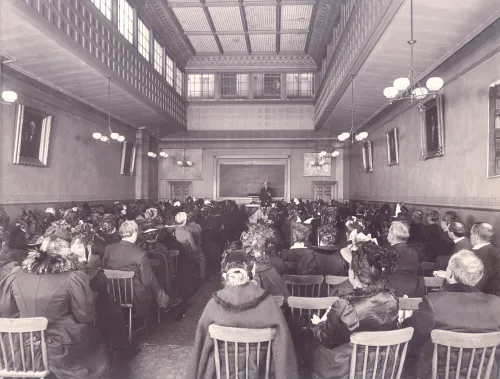
Within a year after its founding, the Union's activities and influence extended far beyond the boundaries of Philadelphia. Requests for admission to and aid from the Union came from schools and societies throughout the country. To facilitate its work, the Sunday and Adult School Union hired William Blair as a trained missionary in 1821. In his first year, Blair traveled 2,500 miles between Pennsylvania and North Carolina. He founded 61 schools, visited 35 others, revived 20, and established six tract societies and four adult schools. By 1823, more than 700 societies and individual schools were enrolled in the Union, while approximately 7,000 teachers and 50,000 students were affiliated with it.
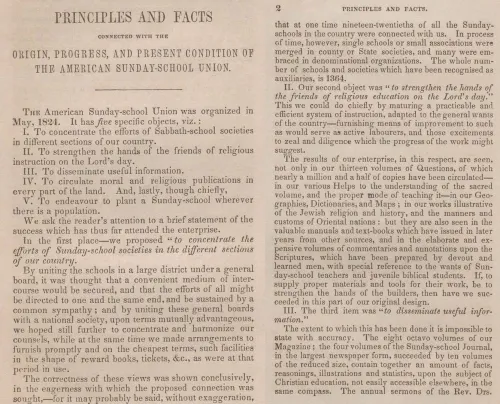
In 1824, Henry’s endeavor was renamed the American Sunday School Union, as it expanded its activities to the national level. The goals of the Union were reiterated in the constitution of the newly named society—the objects were to "concentrate the efforts of Sabbath school societies in the different sections of our country; to strengthen the hands of the friends of pious instruction on the Lord's day; to disseminate useful information, circulate moral and religious publications in every part of the land; and to endeavor to plant a Sunday school wherever there is a population."
The Presbyterian Historical Society is the home of the American Sunday School Union (ASSU) Records, a collection made up of 177 boxes of materials. Ranging from 1817 to 1933, the records primarily consist of correspondence and annual reports. In 1980, Barbara A. Sokolosky shared with PHS the administrative history of the Union that she’d compiled. It is extensive, almost 5,000 words long, and highly detailed. Readers and researchers interested in learning more about the 19th century beginnings of the American Sunday School Union, how the organization survived during the Civil War and beyond, and the publication of serial magazines like the Youth’s Penny Gazette can read Sokolosky’s full history in the collection guide.
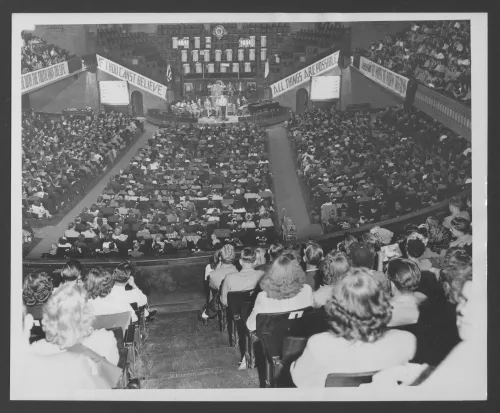
Evangelism and Sunday school enrollment steadily increased in the early 20th century. The ASSU continued to send missionaries into rural homes, with almost 200,000 families visited by 1915. At that time, the total number of schools organized since 1817 was estimated at 131,814; the total enrollment for the 100 years was nearly 700,000 teachers and over five million students.
The Sunday school has played a pivotal role in the Christian education of many generations of children and adults. Hand in hand with its development, women’s role within the church has expanded. From the beginning, most Sunday school teachers were women, and their participation dramatically changed the generally accepted scope of female activities. Through their involvement, they gained opportunities not only to teach, but also to engage in social work and theological study, to establish libraries, prepare curriculum materials and to work in a national institutional network.
One of the most familiar Sunday school songs is “Jesus Loves Me.” This hymn is an example of the great Presbyterian influence on the Sunday school movement, for the words are by Anna Bartlett Warner, a devout Presbyterian.
Anna Bartlett Warner was born in New York City in 1827, a decade after Henry’s Sunday and Adult School Union was established downriver in Philadelphia. Anna’s mother died shortly after her birth; her lawyer father lost almost everything they had in the Panic of 1837. The family left the city and moved to their former summer home near West Point.
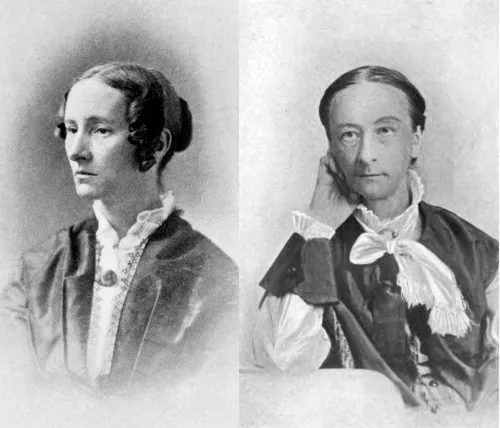
To help with expenses, Anna and her older sister, Susan, became writers. Both separately and in collaboration, they produced best-selling novels and Sunday school literature. Susan Bogert Warner is best remembered for her novel "The Wide, Wide World," the first of 30 novels she’d write. Published in 1850 under the pen name Elizabeth Wetherell, "The Wide, Wide World" was a brilliant success. Jo March reads Wetherell’s novel in Louisa May Alcott’s "Little Women"; Susan’s best-selling novel went through 14 editions in just two years. Anna also published her works under a pen name, Amy Lothrop. As Lothrop, Anna wrote more than a dozen books, including two collections of hymns.
In 1860, the sisters finished a thousand-page novel, "Say and Seal," to great reception. In the preface, the women introduce their work as being “of very moderate limits — considering that two women had to have their say in it. It is pleasant to wear a glove when one shakes hands with the Public; therefore we still use our ancestors' names instead of our own — but it is fair to state, that in this case there are a pair of gloves! Which is the right glove, and which the left, the Public will never know,” they jest, before sharing a glimpse into the story that follows.
“Meantime, hear this. In a shady, sunshiny town, lying within certain bounds— geographical or imaginary, — these events (really or in imagination) occurred. Precisely when, the chroniclers do not say. Scene opens with the breezes which June, and the coming of a new school teacher, naturally create. After the fashion of the place, his lodgings are arranged for him beforehand, by the School Committee. But where, or in what circumstances, the scene may close, — having told at the end of the book, we do not incline to tell at the beginning.”
The sentimental plot revolves around a Sunday school teacher named John Lindon, his love for a girl named Faith, and his concern for one of his pupils, a sickly little boy. As John holds the dying boy near the end of the book, he sings these lines:
"Jesus loves me, this I know, For the Bible tells me so; Little ones to him belong, They are weak but he is strong. Jesus loves me — he who died / Heaven’s gate to open wide; He will wash away my sin, Let his little child come in. Jesus loves me, loves me still, Though I’m very weak and ill; From his shining throne on high / Comes to watch me where I lie. Jesus loves me — He will stay / Close beside me all the way, Then his little child will take / Up to heaven for his dear sake."
Anna penned the above words, which, in 1861, would be set to music by hymn writer William B. Bradbury. Bradbury also added the chorus: “Yes, Jesus loves me; The Bible tells me so.” The rest was history.
After leaving New York City, Susan started a Bible class for West Point cadets, and the sisters taught the class in their home for decades, writing all the while. Anna Warner continued to teach Sunday school for the cadets almost until her death in 1915, when she was buried in the West Point Cemetery, where she rests alongside her sister.
The ASSU exists today, as InFaith. Readers can learn more about the history of the organization at InFaith’s website, where the group shares updates on its various ministries, including chaplaincy, creative arts, trauma and abuse recovery, and more. InFaith’s current mission echoes that of Henry’s initial hopes — to offer healing, purpose, and a sense of belonging to those in need; to change lives through the sharing of Christ’s love.
Enjoy these glimpses into Presbyterian history in years past? Donate to the PHS Annual Fund, which supports the efforts of the Presbyterian Historical Society to collect, preserve, and share the past in order to transform your current perspective on church history.
You may freely reuse and distribute this article in its entirety for non-commercial purposes in any medium. Please include author attribution, photography credits, and a link to the original article. This work is licensed under a Creative Commons Attribution-NonCommercial-NoDeratives 4.0 International License.


.png)
