Discernment in the early church — and today
Author and scholar the Rev. Dr. John Lewis sheds light on early church practices on ‘A Matter of Faith: A Presby Podcast’

LOUISVILLE — The early church, especially the faith communities that Paul started, prioritized moral formation and community building, and employed practices of communal discernment that modern-day people of faith can learn from.
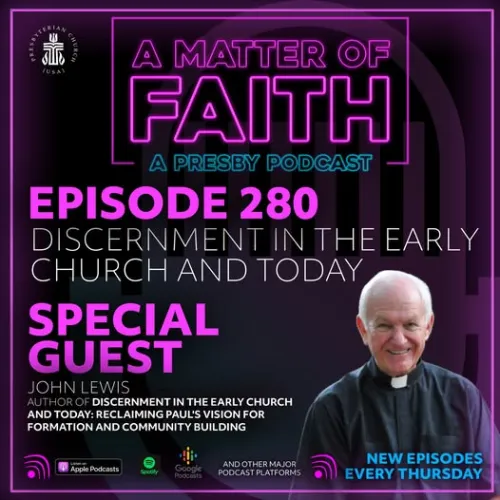
Last year, the Rev. Dr. John Lewis published “Discernment in the Early Church and Today: Reclaiming God’s Vision for Formation and Community Building.” Lewis, who founded St. Benedict’s Workshop and is the theologian in residence for the Iona Collaborative at Seminary of the Southwest, stopped by the “A Matter of Faith: A Presby Podcast” virtual studios recently to discuss the early church with podcast hosts Simon Doong and the Rev. Lee Catoe. Listen to their 61-minute conversation here.
Worship in those early churches wasn’t anything modern worshipers would recognize, Lewis said. “The idea that every person needed to be formed in the image of Jesus was the centerpiece of what worship in the early church was about,” he said. Many New Testament references indicate that “getting people to live Jesus as opposed to living the values and the norms of the culture was ongoing, challenging and conflicted work.”
When a problem comes up for a person of faith today, “we look at it, make a decision and move forward. The early church was trying to break down those barriers by having that conversation be a community practice,” Lewis said. “The patience required to have a deliberative conversation with people who are very different from you was crucial to this process of formation that we see.”
“Being able to discuss those in my small Christian community was what allowed me to become a person of humility and a person of practical wisdom,” he said. “It informed the community as one of accountability, where we both encouraged and built up others and, with humility, received critique from time to time of our practice.”
“That takes vulnerability and trust,” Catoe noted.
In those days, “how to live Jesus was highly contextual,” both in the life of the individual and the community. “Life in Corinth was very different from life in Ephesus or life in Philippi,” Lewis said. “Part of what’s happened over centuries is we try to move toward unification, which in some cases means standardization as opposed to what does it look life for me to live my life here in San Antonio, Texas, in a particular Episcopal Church setting? That differs even from some of the churches down the street.”
We have to accept those differences, he said, because “discernment is about what does Jesus look like and how and I living and how is God manifesting fruit from the way I live to build up my community and the lives of the people I serve.”

In our current political and social climate, “it feels like discernment and ongoing learning is not possible,” Doong said.
Coming to a place of knowledge and truth was far from what people in the early church thought being a Christian was about, Lewis replied. They’d descended from centuries of having the Torah, the Jewish law, “to help them shape how they lived holiness in daily life.”
They soon, of course, focused “on the person of Jesus for how to live and how to do things that are pleasing to God. In that way, we become conduits in the world for this life-giving power of God to encourage and build up other people. … That’s how they saw their life of living Jesus. Week in and week out, they would come together and share with one another actions and consequences, some that bore wonderful fruit in the lives of other people and some that clearly became problematic.”
“By sharing both the fruits and the challenges over time, the group was shaped to come to a practical wisdom, a wisdom of understanding how to live Jesus that brought life to the world,” Lewis said. “Today, when people can’t even talk to each other, we’re not sharing. We’re not deliberating on the practices of living Jesus that bear fruit, and some of the actions that we take trying to live Jesus create chaos.”
“There’s no discernment about that, because we don’t talk to people, except the people we agree with on fundamental issues,” Lewis said.
In Paul’s community, “while I’m looking to discern how Jesus comes alive in me, the point of Jesus coming alive in me is so I can reach out in love by giving myself to other people in particular ways,” Lewis said. “You become a conduit for that life-giving power of God that builds up the body of Christ and builds up your community.”
When I gather with my siblings to worship, “yes, I’m looking for their help and input in living faithfully in my ordinary life,” he said. “But I’m also coming to hear what is the common good for the well-being of my community and how I can use my gifts and put them in the service of the common good.” Community “has to be understood as not everyone who looks and thinks like me, but in fact is a diverse community because every single person is made in the image and likeness of God. We have to learn how to serve different people’s needs as part of our Christlike identity.”
“The disciples were not the best at doing that,” Catoe noted. “There are so many stories of them getting it wrong and having to discern and come back and be held vulnerable and accountable. I think that is the beauty of our faith: it is rooted in humanity. … We are called to learn about our context, which takes a lot of work.”
For Lewis, “when I think I am certain about universal truth for any Christian perspective, then I become the oppressor. That’s a lot of what’s happening surrounding us in our culture. … That would be so far from the early church that I don’t think [early church-goers] would recognize what’s happening.”
As a biblical scholar, Lewis said he marvels “every single day” at the ability of early church leaders “to write and communicate and persuade, not only to the first-century world but to our world as well.”
“Brilliant people were speaking to brilliant people who were then saying, ‘how do we make God and God’s power accessible to everyone?’ They were masters at it,” Lewis said, “way beyond what many of us can accomplish today.”
Discernment “may have been messy, and it took more time to reach decisions,” he said, but it helped the early church make lasting decisions in ways voting can’t, because “voting always creates winners and losers,” Lewis noted. “Voting has taken on such importance in democracy, but in the church, voting can be a practice of alienation as much or more so than a practice of community-building.”
“Discernment is not about voting,” he said. “It’s about collaborative, deliberative, transformative conversation.”
New installments of “A Matter of Faith: A Presby Podcast” drop every Thursday. Listen to previous editions here.
You may freely reuse and distribute this article in its entirety for non-commercial purposes in any medium. Please include author attribution, photography credits, and a link to the original article. This work is licensed under a Creative Commons Attribution-NonCommercial-NoDeratives 4.0 International License.


