Through a Lens: Remembering the Philadelphia Eleven
On Oct. 22, the Presbyterian Historical Society will screen a documentary on the 11 women ordained in Philadelphia as Episcopal priests in July 1974
When Dame Sarah Mullally made news earlier this month as the first woman to be named Archbishop of Canterbury, her story recalled a handful of Episcopal women who were similarly in the headlines some 50 years ago.
The Presbyterian Historical Society gladly researched their story.
A warm Monday evening in late July. A sanctuary in North Philadelphia. The Rev. Paul M. Washington opens the doors of George W. South Memorial Church of the Advocate, welcoming in a bustling crowd of over 2,000 worshipers. What might seem like a normal day becomes an extraordinary moment in history as, on July 29, 1974, 11 women stand before bishops not their own and are ordained into the priesthood of the Episcopal Church — in defiance of church authority and centuries of tradition.
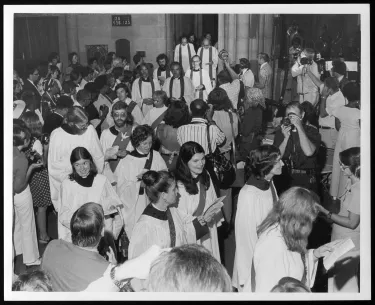
The women, who became the first female Episcopal priests that day, are known as the Philadelphia Eleven. Their brazenness and bravery in the face of pushback, discouragement, death threats and legal trials sparked a movement for gender equality in religious leadership across denominations.
And of course, the Religious News Service was on the scene to capture not only the ceremony itself, as seen in the image below, but also the ongoing discourse surrounding the event as folks across denominations argued either in support of or against the ordination of these 11 women.
On Wednesday, Oct. 22, from 6–8 p.m. Eastern Time, the Presbyterian Historical Society in Philadelphia will host a screening of the feature-length documentary film named after the women, created by Margo Guernsey and Nikki Bramley. A pop-up exhibit featuring archival images from the Religious News Service Photographs Collection will be on display that depict members of The Philadelphia Eleven conducting communion services and continuing to fight for the validation of their priesthoods. Although the event is free and open to the general public, registration is required.
The names of the Philadelphia Eleven are Merrill Bittner, Alla Bozarth-Campbell, Alison Cheek, Emily Hewitt, Carter Heyward, Suzanne Hiatt, Marie Moorefield, Jeannette Piccard, Betty Bone Schiess, Katrina Swanson and Nancy Wittig. Piccard was the eldest at age 79. She’d wanted to be a priest since she was 11 and was the first of the group to be ordained. The youngest of the group was Bozarth-Campbell, who was 29.
These women, and the many who supported them in their fight for ordination, had been waiting a while for the General Convention to formally welcome them into the Episcopal priesthood. The canons of the church did not forbid women from being priests in specific terms — rather, they require that a person seeking ordination receive the consent of their diocese's standing committee. Ten of the women did not have those consents. Only seven months before, the 11th woman had received the approval of her standing committee but was still refused ordination by her bishop.
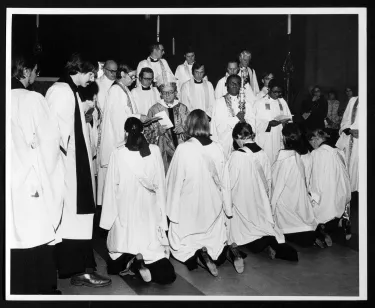
On Dec. 17, 1973, Heyward presented herself to Episcopal Bishop Paul Moore Jr. during a ceremony for the ordination of five male deacons at the Cathedral of St. John the Divine in New York. The bishop allowed Heyward, as well as the four other women who joined her in kneeling before him, to go through every part of the service — except for the laying on of hands, the final blessing required to be welcomed into the priesthood. According to the caption of the RNS image of this moment, Moore was a supporter of women in the priesthood but “said he could not perform the rite until the Episcopal Church changes its stand against women priests.”
But when would that be? The 1973 General Convention had gathered just months before, in early October, with the resolution for women's ordination failing to pass yet again, “although a majority of the Church's bishops supported the measure.” This was the second time the resolution had been rejected, the first instance being at the 1970 gathering of the Church’s governing body. Heyward was tired of waiting, as were many others. This group of women deacons, ready to take to the pulpit, decided to take matters into their own hands. When three retired bishops volunteered to ordain the women, claiming that “obedience to the Spirit” justified this action, the search began for a sanctuary in which the ceremony could take place. The Church of the Advocate at 1801 W. Diamond St. in North Philadelphia was the only congregation that was willing to host the trailblazing women.
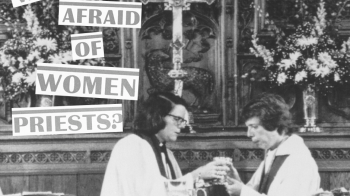
Months after the July 29 ceremony, the women priests were still a major point of religious and societal discourse. The December edition of Ms. magazine featured a smiling and waving Heyward with the correlating headline asking readers, “Who’s afraid of women priests?” The feature article was penned by Malcolm Boyd, an Episcopal priest and author, and included an interview with Heyward herself.
December readers of Ms. also enjoyed an exclusive interview with Dr. Charles Willie, previously the vice chairman of the House of Deputies of the Episcopal Church. Two weeks after the controversial ceremony in Philadelphia, an emergency meeting of the House of Bishops was held. These two houses, both populated with elected officials, make up the General Convention of the Church. At the meeting, it was decided that the women had been “irregularly ordained,” and the bishops requested that all ordination of women be put on hold until the next Convention gathering, which was set for 1976 — two years in the future. When Willie heard that his cohort at the House of Bishops had declared the women’s ordination invalid, he resigned from his position in the House of Deputies.
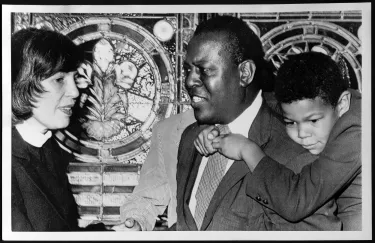
At right, Willie is seen speaking with Bone Schiess, one of the Philadelphia Eleven, in the moments after he'd announced his resignation. His son, James, clings to his father’s back. The press release that was published alongside this image mentions that Willie had been present at the controversial ceremony, having preached the sermon at the women's ordination. “To carry out the unjust laws of this Church, which do not affirm the rights of females to be priests and bishops, is to visit oppression upon women,” Willie is quoted to have said in a sermon at Grace Episcopal Church in Syracuse, New York.
Valid or invalid? Arguments abounded on both sides. Meanwhile, members of the Philadelphia Eleven took every opportunity that was offered them to celebrate the Eucharist — against orders from the bishops. In October at Riverside Church in New York, Cheek, Piccard and Heyward celebrated communion together at an ecumenical service in honor of Reformation Sunday, becoming “the first women in the U.S. Episcopal Church to publicly celebrate the Eucharist.”
In early December, Cheek and Heyward were invited to celebrate the Eucharist at Christ Episcopal Church in Oberlin, Ohio. These events didn't go unnoticed by the larger church, and in the summer of 1975 the parish rector, Father L. Peter Beebe, was brought to ecclesiastical trial by the diocese and convicted of disobeying a “godly admonition” in permitting the women to perform the ceremony. Beebe, despite all of this admonishing from the Church, continued to allow it, having the women priests host communion even as his trial went on.
Not all Episcopal Church institutions were against the ordination of the women, however, and in January 1975 the trustees of the Episcopal Divinity School in Cambridge, Massachusetts, offered faculty appointments with full priestly duties to Hiatt and Heyward. Both women began celebrating the Eucharist in the seminary chapel in March 1975.
In February 1975, advocates of women’s ordination to the priesthood and episcopate formed an organization called Women’s Ordination Now (WON) to support the women of the Philadelphia Eleven as well as the bishops who had ordained them. At the 1976 General Convention, WON worked to see that the previously “irregularly ordained” women were fully recognized as priests and allowed to function without any penalties. From this point onward, women were being ordained into the priesthood at a much quicker pace than before. The revisions set forth by the 1997 General Convention solidified the protection of women's ordination, in that the canons now prevent any diocese from denying access to ordination or refusing to license a clergy member based solely on the grounds of gender.
Six of the Philadelphia Eleven remain. Piccard died in 1981, at the age of 86. Hiatt and Swanson died in 2002 and 2005, respectively. In 2017, Bone Schiess died, and in 2019, Cheek died.
To learn more, register now to attend the free Oct. 22 documentary screening at the Presbyterian Historical Society, 425 Lombard St. in Philadelphia. Light refreshments will be available, and attendees will have ample time after the show to mingle and browse the display items.
You may freely reuse and distribute this article in its entirety for non-commercial purposes in any medium. Please include author attribution, photography credits, and a link to the original article. This work is licensed under a Creative Commons Attribution-NonCommercial-NoDeratives 4.0 International License.