Why women quit church and what might reverse that trend
Journalist Sarah Stankorb appears on ‘A Matter of Faith’ to discuss her new book
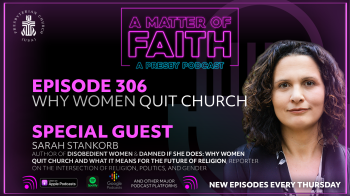
LOUISVILLE — In the U.S., an estimated 16 million women have left churches of all stripes over the past 10 years or so, author and journalist Sarah Stankorb said during her recent appearance on “A Matter of Faith: A Presby Podcast,” which can be heard here.
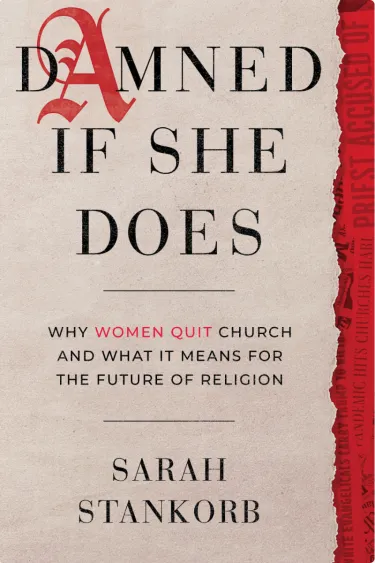
Podcast hosts the Rev. Lee Catoe and Simon Doong asked Stankorb, the author of a new book, “Damned If She Does: Why Women Quit Church and What It Means for the Future of Religion,” what in fact the implications of those departures might be and whether it’s possible for progressive faith communities “to do the hard work to recognize the harms women have experienced at the hands of the Church and restore their trust in church as an institution?”
Stankorb, who previously published “Disobedient Women,” said her reporting indicates many people have left their faith community saying they “didn’t like the way my church treated queer people or my queer kid, or they professed sexism and homophobia, and their church also didn’t want to talk about race and racism as a systemic issue.”
“When the place they’re going every Sunday no longer seemed to align with what Jesus wanted of them or what their church leaders told them was important, cognitive dissonance becomes too much,” Stankorb said. Some have quit and gone back to try again, “and something else came up, so they pulled back.”
“For many people, this is a heart-wrenching process,” Stankorb said.
She said she’s interviewed “enough survivors of abuse to understand what PTSD does and how it pulls you back into the moment, how the memories are so vivid.”
Doong said he appreciates the way Stankorb reported extensively on young women leaving the church. “In our media, we focus so much on men and young men especially joining conservative and evangelical movements,” Doong said. “It’s very male-oriented, and we don’t talk about women leaving the church. What does it mean to change that narrative?”
Stankorb noted that in spring, a handful of surveys “came out with numbers that showed a slowdown of people leaving the church.” The next day, Gallup came out with a poll showing a 14% uptick in young men’s interest in the church. “There was an explosion online,” she said. “There’s been this decades-long hope that if we can keep the men, we’ll keep everyone, but that hasn’t really played out.”
Rather than “an addition equation of young men returning to church, there’s a subtraction equation of young women leaving,” she said. “Evangelicals are good at getting splashy headlines, but they’re not the whole of America’s church. … What we miss is the vast middle where people with a variety of views sit side-by-side in the pews — people with a variety of interests in serving their community. That’s where a lot of this thinning out is happening.”
Thinking about the next generation, “We usually inherit our religion from our mothers,” she said. “We are starting to see the consequence of Millennial parents like me not raising their kids in the church.”
However, “there is always space for change,” Stankorb said. “Maybe some of the folks who were not treated as if their voices are valuable will find each other and make something new.”
“This is me, an agnostic talking, one who talks to a lot of religious people,” Stankorb said. “Following your faith has high moral demands on you. It’s hard,” as are maintaining qualities like pluralism and even democracy. “But I think that’s why we must pursue these things. Doing hard things is worthwhile.”
“We have to talk to each other. We have to do this. We have to confront the ugliness that’s being exposed and get up the next day to say, ‘It’s worth it to be neighbors.’”
Catoe lamented that faith “has been made to be fragile.”
“If you have a very fragile Christmas ornament, you have to hide it on the tree so someone doesn’t break it. For me, faith was never that way,” he said. “If our God were that fragile, that’s not faith to me.”
He said Stankorb’s most recent book is helpful “because it’s bringing to light the people who have been shunned by that fragility. They are the strongest ones. Many of us in marginalized communities are strong, and we crave a strong faith that can handle all that.”
Stankorb left the church by the time she was 20, she said. “I was the only person I knew who faith mattered so much to and then left. There’s often this profound loneliness,” Stankorb said. “I just hope people who have felt alone will know they are part of a reality for millions of other people. I hope folks from churches read this book and don’t just wave off these people as lost causes.”
“You can learn a lot,” she said, “and whether it means getting extra people into your pews or not, be instrumental in making someone whole. As unrealistic as it may seem, I’m hoping to get both these audiences together talking. That’s what I’d like to see.”
“We’ll be praying for that to happen,” Doong told her, “and we’re so grateful to you for this book that can spur some more of that conversation, and we’re so grateful to you, Sarah, for joining us today on the podcast.”
New episodes of “A Matter of Faith: A Presby Podcast” drop every Thursday. Listen to previous editions here.
You may freely reuse and distribute this article in its entirety for non-commercial purposes in any medium. Please include author attribution, photography credits, and a link to the original article. This work is licensed under a Creative Commons Attribution-NonCommercial-NoDeratives 4.0 International License.


