Young Adult Volunteers speak of their work and its impact — on themselves and on the communities they serve
The PILLARS recurring gift community receives its second up-close look at a cherished PC(USA) ministry
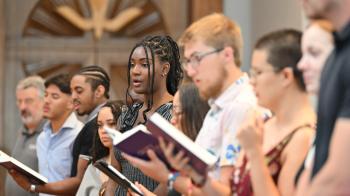
LOUISVILLE — The PILLARS recurring gift community held its second webinar Tuesday. This time the focus was on the ministry and inspiration of Young Adult Volunteers, past and present.
The PILLARS community supports the mission and ministry of the Presbyterian Church (U.S.A.) through the convenience of recurring giving. In August, the community’s first webinar focused on the work of the Presbyterian Hunger Program.

More than 2,000 young people have served as YAVs over the past 33 years, the Rev. Destini Hodges, YAV manager, told those in attendance via a recorded message. This year, 47 young adults are serving in nine sites across the country and around the world.
“Thank you for believing in young adults and this ministry,” Hodges told donors, and for “continuing to make possible” the YAV tagline: a year of service for a lifetime of change.
The Rev. Wilson Kennedy, Associate Director of Stewardship and Funds Development, posed questions for the gathered YAVs and YAV alums. The first asked them to name an experience that “stayed with you.”
“I was an English teacher at a women’s cooperative” at the U.S.-Mexico border, said Jay Stone, a member of last year’s YAV class. “I saw the dynamics of the border and a different perspective of how they walk with God every step of their lives.”
“I served in the late 1990s in Belfast, Northern Ireland. It was life-changing,” said the Rev. Jenn Williams-Wilson. So life-changing, in fact, that her son, Josh Wilson, is a current YAV serving in Seoul, South Korea. Wilson was also on the call.
Upon his arrival, “I went to a small church where everyone spoke only Korean. It was very immersive,” Wilson said. “I was invited with open arms. We ate together and drank tea and reflected on worship — even with the language barrier.”
Madeleine So currently works at the Presbyterian Ministry at the United Nations. “It’s been special tying faith and advocacy into one,” So said, speaking up for those considering attending the 71stCommission on the Status of Women in March 2027.
Steffan Johnson, a former YAV, now serves the program as a mission specialist. During his first year of service, “all my housemates were from Scotland,” Johnson said. “Within a week we were best pals, and to this day we still communicate.”
Wilson asked: Of the YAV program’s five core tenets — intentional Christian community, simple living, cross-cultural mission, leadership development through faith in action, and vocational discernment — which one do you carry with you today?
For Williams-Wilson, it was the first tenet. “I thought I would go change the world, but really the world changed me,” Williams-Wilson said. “It’s all about being in community and helping each other.”
“Mine definitely was simple living,” Stone said. “You learn to live within your means, and you’re focused on building that strong community.” These days, Stone enjoys creature comforts, including access to a dishwasher.
Wilson is working on vocational discernment through work at the Siloam International Center in Seoul, where the focus “is on placing people in jobs that fit their skills and passion. In that, I found my passion for serving others.”
Through work at the United Nations, So said, “I’ve realized I can’t help communities I want to help if I’m not a good neighbor. Getting to know my neighbors means learning about their challenges and problems.”
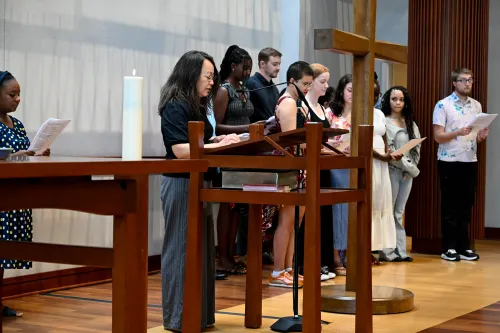
Kennedy asked YAV alums how their YAV year influenced the work they’re currently engaged in.
“In Belfast, my job was to work with Catholic and Protestant youth and have them meet each other. I have continued to work in youth ministry,” Williams-Wilson noted, as she works with underprivileged youth in a vocational center. “I didn’t know what I was going to do until I had that time in Belfast, using my skills to work with kids.”
“I was working with youth and young adults [in New Orleans]. With YAVs, I realized service was as simple as opening the door for someone,” Johnson said. “I now focus on recruiting YAVs, and sometimes I give them too much information,” Johnson said with a grin. “If you stand beside them and give them a little insight, that can be more impactful than you’ll ever know.”
Kennedy asked panelists to offer up a story about a person and their impact.
“My roommate here in Seoul — he’s the best,” said Wilson, adding he got sick on his second day there “and he took me to the hospital and spoke for me.” Ever since, “he’s been teaching me to cook and he’s learning English.”
“This city [of more than 10 million residents] is very dense, much more than I’m used to,” Wilson said. “I wouldn’t get through without a good friend like that to help support me.”
Without Spanish, the first three months serving at the U.S.-Mexico border was “a long journey,” Stone said. But the women at the cooperative where Stone served “showed me what it means to be a villager in a village. You have to show up with joy to serve others.”
The site supervisor in Belfast and his family “pulled me in,” Williams-Wilson said. “I missed my boyfriend back home, who is now my husband and Josh’s father.”
“We had a home, and that helped my parents” feel better about their daughter being in Northern Ireland, she said, adding her own gratitude for her son’s site supervisor.
Johnson said he’d just completed his graduate studies before joining his roommate, Dan, at the home in New Orleans where the YAVs stayed. “We would talk into the night, talking about everything,” Johnson said. “His sense of humor was amazing.”
Asked by Kennedy what it means to be a neighbor, So said that “what’s special about the UN is you can hear so many stories from so many perspectives. People are empowered to tell their own stories, and I’ve learned to listen — a lot.”
Stone and So became fast friends after meeting briefly for YAV orientation. “It’s about accompaniment,” Stone said, “being willing to show up and walk beside people.”
“It’s bittersweet that it’s only a year,” Johnson said. “You go in thinking, a community won’t welcome me in just 11 months. But if a community welcomes you, you’re part of it, and it can be a lifetime-long welcoming.”
“That radical welcoming is important,” Johnson noted. “Every [neighborhood] community has a different perspective of New Orleans.”
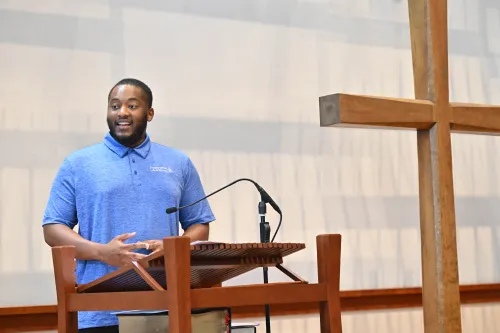
Johnson said the most insight he gained serving as a YAV was from the unhoused community. “They see the city, and they’ve seen a lot of changes,” Johnson said.
Williams-Wilson arrived in Belfast about 10 years after The Troubles, the violent struggle of people in Northern Ireland who many thought divided along religious and political lines. “It was always framed as religious troubles, but I soon became aware it was the haves and the have nots, poverty vs. wealth,” she said. “When you’re in a place of poverty, how do you find your identity? I felt honored the nights people would bring me to the pub to tell me their story.” The pub “was where the heartbeat of the community was,” she said.
Living along the U.S.-Mexico border “created dynamics you can’t understand unless you’re there,” Stone said. “Living on the Mexico side gave me a beautiful perspective of what the border is.” For the people living south of the border, “that ugly fence is not all they’re focused on. It’s a big issue, but it’s not their life.”
“Changing people’s perspective one thing at a time is a beautiful experience,” Stone said. “The best part of coming back has been educating others.”
Asked by Kennedy what they’d like the PILLARS community to know about YAV service, Wilson named the direct impact. “This is not a faceless program,” Wilson said. “There is a lot of meaning [derived] discussing what we’ve learned and experienced.”
“It’s the interpretation of your year, which is almost as important as the year itself,” Wilson’s mother added. “What those in the PILLARS community are doing is amazing, whether you’re in Korea, on the border, or in Belfast. You are there,” she told the donors.
“I want to voice how thankful I am and how special it is for people you don’t even know to be praying for you and giving,” So said. “I’m just so grateful.”
A YAV’s service does not end after their year of service, Johnson noted. “There is a large percentage of people who leave the YAV program and go to work for the church or in their community. Their contributions go way beyond their year of service,” Johnson said. “Whatever the [financial] contribution is, it goes further than what we can see, and I think contributors need to know that.”
“It’s a testament,” Wilson said, “that God is at work in the world.”
Toward the end of their hour together, Wilson proudly held up a weathered backpack.
“It’s the backpack my mom brought to Belfast,” Wilson said. “The thing is old, but it still works. I’m bringing it to work today. It’s been on three continents.”
“That is the original backpack,” Wilson’s mother confirmed. “Now it’s on its second YAV tour.”
You may freely reuse and distribute this article in its entirety for non-commercial purposes in any medium. Please include author attribution, photography credits, and a link to the original article. This work is licensed under a Creative Commons Attribution-NonCommercial-NoDeratives 4.0 International License.