Sustaining the weary
Recently returned from an ecumenical solidarity visit to Cuba, the Rev. Jihyun Oh has Holy Week hope for people in exile
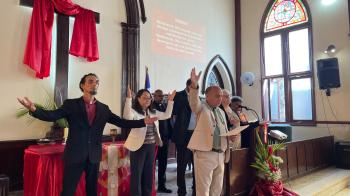
LOUISVILLE — Fresh off an ecumenical solidarity visit to Cuba, the Rev. Jihyun Oh used the prophetic call from Isaiah 50:4-9a as the scriptural basis for the homily she delivered online during Wednesday’s Chapel Service.

Oh, Stated Clerk of the General Assembly of the Presbyterian Church (U.S.A.) and Executive Director of Presbyterian Life & Witness, described the call on Isaiah’s life, “a call to sustain the weary, the weary who have been living in exile, the ones who have been separated from their homes,” including “the soil they know and the familiar sounds, perhaps the wind blowing through familiar trees and valleys,” and “the foods that provide comfort.”
Isaiah “is called to sustain the weary who are living in profound separation — physical, emotional and spiritual separation — even if they are with family and others they know,” Oh said. “What God gives the prophet for this call is a trained tongue so that the prophet knows how to sustain the weary.”
The word for “training” used here can refer to teaching about one’s tradition, Oh said. “The prophet is given language and knowledge and skills so the prophet knows how to sustain the weary with a grounding in tradition,” she said, “a grounding in their sense of self and to their connection to the broader people of God.”
We are told that the prophet listens every morning — “listens to the teachings, listens to the reminders, listens to the grounding that the prophet needs to be able to sustain the weary,” she said. That assurance has been welcome news for Oh in recent days as she journeyed to Cuba and back, observed March 31 as the Transgender Day of Visibility, and thought about her own family’s history and the history of Korea, including its occupation by Japan and imperialism by China, as well as its history of immigration.
“That has made me wonder about exile in a different way,” she said, “wondering about who is exiled or living in a sort of exile today.”
That can include Indigenous communities “who have long been exiled from the land of their ancestors and are living separated from many of their traditions,” Oh said. It can also include enslaved persons and diaspora communities descended from enslaved persons “who are also living in that sense of having been separated from home in a different sort of way.”
People living under occupation “have been forced into a sort of exile, even if they have been allowed to be in their homes,” she said. The group of exiles can also include people in the LGBTQIA+ community and especially transgender persons, “for whom forces are continuing to seek to separate them from their own selves in a sort of exile from self,” Oh said.
Those in exile certainly includes “communities and nations living in conditions of isolation and separation from the modern broader human community, like those in Cuba, through forces that they have zero control over, who are having to seek connection and relationship but are continually being pushed away from those connections,” she said.
During her time in Cuba, Oh was moved that members of the ecumenical community “remembered the legacy of the PC(USA) from the days of apartheid in South Africa.”
“They lifted up the story of how those within the denomination refused to believe the stories that were coming out and being told to them,” she said. “They said, ‘we will go see for ourselves,’ and went to be with those who were weary and were living in the state of being separated within their communities or their own homes.”
Upon their return to the United States, they “faced so much pushback, so much spitting and insults — so many things from communities who did not want to believe or hear the words of the denomination that stood with those in South Africa,” Oh said. “It reminded me of all those traditions — not just the ones written in the Bible, but all of them — the work of the saints that has been continuing ever since.” That includes the work of “the saints of today, who are telling us something new about how God is working in the world.”
Our cloud of witnesses goes “back and back and back” to connect us to Jesus, “who this week we remember continued in spite of the spitting and the insults and the suffering to walk toward that call that was placed upon his life,” she said. “We remember that all of that — all those challenges — are not the last word, and that the profound separation Jesus experienced as a human on this Earth, separated even from God’s self, is not the last word.”
The church in Cuba “was so grateful for the ecumenical community to be present with them to start Holy Week off on Palm Sunday as we worshiped together,” Oh said. As she’s reflected on the trip, “I wonder whether part of that gladness was about remembering together that suffering, that sense of exile, that sense of separation. There is a promise that we live into at this time — particularly this week — when we remember that the sense of exile is not the last word, that there is hope for connection and reconciliation and wholeness of being restored to one’s self, to one’s community, to one’s tradition, to one’s broader human community, and with God.”
She wondered: what are the trainings and the teachings we receive each morning, such as Isaiah did? Who tells us “not exactly the words to say, but how we might sustain ourselves and those we are in community with, so that whenever we get weary, whenever we lose heart, we remember that there is hope beyond the horizon.”
“May that be an encouragement for you and for me this week,” Oh said.
You may freely reuse and distribute this article in its entirety for non-commercial purposes in any medium. Please include author attribution, photography credits, and a link to the original article. This work is licensed under a Creative Commons Attribution-NonCommercial-NoDeratives 4.0 International License.


