Author recounts his family’s history of White House service
John Wrory Ficklin’s grandfather was born enslaved. His father was the White House maître d’, and he himself was a longtime staffer for the National Security Council

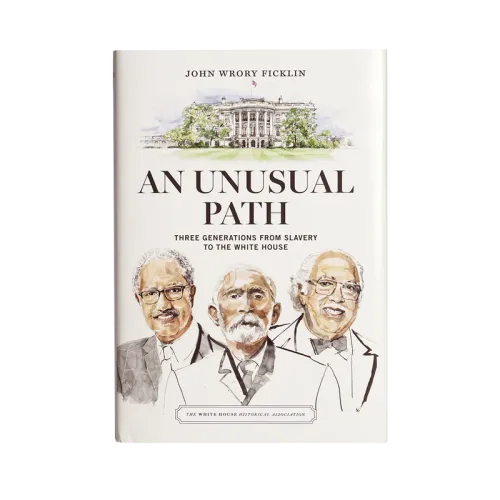
LOUISVILLE — John Wrory Ficklin stopped by the “A Matter of Faith: A Presby Podcast” virtual studios recently to talk about his new book, “An Unsusal Path: Three Generations from Slavery to the White House.”
Ficklin’s grandfather, James Strother Ficklin, was born enslaved. After the Civil War, he purchased 37 acres of land in Virginia, where he farmed and raised 10 children including the author’s father, John Woodson Ficklin, who would put in 37 years of service in the White House and rise to maître d’ hotel. His son would serve seven presidents as a staff member of the National Security Council.
Ficklin’s son is a close friend of Simon Doong, who along with the Rev. Lee Catoe host “A Matter of Faith,” a weekly podcast. Listen to their 45-minute conversation with Ficklin here.
Catoe asked Ficklin what role faith played in his family’s story and his own White House experience. Ficklin said it’s a question he struggled with until his pastor, the Rev. Dr. Dededrick O. Rivers, wrote a blurb in support of Ficklin’s book.
“The Ficklin family story is a living testament to God’s faithfulness across generations,” Rivers wrote. “This book is more than history. It is an inspiration and a beacon of hope for all who believe in the power of God’s covenant blessings.”
Ficklin’s grandfather never knew who is father was. “It’s assumed his father was a white man,” Ficklin told the hosts. He was conscripted into the Confederate Army, where he served as a waterboy. After the war, he purchased land in Rappahannock County, Virginia, and helped raise his 10 children.
“My dad told stories of growing up in a very poor household. He said he wore patched-up clothing and worn-out shoes, or no shoes,” Ficklin said. His father was a faithful church-goer who was asked several times to serve as a trustee, declining every invitation because he didn’t have the time.
“He passed that responsibility on to me. I’m currently a trustee,” Ficklin said. One of his proudest accomplishments was helping to build and install a streaming service for the church a month before the Covid pandemic forced an end to in-person worship. “We spent a lot of money that some congregation members were very upset about,” he said. “What that streaming service did was allow the word of the Lord outside of those four walls.”
“The work of the Lord has been instrumental in all three of our lives,” he said of his family. “It’s covered in the book.”
At age 7, Ficklin was playing catch with his best friend the day that President John F. Kennedy was assassinated. His friend’s mother told him he ought to go home, and when he did, his mother was in tears in front of the television. She asked him to sit with her, which he did. “For those next few days, my dad didn’t come home,” Ficklin said. “I was concerned about that because I found my dad’s snoring to be quite comforting.”
Seeing his father on television during Kennedy’s funeral “was something that to be honest, I didn’t understand until years later,” he said.
Despite Eugene Allen being named in Lee Daniels’ film “The Butler” as the first White House service staff to attend a state dinner, that honor rightfully goes to Ficklin’s father, he said. Allen “was a longtime assistant to my dad,” Ficklin said. “I couldn’t think of a nicer person to be portrayed in the movie. He danced at our wedding.”
Years later, Ficklin and his wife “were honored to attend a state dinner” hosted by President Barack Obama and his wife, Michelle. He called it “one of the most memorable events of my career,” made even more memorable by watching “the elegance and the precision of the service that [White House staff] provided.”
His father had attended a state dinner during the Reagan administration, to which he wore his personal tuxedo and not his work tuxedo. When it was the younger Ficklin’s turn to attend a state dinner, he proudly wore his father’s tuxedo jacket.
Ficklin’s Uncle Charles, his father’s oldest brother, was the first Ficklin to work in the White House, where he served as a butler beginning in 1939. He recruited Ficklin’s father to work there, first as a pantryman — “a glorified dishwasher,” Ficklin said, and a job he would later have — before serving in the U.S. Army during World War II, then returning to the White House as a butler.
Ficklin said his school bus used to pass by the White House on the way home. Sometimes he’d get off the bus early, head to his father’s office, and knock off a school paper on an office typewriter “because we didn’t have one at home,” he said.

“You’ve worked with a lot of administrations over time,” Doong noted. “I know when administrations change, you have to build trust.”
Ficklin said he recalled giving his father grief for working in the Nixon White House. “Do you like having a roof over your head and food on the table? This is my job,” his father told him and his brother.
The president holds the highest elected office in the land, “and I respect the presidency. I am going to do my job the best I can,” Ficklin said. “I wasn’t concerned whether it was a Republican or a Democrat.” The person working in the Oval Office “deserved the best service that we could provide, and that’s what I did.”
By the time he completed his career, Ficklin had served longer than any other member of the NSC staff. “There is something to be said about that in times such as this,” Catoe told him. “Working together is a good thing.”
“It is. It’s American history. It’s our history,” Ficklin said. “America is a great country, and I hope and pray it remains that.”
Then he decided to inject a little levity into the conversation. During the 1980s, his father publicly revealed his sought-after eggnog recipe. A Washington Post reporter acknowledged it was “strong enough to turn a Democrat into a Republican and a Republican into a Democrat.”
The presidents Ficklin served “were all good people,” he said. George W. Bush “would walk into a room and he’d immediately be your best friend.” Bill Clinton “could make you laugh in a moment, and these are very serious people.” Ficklin first met Barack Obama when the future president was a classmate of Ficklin’s wife at Harvard Law School. “He was a good, fun-loving person then,” Ficklin said. “As president, he was a serios man, but he had a lighter side just like the rest of us.”
Those on the NSC staff worked long hours, especially after the 9/11 attacks, but “the competition for advancement didn’t really exist in the cutthroat way that it can in other government agencies or in the private sector,” he said. “Our goal was to give the best advice and assistance to the president of the United States that we could. We did that by working together and trying to reduce that competition to get my idea used as opposed to your idea. It served the president best.”
Asked about how closely “The West Wing” resembled real-life White House work, Ficklin called the series “historical fiction, but there’s some fact in fiction sometimes.”
However the listeners of “A Matter of Faith” serve their church or community or nation, Ficklin wants them to feel blessed by their service.
“It’s a blessing to serve,” he said. “My family has benefited from service, and our country has benefited from our service.”
He said he and other family members found joy from “the satisfaction of getting the work done.” One memorable event was the largest and most elaborate dinner in White House history, which Nixon and his wife, Pat, held on the South Lawn on May 24, 1973, to honor more than 590 returned prisoners of war from the Vietnam War.
“They got additional butlers to serve and ended up using canoes to ice champagne and cocktails,” Ficklin said. “They worked a very long time to make that successful, and they celebrated after it was done.”
Once the hosts had thanked Ficklin for his time, Catoe said it’s not often he and Doong “ask people who serve in government about their faith and what it means to them.”
“I think we should do that more,” he said.
New episodes of “A Matter of Faith: A Presby Podcast” drop every Thursday. Listen to previous editions here.
You may freely reuse and distribute this article in its entirety for non-commercial purposes in any medium. Please include author attribution, photography credits, and a link to the original article. This work is licensed under a Creative Commons Attribution-NonCommercial-NoDeratives 4.0 International License.


