
Presbyterian peace leader: Gun violence prevention is our lane
Third annual Atwood Institute for Congregational Courage reasserts the church’s role in gun-violence prevention
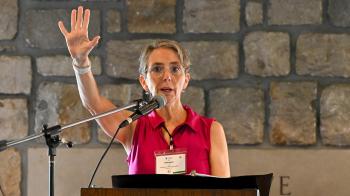
PARKVILLE, Missouri — As the Presbyterian Peace Fellowship’s Minister for Gun Violence Prevention, the Rev. Margery Rossi has heard the words many times: “Stay in your lane.”
The dismissive reply to doctors, safety advocates, and people of faith is a way for gun rights advocates to brush their messages aside, Rossi said to people attending the third annual James Atwood Institute for Congregational Courage last week at the Heartland Retreat Center outside Kansas City.
“’You don't have anything to say about this.’ ‘This is political.’ ‘This is our territory.’ ‘Stay in your lane,’” Rossi recalled being told.
“Well, this is our place. We have some things to say.”
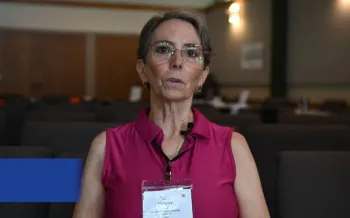
Rossi was wading into a discussion about how Presbyterian polity is a key to advocating for stronger gun violence prevention measures and crystalizing a message that had been delivered from a variety of perspectives over the previous two days of the annual gathering named in honor of late pioneering Presbyterian gun violence prevention advocate the Rev. Jim Atwood.
“Gun violence is a spiritual issue,” Rossi said in an interview. “It is a spiritual crisis in this country. There are moral issues here. The church has something to say about moral issues. There’s death. There’s grief. There’s trauma. This is a pastoral issue. This is a theological issue. Do we value life? Do we see one another as children of God, as beloved? These are all ours.”
Opening night keynote speaker, the Rev. Dr. Jer Swigart pointed out the opposition often comes from Christians who have a very different perspective on gun violence.
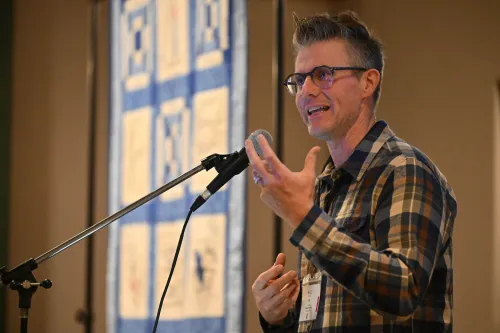
“We've got a gun problem,” said Swigart, co-founder of Global Immersion, a peacemaking training organization. “But that gun problem is rooted in an insidious, malformed, illegitimate theology that endorses the elimination of our enemies rather than our love for them.”
Swigart went through a litany of gun violence incidents he has been proximate to, from a friend who was shot to death by another friend playing with a gun when he was 13 years old to his own children’s experience with lockdowns and students acting out at school. He said others in the room could probably tell similar stories.
In a few of Swigart’s examples, faith was intertwined with the use of guns, including a prominent faith leader in a community he lived in showing Swigart his collection of AR-15s.
That stood in stark contrast to the example of Jesus Christ, Swigart said, who told his followers to love their enemies and modeled peaceful acts like de-escalation, such as the story of Jesus confronting the mob that wanted to stone a woman accused of adultery in John 8:1-11.
“He establishes his authority with self-control,” Swigart said, recounting how Jesus disarmed the mob by saying, "Let anyone among you who is without sin be the first to throw a stone at her. "He slowed everything down," Swigart said, "which is insightful for us as leaders.”
“There is a rich theology that stands behind the work that we’re doing," Swigart said. "The work that you’re doing isn’t an add-on to the Christian faith; it’s the essence of it.”
In the three days of the Institute, Swigart and others talked about numerous ways to approach gun violence prevention in the United States, including personal engagement, care after incidents of gun violence, and advocacy with local, state, and federal leaders. A consistent theme was seeing the Imago Dei, the image of God, in each person in all circumstances, from victims of gun violence and oppression to people who have committed acts of violence to the person who disagrees with you on an issue.
The discussion of gun violence can be hyper polarized, numerous leaders at the institute noted, and that is where faith leaders can help find common ground in partisan political discussions. Numerous times they noted the movement is anti-gun violence, not anti-gun, and includes gun owners and users who advocate for safety.
Dr. Andrew Peterson, a representative for peacemaking focused on gun violence in the PC(USA)’s Office of Public Witness in Washington, participated in the Institute, including introducing a new resource for clergy working with Extreme Risk Protection Orders developed in conjunction with the Johns Hopkins Center for Gun Violence Solutions.
Learn more about an upcoming webinar introducing ERPOs in Practice: A Guide for Clergy
“One of the things that I think is really important about the kind of faith-based advocacy that I do, and about the partners that I have doing that kind of work in D.C., is that we bring something other than the kind of hyper-partisan taglines that can help really break through some of that discourse in D.C. to bring to bear a majority of the way that Americans think about gun policy and the kind of gun policies that they would like to see at the federal level,” Peterson said. “So, I am hopeful about the church's role in that kind of work.”
And that, Rossi said, is an essential element of addressing gun violence: hope. She pointed to “Gun Violence, Gospel Values: Mobilizing in Response to God’s Call,” a policy passed at the 219th General Assembly of the PC(USA) in 2010.
Rossi told institute participants that policy, which is generated from churches and mid councils across the country, is essential to allow Peterson and others speaking on behalf of the church, including the Stated Clerk of the General Assembly and Executive Director of Presbyterian Life & Witness, the Rev. Jihyun Oh, to make statements.
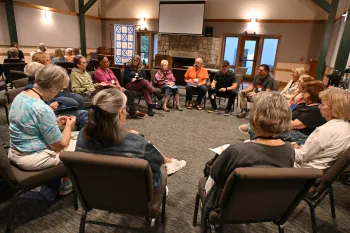
“It is important for our policy to give Andrew what he needs to speak on behalf of the church,” Rossi said to the institute, noting one of the Peace Fellowship’s roles is to find holes that need to be filled in policy and guide those overtures to the General Assembly.
In “Gun Violence, Gospel Values” she noted an enumeration of five elements necessary for successful social movements, the first four being a clear grievance, moral arguments, sparking events, and human and financial resources.
“For years and years and years, gun violence has had all of those things, and we still haven't been able to move,” Rossi said. “And that is because what has been missing is the final condition, and the final condition that must be present in order for all the rest of these to matter is what social scientists call a sense of viability, and what people of faith call hope. And I believe strongly that that is the role of the church. That is our lane.”
Watch for more reporting from the 2026 Atwood Institute for Congregational Courage next week in Presbyterian News Service.
You may freely reuse and distribute this article in its entirety for non-commercial purposes in any medium. Please include author attribution, photography credits, and a link to the original article. This work is licensed under a Creative Commons Attribution-NonCommercial-NoDeratives 4.0 International License.


