The Bishop Richard Allen Way
PHS representatives attended an historic street renaming ceremony in Philadelphia on Oct. 7
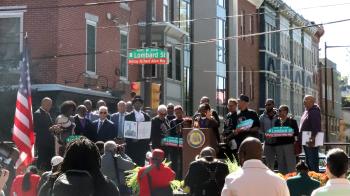
On October 7, 2026, representatives of the Presbyterian Historical Society attended an historic event. The City of Philadelphia formally renamed the corner of Sixth and Lombard for Bishop Richard Allen – one of the founders of the African Methodist Episcopal denomination and leader of Mother Bethel, the first organized, autonomous African American church in the nation.
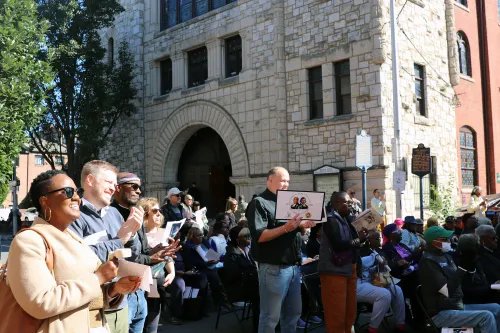
The event began with coffee and community on the first floor of Historic St. George’s Church in Philadelphia’s Old City, after which attendees moved into the sanctuary for words from pastors and bishops of the United Methodist Church and the A.M.E. church. Dr. Rev. William Wilson, Sr., pastor of St. George’s, shared the story of the historic walk-out that led to the founding of the A.M.E denomination.
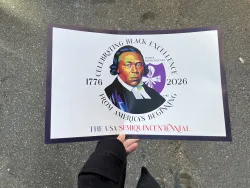
In 1786, Allen began leading services at St. George’s, catering to the growing body of African American worshippers. The white leaders of the church would only allow him to preach at 5:30 a.m. As the number of Black worshippers grew, the white leaders at St. George’s instituted a forced segregated seating policy. Church leaders accosted Allen and others for not abiding by the policy, leading to the walk-out that resulted in Allen and his fellow pastor, Absalom Jones, founding their own church and denomination. Today, Mother Bethel sits at what is now Bishop Richard Allen Way. In addition to its other claims to fame, it is the oldest property continually owned by African Americans in the country.
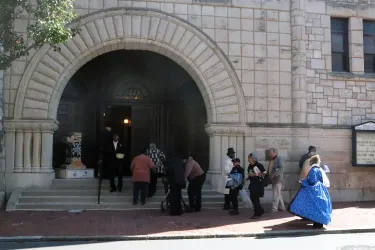
After talks in the sanctuary, attendees walked a mile from St. George’s to Mother Bethel for the official renaming ceremony.
"I was moved by the joy and conviction I saw," said PHS Outreach Specialist Olivia Cacchione, who attended the morning activities. "Seeing these two congregations unite for this historic event in the face of their shared history was beautiful."
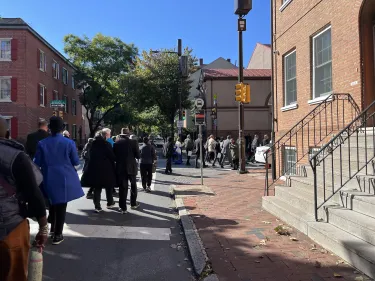
It was also a beautiful day for a walk. The city closed the roads for the trek between the two churches, and a celebratory procession strolled down Fourth Street.
The outdoor ceremony was standing room only. The first rows of chairs were reserved for special guests, most notably a group of Richard Allen’s living family members, the seventh generation of the Allen family. The rows behind them were marked with signs reading “Reserved for Clergy.”
The ceremony commenced at 11 a.m. and was followed with a shared meal inside the sanctuary of Mother Bethel. The crowd listened, enraptured and attentive despite the bright shining sun, as various city officials, councilmembers, and other distinguished guests offered remarks and greetings from the stage. Behind them, just above their heads, the new sign stood waiting to be revealed, covered as it was with dark cloth.
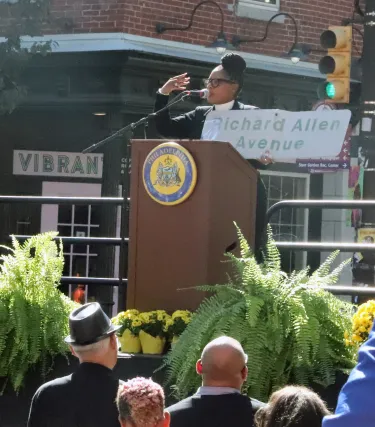
The Reverend Carolyn Cavaness, Mother Bethel’s 53rd pastor and first female to serve in its pulpit, regaled the crowd with the story of the sign. It all began when she noticed a bent grey sign hanging high in the trees at the crossroads of 6th and Lombard, adjacent to her church building. Rev. Cavaness brought the sign to the attention of Philadelphia’s City Council, and together they discovered that the sign, which read "Richard Allen Way," had been put up for a commemorative event during the bicentennial year of 1976.
"Thank God for a little research," Rev. Cavaness told the crowd. "What it was…was that from February 22 to 27 of 1976…the connectional church was coming to Philadelphia…We found the actual City Council Resolution…passed on February 19, 1976, where it stated that between Vine and Washington Avenue, 6th Street would be deemed temporarily as Richard Allen Avenue. It was temporary! But thank you to whoever left this sign on the corner, which sparked this moment, which brings us together right now…"
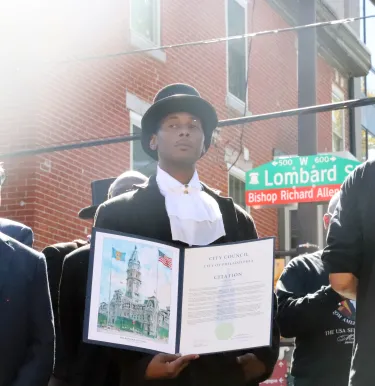
There were a handful of people dressed in 18th century historic costume, including three young women who took to the stage at the beginning of the ceremony to offer the opening welcome. Mr. Marques Daughtry performed the part of Bishop Richard Allen, the man of the hour. He thanked the crowd and introduced Mrs. Yvonne Studevan to the stage to share greetings from the Allen family.
"It is with heartfelt gratitude and profound pride that we, the descendants of Richard Allen, are here today in the city of brotherly love, as a street is renamed in honor of our venerable ancestor," Mrs. Studevan said. She is the great-great-great-great granddaughter of Bishop Richard and his second wife Sarah Allen. "To rename a street after an individual is a powerful public honor. It permanently places that person's name and legacy into the physical and cultural landscape of a community. Today, Philadelphia pays tribute to a godly man, a courageous man, a generous man, and a servant of god and humanity."
At the conclusion of Mrs. Studevan's message, members of Mother Bethel and city officials alike gathered beneath the street sign. A signal was sent; a rope was tugged; the veil fell from the sign, and all cheered for the bright red stripe declaring the street as Bishop Richard Allen Way.
Bishop Cynthia Moore-Koikoi, Presiding Prelate of the Eastern Pennsylvania and Greater New Jersey Episcopal Area, spoke the closing prayer and offered benediction over the gathered crowd. This concluded the ceremony.
Some audience members headed up the steps of Mother Bethel to enjoy refreshments and conversation in the sanctuary. Others readied themselves for their return travels, as many in the crowd had come from afar to convene at the corner of 6th and Lombard and watch history being made.
Learn more about Bishop Richard Allen at https://motherbethel.org/, or visit their Facebook page to watch recorded videos of the event, which the congregation had live-streamed.
You may freely reuse and distribute this article in its entirety for non-commercial purposes in any medium. Please include author attribution, photography credits, and a link to the original article. This work is licensed under a Creative Commons Attribution-NonCommercial-NoDeratives 4.0 International License.
