When the two men interrupted the secret proceedings in the Pennsylvania State House on July 1, 1776, they made an impression on the 60 men contemplating treason.
They were unusually big men, both six feet tall or better, the older man on the jowly side and the younger man slimmer. No one had expected these two. They were, in fact, late, and should have arrived on June 28th, when Francis Hopkinson presented the credentials of the handpicked New Jersey delegation. Hopkinson said he could do nothing without them, but now, here they were, muddy and dripping wet from summer thunderstorms that lashed the State House and had plague them on their ride south from Princeton to Philadelphia. They were intruding on the pivotal moment in the fight to decide whether to secede from the British Empire.
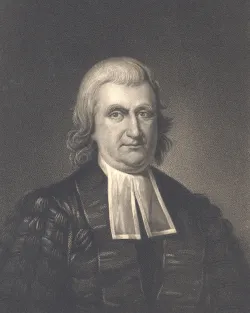
It wasn’t just their size but their stature. The Rev. John Witherspoon, 53, the pastor of First Presbyterian Church of Princeton and the President of the College of New Jersey, was known not only across the colonies, but globally. The man next to him was his neighbor and congregant, New Jersey Supreme Court Justice Richard Stockton, 46. They had been chosen as delegates expressly for their hawkishly pro-independence views.
Between the storm and the flickering candlelight, an expert screenwriter couldn’t have scripted a better scene. Late on the afternoon of July 1, independence was no sure thing. The Continental Congress was split into two factions. A disgusted George Washington said the first was “still feeding themselves upon the dainty food of reconciliation.” The second, led by John and Sam Adams, wanted to split from Great Britain.
Almost a month before, Virginia’s Richard Henry Lee had moved to declare independence, but the Adams-Lee faction didn’t have enough support to carry the day. Congress decided to delay the vote on independence until July 1st.
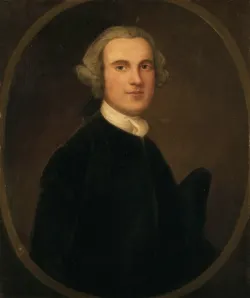
That day had arrived and the reconcilers’ leader, Pennsylvania’s John Dickinson, aristocratic, tall, sickly, and prosperous, a lawyer raised in the Quaker tradition, had spent the morning begging his 60-odd fellow delegates to give reconciliation one more chance. Speaking from scrawled notes, he warned, “To escape the protection of Great Britain by declaring independence, unprepared as we are, would be as to brave a storm in a skiff made of paper."
.jpg)
Dickinson was persuasive. John Adams knew he had to respond or the moment would be lost. So, the pudgy, 42-year-old Massachusetts lawyer, a man even he knew was considered “obnoxious”—rose to his feet and began to argue the case for independence.
Just as he was winding up, the new delegates from New Jersey made their rather startling appearance, disrupting the proceedings. Told that Adams had been arguing for independence, Stockton and Witherspoon “expressed a great desire to hear the Arguments.”
Adams said nothing, at first. “All was Silence,” he recalled. “No one would speak. All Eyes were turned upon me.” The delegates looked expectantly at the prickly, peevish Adams, who later told Mercy Otis Warren he refused even though “Judge Stockton was most particularly importunate.” For the moment, Adams’ petulance and ego got the better of his political judgment.
The silence lengthened. Adams glared. Candles flickered in the stormy late afternoon gloom. Tensions grew, and everyone seemed helpless to act. More than Adams’ pride hung in the balance: independence, itself, did.
Then South Carolina’s Edward Rutledge stood and crossed the room to Adams. Rutledge, a Dickinson ally, was one of those who found Adams obnoxious and distasteful. Adams held an equally dim view of Rutledge, believing him to be "a little unsteady, and injudicious." Despite their mutual distrust they knew the postponed day of reckoning had arrived. Something must be done.
As the men stood there, sweat rolling down their cheeks, Rutledge said to Adams, laughing, “Nobody will speak but you, upon this Subject. You have all the Topicks [sic] so ready, that you must satisfy the Gentlemen from New Jersey.” It broke the ice.
Jollied, Adams said the request “had so much the Air of exhibiting like an Actor or Gladiator for the Entertainment of the Audience, that I was ashamed to repeat what I had said twenty times before, and I thought nothing new could be advanced by me.” He began again till at length “the Jersey Gentlemen said they were fully satisfied.”
Debate ensued. Witherspoon thundered in his Scottish brogue that the colonies were “not only ripe for [independence] they were in danger of being rotten for the want of it.” For the first time, with Witherspoon and Stockton present, the New Jersey delegation was for independence.
Congress took a straw vote. New Jersey voted Yes. Pennsylvania and South Carolina voted No, and New York and Delaware passed. Sensing New Jersey’s vote had changed minds, Rutledge asked to delay a formal vote until July 2nd. Stockton and Witherspoon had put New Jersey’s marker on the table. Would the others follow?
New Hampshire started the vote on July 2nd by voting Yes. New Jersey voted sixth, after New York abstained again – but New York’s delegates said they were now personally in favor of independence. New Jersey was a Yes. All eyes were now on the next colony, Pennsylvania.
Reading the writing on the wall, Dickinson and his ally, Robert Morris, had stayed home. Pennsylvania’s Benjamin Franklin, James Wilson, and John Morton unanimously reversed Pennsylvania to a Yes.
Reinforced by Caesar Rodney, Delaware flipped. Maryland, Virginia, and North Carolina voted Yes.
South Carolina was up next. What would it do?
Rutledge voted Yes, making Georgia’s Yes anti-climactic. At last, Congress had done what it could not and would not do until the two Presbyterian gentlemen from New Jersey walked into the flickering candlelight of history.
Mark S. Herr is the son, grandson, and great grandson of preachers and a ruling elder at Nassau Presbyterian Church in Princeton, NJ. He is a lawyer by training and a historian by passion. He is currently writing “First Church of the Revolution: How a Small Church in a Tiny Village and a Fractious Demonization drove New Jersey to Independence.”
You may freely reuse and distribute this article in its entirety for non-commercial purposes in any medium. Please include author attribution, photography credits, and a link to the original article. This work is licensed under a Creative Commons Attribution-NonCommercial-NoDeratives 4.0 International License.