The Presbyterian Historical Society (PHS) staff have recently processed the Cook College and Theological School (CCTS) Records (RG 556). The PHS Reparative Description Committee's previous work on the Tucson Indian Training School Records (RG 103) informed the selection of the CCTS records collection as a high priority archival processing project. The Cook Native American Ministries Foundation deposited the collection at PHS in 2010, and the processed collection totals 110 cubic feet (144 boxes). Processing this collection aligns with the work of the Native American Coordinating Council and with former PC(USA) Stated Clerk Reverend Dr. J. Herbert Nelson, II's Call to Action "urging mid councils and congregations to take steps to recognize failure by the U.S. to uphold the rights, traditions and livelihood of Native Americans, including failures by Protestant denominations." Additionally, RG 556 complements the Cecil Corbett Papers (RG 535), another Indigenous collection processed at PHS in 2022.
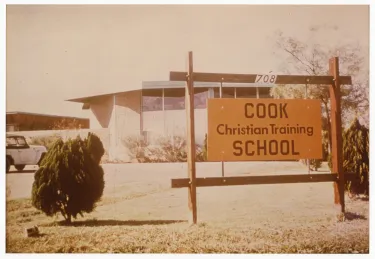
CCTS and its predecessor and successor entities trace their beginnings to the missionary activities of Rev. Charles Henry Cook. In 1855, Karl (or Carl) H. Koch immigrated to the United States from Germany. He enlisted in the United States Army in Rochester, New York in January 1864 and was mustered in as a corporal (Battery L, 1st Regiment, New York Light Artillery) under the name Charles H. Koch (he had previously enlisted in either Company C or H of the 3rd Regiment, United States Cavalry). He participated in the Civil War and was mustered out in Elmira, New York in June 1865. After the Civil War, he became an ordained elder in the Methodist Episcopal Church and settled in Chicago, Illinois. He left for the Territory of Arizona in September 1870 and arrived in Sacaton in December. He was hired by Captain F. E. Grossman (of the Gila River (Pima) Agency) as a government teacher for Pima (Akimel Oʼodham) children in January 1871. Cook began studying the Pima (O'odham) language and preaching in it. He supported the Pima in their reclamation and restoration of their water rights after the United States federal government's land policies infringed upon them. Cook became an ordained Presbyterian minister and Presbyterian Church in the U.S.A. (PCUSA) Board of Home Missions (BHM) missionary in 1881 on the recommendation of fellow Presbyterian minister/missionary Sheldon Jackson. Cook organized the first Presbyterian church at Sacaton in 1889. In 1890, he founded a Christian training school in his home on the Gila River Indian Reservation, specifically to convert and culturally assimilate the Pima people and to train Pima men to be lay preachers. He established multiple Indigenous churches throughout his missionary career.
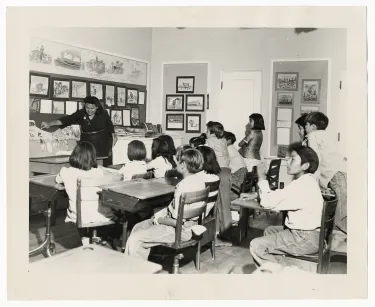
Rev. George Logie, the PCUSA Synod of Arizona, and the PCUSA BHM founded and organized the Charles H. Cook Bible School in October 1911 in Tucson, Arizona, with the stated aim of continuing the missionary and educational work of Charles H. Cook. Logie served as superintendent from the school’s creation until around 1934 or 1935. The school’s early goals were to convert to Christianity and culturally assimilate Indigenous peoples of Arizona, train them as lay leaders, and ultimately have them evangelize to and convert other Indigenous people in their own communities. The first classes were held in the PCUSA BHM's Tucson Indian Training School (a Presbyterian, non-reservation/off-reservation Native American boarding school). Cook School moved to Phoenix, Arizona in 1913, and its students taught Christian education classes across the street at the Phoenix Indian High School (also called the Government Indian School or the United States Indian School, a non-reservation/off-reservation Native American boarding school operated by the Bureau of Indian Affairs (BIA)). Cook School’s first graduating class in 1914 consisted of nine Indigenous students. The Synod of Arizona operated the school until 1939, when it was transferred to the PCUSA Board of National Missions (BNM). In 1940 or 1941, the school's name was changed to Charles H. Cook Christian Training School, and it became interdenominational. In 1941, the school was transferred from the PCUSA BNM to the Home Missions Council of North America (National Council of Churches (NCC)). In 1945, the school was fully turned over to its own Board of Trustees, and Rev. George Walker became the first full-time president, working in the role until 1961.
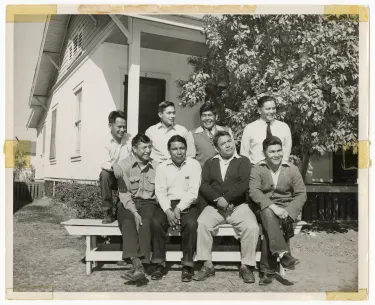
Many Indigenous WWII veterans took advantage of the G.I. Bill's tuition assistance program to attend Cook School after the war. By the 1960s, the school needed to relocate to a larger site, and a 20-acre former dairy farm was purchased in nearby Tempe, Arizona in 1965. The auxiliary was organized in 1966 as the Women's Auxiliary. The school’s first Indigenous leaders were Dr. Alonzo (Al) Spang (Northern Cheyenne), hired as superintendent in 1967, and Dr. Cecil Corbett (Nez Percé), hired as director of programs in 1967 as well. Corbett was elected executive director in 1968 and went on to serve as president (title changed in 1983) and chancellor (in 1990). Throughout his career at the school, Corbett sought to increase the number of ordained Indigenous clergy across denominations. He also pushed for more active fundraising.
Records in the collection show a shift away from assimilationist narratives/practices at the school after the installation of Indigenous leadership. A 1988 school mission statement states that "The School seeks to develop and nurture the Christian faith in Native American congregations within the context of their own cultures; seeks to train Native people serving Native congregations first in lay leadership capacity and seeks to provide a variety of Biblically sound culturally relevant courses and workshops in order to prepare people for their professional ministry and leadership roles." A 1994 public relations plan states "The School fulfills the need for competent leadership training among Native Americans whose voices have not been heard and have been educationally, socially, or economically deprived of access to higher education ... It is a unique institution whose distinctive educational program has enabled Native Americans from ninety tribes across the continent to become ministers to their own people." The 1999-2001 CCTS student catalog states that "Tribal, native and indigenous teachings and traditions are lifeways which are rich in holistic wisdom. Respect for American Indian and ethnic pluralism is a high ideal for the Cook College community."
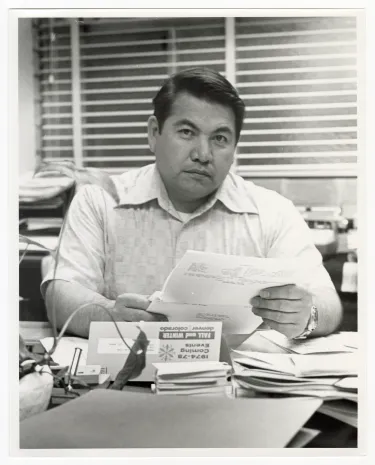
An extension program (Theological Education By Extension (TEE)) was established in 1975, expanding courses to western Canada and the Marshall Islands. In the late 1980s (1986 or 1988), the school's name changed to Charles Cook Theological School when seminary-level courses began. In 1992, an Associate of Arts academic degree program began, and the school's name changed to Cook College and Theological School. Rev. Emerson Falls (Sac and Fox Nation) became president in 2001. Rev. Howard Rice became interim president in 2003 after Falls's resignation. In 2006, the school transitioned away from college degree programs, and its name changed to Cook School for Christian Leadership. The school closed in 2008, and continuing programs fell under the rubric of a foundation, Cook Native American Ministries (CNAM) Foundation.
The collection contains two series:
Series I, Cook College and Theological School (CCTS) Records, circa 1890-2010, is the bulk of the collection and contains materials created and compiled by CCTS administrators, staff, and students. Records pertain to school administration, governance, and planning; departmental operations; school programs and programmatic matters; education and coursework in a Christian and Indigenous school setting and in extension sites; special events; the school's creation of publicity and educational resources; and the school's history. Subseries within this series include: the Departmental / Organizational Records subseries, circa 1890-2010; the Publications / Printed Materials subseries, circa 1923-2008; the Student Files subseries, 1942-2009; the Photographic Materials subseries, 1908-2006; and the Audiovisual Materials subseries, circa 1927-2009. Please see the RG 556 Collection Guide for additional descriptions of these subseries.
Series II, Women's Auxiliary Records, 1938-2005, includes correspondence, membership lists, minutes, newspaper clippings, photograph albums, photographs, reports, scrapbooks, and yearbooks documenting the activities and history of the CCTS Women's Auxiliary group.
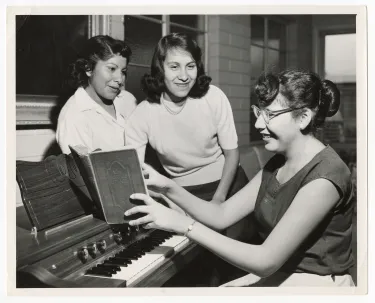
Click here to access the guide to the Cook College and Theological School Records and read more about the contents of the records collection.
You may freely reuse and distribute this article in its entirety for non-commercial purposes in any medium. Please include author attribution, photography credits, and a link to the original article. This work is licensed under a Creative Commons Attribution-NonCommercial-NoDeratives 4.0 International License.