Crossing the divide from death to life
PC(USA) Chapel service takes a modern look at God parting the Red Sea

LOUISVILLE — In Exodus 14:10-16, the Israelites — with pharaoh’s army nipping at their heels and the Red Sea looming in front of them — were “stuck between the devil they know and the devil they don’t,” according to the Rev. Alex Rodgers.
Rodgers, the Manager for Preparation for Ministry and Exams in Denominational Life & Witness, part of Presbyterian Life & Witness, provided a reflection for PC(USA) staffers during Wednesday’s online Chapel service.
The next part of the story is known to most Sunday school students: God parts the body of water and the Israelites hurry to the other side. The Egyptians pursue them, the water returns from whence it came, and the army meets a watery end. “God’s power and glory and might are on full display,” Rodgers said. “The Israelites are saved. This group of people who had no discernable identity become God’s people. Their fear turned to faith.”
“You would think the parting of the sea would guarantee the people’s faith in God, wouldn’t you?” she said. “You would think crossing the divide from death to life would convince them of God’s faithfulness. They would definitely trust God from this day forward, right? If only.”
Even on our best days, we’re “all too often governed by fear,” Rodgers said. “Fear makes us believe we are all alone. Fear keeps us small. It robs us of hope, joy and possibility. It is fear that blinds us to God’s goodness, grace and mercy.”
Throughout the Bible, we see what happens when people are afraid. Jonah was swallowed by a big fish. Zechariah lost his ability to speak. Peter sank “when he realized the waves were between himself and Jesus,” Rodgers noted. The disciples “locked themselves into an upper room after Christ was crucified.”
While those stories “are plentiful in Scripture, so too are reminders of how do deal with our fear,” she said, “for God did not give us a spirit of fear” and “perfect love casts out fear.”
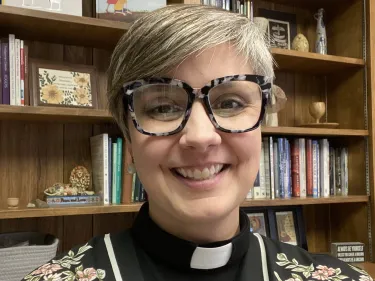
“God is love, we are told implicitly and explicitly throughout our sacred text,” Rodgers said. “God came into this world to become one of us in love.”
Fear, she said, “cannot halt God’s purposes. Fear cannot triumph over love. Fear never gets the last word,” and so “it makes sense that the God who claims us, who calls us by name and loves us, is the same God who provides a way for us when there appears to be none.”
“With the world teetering on the brink of something and everything, I understand deeply where the Israelites are coming from,” Rodgers said. “What does happen next? Where do we go from here, wherever here might be? It’s not clear. It rarely is.”
All too often, what lies ahead of us “looks a lot like the wilderness. What lies behind us might be its own kind of wilderness, but at least it’s familiar,” Rodgers said. We can try to go back, we can stay right where we are, “or we can move forward, inch by inch, into the less known.”
Going back feels comfortable and safer, she said. “In this story from Exodus, the Israelites were pretty convinced that their time in Egypt was delightful, though all common sense and evidence told a very different story.”
“I suspect we know we can’t go back. That’s when it’s awfully tempting to stay stuck,” she said. “What if we all just hunker down and not ask too many questions? What if we just do things the way we’ve always done them? That doesn’t feel right either.”
The best option is to move forward, despite the risks. “What if there’s a wall of water up ahead? What if we run out of food? What if we lose our way? What if everything is different and the landscape is wild and we don’t know what to do?”
The Israelites were in a life or death situation “that they interpreted as death or death,” Rodgers said. “What they didn’t know in that moment was that the God who claimed them as God’s own would provide a way forward. Impossibly, improbably, the waters would part, and the dry land would appear.”
Sometimes, that’s exactly what grace and mercy look like, “possibility when all seemed impossible, getting unstuck and moving forward in faith, getting out of our own way and trusting that God is up to something good,” she said.
“God’s call and claim on each of our lives” empowers us to do that which seems impossible and to do what we thought we couldn’t do. “It’s the nudge, the push, the shove out of complacency and anxiety and doubt and fear,” Rodgers said.
The waters of baptism “are meant to represent a journey from death to life, a dying and a rising, a passing through what feels dangerous and risky as we say yes to God’s call on our lives,” she said, “as we say to God, ‘I love you too.’”
We go into the water and come out on the other side empowered to live a life of faith, knowing we are loved beyond our wildest imagination and knowing that “God is with us, no matter what.”
The world is changing faster than we can process, Rodgers said. “It doesn’t feel like life is getting any better for far too many people. The church too is changing, and sometimes it feels like we just can’t catch up.”
“This life of faith is a life of risk and challenge. It is a life that calls us to courageously, or with fear and trembling, walk forward in faith,” she said. “I’m not sure courage is required — just a willingness to take one step and then another and then another.”
Of course we worry as we go. “We worry about what might be ahead, and whether it will be too wild for us to manage,” Rodgers said. “Scripture reminds us, though, that the wilderness isn’t as scary as we make it out to be. Growth and challenge, revelation and transformation happen in the wild places of our lives.”
It’s in these moments that Rodgers hears the voice of the prophet Isaiah: Do not fear, for I have redeemed you. I have called you by name. When you pass through the waters, I will be with you. When you walk through fire, you will not be burned and the flames shall not consume you.
“Colleagues, we know there are no ‘ifs’ here — just a series of ‘whens,’” she said. “Where do we go from here? Forward. We can’t go back, and standing still won’t do anyone any good. It’s forward in faith for us.”
You may freely reuse and distribute this article in its entirety for non-commercial purposes in any medium. Please include author attribution, photography credits, and a link to the original article. This work is licensed under a Creative Commons Attribution-NonCommercial-NoDeratives 4.0 International License.