150 dangerous songs
Pastor and author Richard Bruxvoort Colligan stops by the ‘A Matter of Faith’ virtual studios

LOUISVILLE — The Rev. Dr. Richard Bruxvoort Colligan calls his new book on the psalms “musical exegesis” and “150 windows into the human experience.”
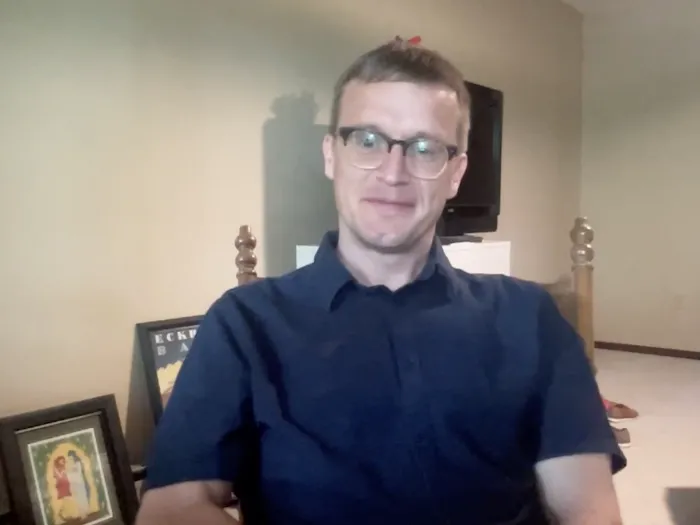
Colligan, who wrote “Dangerous Songs: The Psalms and a Gloriously Disrupted Life” and is the director of spiritual formation at Mount Olive Lutheran Church in Rochester, Minnesota, was the most recent guest on “A Matter of Faith: A Presby Podcast,” hosted each week by Simon Doong and the Rev. Lee Catoe. Listen to their one-hour conversation here. Colligan is introduced at the 5:15 mark.
What do we miss, the hosts asked Colligan, by failing to recognize the full of experience that the psalms depict, which include joy but also grief and struggle?
Faith is both mysterious and expansive, Colligan said. We find joy in the psalms but also outrage when we feel abandoned, like Jesus did on the cross when he cried out to God using language from Psalm 22:1.
Many of us grew up in a faith tradition “where the narrative was ‘God likes it when we’re happy,’” Colligan said. Eventually we learn life is complicated. “How great to discover that all of scripture, if you read it a certain way, can embrace all the complications of life,” Colligan said. “If you’re musical or artistic, a storyteller or an actor, you’re going to resonate with the tragic parts of the psalms, too.”
After he’d spent part of his childhood memorizing a few of the psalms, Colligan learned that Psalm 51 — “Create in me a clean heart, O God” — comes from David’s murderous impulses. Then there’s Psalm 88, where, according to Colligan, the message is, “God, I don’t know what’s going on. I don’t see you. I don’t feel you. You’ve taken away my love and my friendship. I’ve lost everything. God, you did this to me.”
“Why would that be in the Bible, if not to remind us that in the 21st century, life is expansive and that is part of faith, not something apart from faith,” he said, adding he wants “Dangerous Songs” to “affirm all of our very human experiences, even the ones we shove away, the ones we think are only for therapy. I find the psalms so affirming of the most outrageous limits of our human experience. To me, that represents the faith we have, as dynamic as it is.”
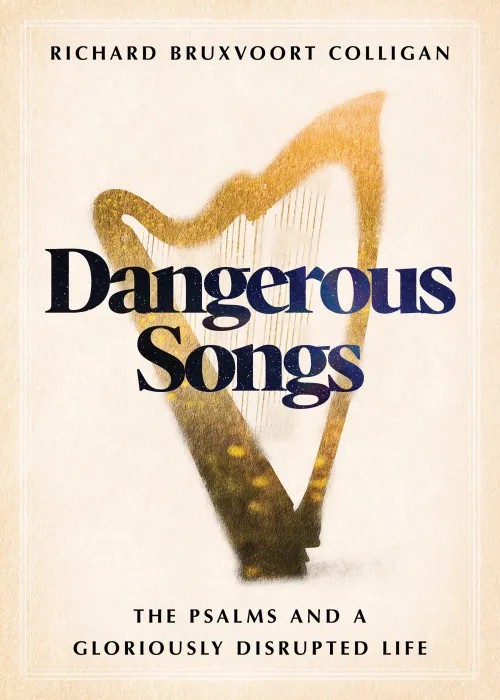
Placing a harp on the cover of “Dangerous Songs” was the publisher’s idea, Colligan said. “Some of us think of the psalms as David reclining somewhere and singing with a harp in these dulcet tones to soothe the spirit of Saul or something,” he said. “What are the odds we would stumble upon song lyrics and poetry from 3,000 years ago from people we’ve never met who lived on the other side of the planet? What are the odds that would have anything to do with my life?”
“If you haven’t looked at the psalms for a while, they’re musical,” said Colligan, himself a musician. “Embedded in the texts are directions: ‘This is for the musical director. Sing it to this tune’ or ‘This is to be done in a certain meter or with a certain instrument or in a certain style.’ Sometimes we don’t even know what it means. We get to imagine: ‘I wonder what the music was like here.’”
Psalm 23 “seems to be pastoral” and “it’s about comfort and abundance,” reminding those of us in the 21st century “that our cup runs over, that God is with us. But it’s also a super political psalm, believe it or not.”
Colligan told a friend from South Africa that for many people of faith in the U.S., Psalm 23 is often used during funerals. “He said, ‘I guess that makes sense, but for us it’s a political thing,’” Colligan said. “That first line says ‘Adonai is my shepherd,’ my leader. You’re not. It’s very pointed.”
It can be tempting “to sprinkle portions of the psalms in a praise and worship song, to name God as the father of orphans or ‘my cup runneth over’ or ‘let everything that has breath praise the Lord,’” Colligan said, “but leave out the part that says, ‘You left me out to dry, and I can’t believe you abandoned me.’ That’s not going to be a popular worship song.”
Worship leaders may not be keen to put Psalm 63 to music as well. Colligan said the message there is “My whole life, God, is aching for you, and you’re nowhere to be found. You’re missing in action and I need you. My mouth is dry. I’m so thirsty for you. Whan am I going to be in your presence? That’s the longing that I’m not sure will ever be popular for industry.”
When Colligan thinks about the war with Iran, he jumps to Psalm 140, “which is a bit of a rant. The psalmist says, ‘Everywhere I look, people are violent and loud. I am for peace.’ This person is feeling alone and hoping desperately there is some other way and they’re not sure what’s going to happen.”
“It’s a psalm that’s millennia old but certainly speaks to our human impulses of emotions and responses to our politics.”
The psalms speak about time as well, he noted: “God, how long? How long will you hide your face?”
“How long will the terrorists be in charge? How long will the innocents suffer? Those were good questions 3,000 years ago, and they’re good questions right now,” he said. “They’re not questions just for God, but for our own humanity, our own policies and legislation.”
Colligan discussed his time doing grief work. “If you’ve experienced grief, you know it’s the strangest experience. You can be exhausted one minute, weeping another, outraged and angry. You can be calm — all in one day. That’s just how grief is. … It’s maybe the most human of deep experiences.”
“The passion in these ancient songs, the psalms, can be good company for us as we explore what is going on in us,” Colligan said. “It takes courage, whether it’s trauma, a bad breakup, betrayal — I feel like I’m doing a trailer for a movie —it’s all in the psalms.”
When we’re “at the end of our rope despairing,” we hear the message behind Psalm 4: “God, I’m lying in my bed and I hear my own lungs rattle and I don’t think I’ll survive the night. God, what is it like to be in hospice and to be evaluating one’s life wondering what’s next?”
In his book, Colligan presents “three dimensions of life that the psalms really sing to: thriving, desolation and unknowing.”
“I hope people who get the book will feel affirmed about how complicated life really is,” he said. “Maybe God isn’t what I thought God really is.” Once scholar likened the psalms to “a playlist from ancient Israel,” Colligan said, adding, “It’s a mosaic of how life is.”
As someone who lived with clinical depression, “I think the psalms may have save my life simply as a witness to how terrible life can feel sometimes,” Colligan told the hosts. “There is an affirmation that things are maybe not as bad as they feel, but life is really hard sometimes.”
“Nobody get out of here without singing the blues,” he said. “The lament [psalms] always start with desolation, but follow an arc that ends up in gratitude and praise. I feel most human when I’m in touch with those kinds of things, and the psalms really help.”
New editions of “A Matter of Faith: A Presby Podcast” drop here every Thursday.
You may freely reuse and distribute this article in its entirety for non-commercial purposes in any medium. Please include author attribution, photography credits, and a link to the original article. This work is licensed under a Creative Commons Attribution-NonCommercial-NoDeratives 4.0 International License.