YAADs to GA227: If you care about the future, listen to us now
Young Adult Advisory Delegates call for a church of justice, inclusion and integrity in action

During the 227th General Assembly of the Presbyterian Church (U.S.A.) in Milwaukee, the church is benefiting from the presence of nearly 90 young adults between the ages of 18 and 22 who are giving of their time and energy as Young Adult Advisory Delegates.
YAADs are selected and supported by their presbyteries, participate in GA committees with full voice and vote, and lend their voices and perspectives to advise commissioners during plenary. They are often celebrated as tangible representations of the future of the church.
Presbyterian News Service sent a request to all of this year’s YAADs for anyone interested to come and share their own hopes and concerns for the assembly and for the church. The YAADs who showed up to the conversation came from different places, bringing different histories with the church and holding a variety of perspectives. But they shared a clear message for the church: We are not just the future — we are the church here and now, and if you care about the future, don’t wait to listen to us.
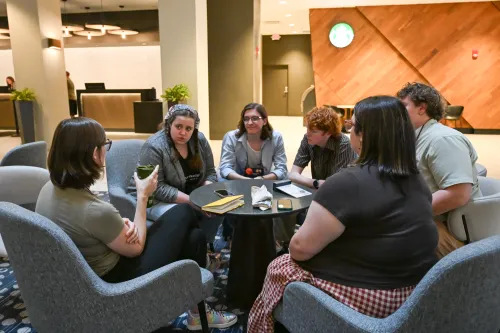
“I don’t know the exact number, but the median age without YAADs would probably be somewhere in the 60s. And to be quite blunt with you, they don’t have as much time left in the church as we do,” said Alexandra Klemp-North, of Winnebago Presbytery. “Our decisions about the future and our insights are — I don’t want to say more important or more impactful, but carry more weight for our futures.”
Riley Boerger, a YAAD from the Northwest Coast Presbytery, agreed, emphasizing that YAADs spend a lot of time and effort to participate in the Assembly, just like everyone else.
“Let’s make sure that when we are saying we want the youth involved, we’re doing it in a way where it’s not ‘they’re the future church’ — it’s that they are the church.”
Currently, YAADs are given full voice and vote during committee sessions; they have only voice and not vote during plenary sessions. While some YAADs said they understand this limitation to a degree, several argued that not letting YAADs participate fully is a missed opportunity.
“For a church that says we support everybody, we support the young people, and we want them involved … you have a perfect platform to let us have power and voice,” said Klemp-North, sharing that several people have expressed surprise upon learning she is not a commissioner. “If I’m coherent enough and vocal and concise enough that they can assume I am an actual voter, that leads me to believe that I should have a voice."
Dexter Mitchell, of the Presbytery of de Cristo, said he believes the rationale is that YAADs are not elders, but points out that that’s not entirely accurate.
“There’s a solid proportion of YAADs that are elders … so the rationale for not giving us a vote is simply untrue."
“My assumption for the rationale would be that we’re simply too young, we either don’t have the experience in Presbyterian polity or just in life to be able to faithfully discern some of these decisions,” said Avery Clark, who represents the Presbytery of the Cascades and identifies as a "PK" or "pastor's kid" and "cradle Presbyterian." “Except they do give us voice and vote on committee. And also, that’s the reason we do collective discernment. It’s not on any one person to be correct and have the right opinion. It’s about doing it all together.”
Despite frustrations about their lack of vote in plenary, the YAADs said they have received numerous compliments for speaking out in committees and making thoughtful contributions.
So what are the issues coming before this year’s assembly that these young adults think are most important for the church and its future?
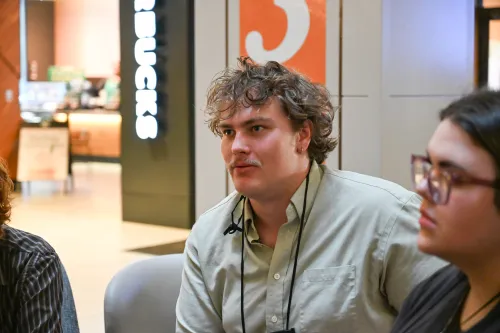
“First of all, the official language of genocide in Gaza (RIW-04 and RIW-06) is really important,” said Alexander Boltz, from the Presbytery of the Twin Cities Area, in naming the overtures he believes are most important for the week ahead. Several other YAADs echoed that the overtures concerning Gaza were especially significant.
Boltz also mentioned GEN-02, which calls for the PC(USA) to advocate for all people to have access to “medically necessary, evidence-based gender-affirming healthcare,” and the overtures concerning fossil fuel divestment (CLJ-01, CLJ-02, CLJ-03, CLJ-05).
Mitchell said he, too, is especially invested in the PC(USA)'s divestment from fossil fuels. He served on the Climate and Environmental Justice committee and first got involved with the PC(USA) through Presbyterians for Earth Care. He pointed out that this is the 14th assembly that environmental justice advocates have been working to pass an overture on fossil fuel divestment. He said the PC(USA)'s strategy of shareholder engagement and divesting from one or two companies a year, while it has its time and place, is simply not enough for the level of change needed.
Boltz and Boerger both served on the Committee on Theological Education and Ordination, and expressed deep investment in ORD-07, a lengthy list of recommendations from the Ordination Task Force. They particularly highlighted item C within that overture, which proposed senior ordination portfolios as an alternative to ordination exams. Boltz authored an amendment to ORD-07, which ultimately allowed item C to be approved by the committee after first failing to garner a majority vote.
“We talked a lot [in committee] about making our testing and ordination processes more accessible for people who have any kind of neurodivergencies. That was something that I didn’t even know was not already being done,” said Boerger. “And so it actually made me very excited as someone who is autistic to be able to stay in a room and have that conversation.”
Clark mentioned several issues that were of particular importance to him: artificial intelligence (RUS-08), the monogamy overture (CON-10), and the laying off of mission co-workers by the Interim Unified Agency (now Presbyterian Life & Witness) last year (CON-02, CON-03). He acknowledged that the AI overture needs some work, but he’s hopeful plenary can work it out so the church can take a stronger stand on the issue.
He voiced concerns about a lack of transparency or even misuse of power with regard to the closing of the World Mission program and felt strongly that it would come up in plenary. Meanwhile, he said that the monogamy overture was poorly written and grounded in a poor understanding of Presbyterian theology and that it was put forth by a group of people “that claims to speak for the youth, but they do not.”
In fact, all of the YAADs interviewed expressed conviction about the church’s commitment to inclusion and equality, and concerns about others in the church, including other young adults, who they believe do not share those values.
“I am concerned about the way that certain groups are using rhetoric and Scripture to exclude and discriminate against other people,” said Klemp-North, who is queer and autistic and believes advocating for others in those communities is part of her responsibility as a YAAD. “We are all children of God, and it is our job to love our neighbors and appreciate and accept and value their stories and learn from them.”
“I think there is an internal conflict about the young future of the church,” said Boltz, referring to GA227 as “the General Assembly of the Young Adults.”
“Is [the church] open and inclusive? Does it welcome our queer siblings? Does it welcome our immigrant neighbors? There is an organization [present at the Assembly] saying that our future does not do that, but I will say most of the young adults I’ve seen and interacted with say we do. And I look forward to seeing the church thrive with opening our tents and welcoming all our neighbors in.”
Mitchell said, “It's difficult, as someone who is gay, being told you’re going to hell … and having Scripture used against you and having to defend yourself.” He added that he’s wrestling with the balance between making sure every voice is heard but also keeping respect for people, “because we are all human beings at the end of the day.”
Klemp-North said she believes her job as a Christian is to live as Jesus lived, which means embracing others. “It’s not your job to be the reason that someone’s not allowed.”
Speaking to the issue of including those she disagrees with, she said the example set by Jesus was one that said, “You as a person are welcome in my church, but your exclusionary hate is not welcome.”
“I think Christ’s ministry is pretty clearly grounded in restorative justice, and I think frameworks of prohibition and condemnation and exclusion simply go against that,” said Clark. “The church builds room for disagreement … and the acknowledgement that we’re all going to be wrong sometimes. Disagreement is OK, but we need to be grounded in a ministry of a sort of justice that doesn’t exclude and hurt people in that process.”
Clark said this is one reason the overtures calling for the repudiation of Christian nationalism here and here is yet another crucial item facing the Assembly this week.
Despite these concerns, the YAADs said they are excited about the week ahead and the opportunity to participate in plenary, connect with others and contribute to the life of the church. And they’re excited about the future church they’re already helping to build — one rooted in intergenerational and multicultural connection, and one that lives on precisely because it lives out its values — in action, in public and with integrity.
You may freely reuse and distribute this article in its entirety for non-commercial purposes in any medium. Please include author attribution, photography credits, and a link to the original article. This work is licensed under a Creative Commons Attribution-NonCommercial-NoDeratives 4.0 International License.