This month in Presbyterian history
A cornerstone laid, a commemorative convocation and a ceremony of integration.
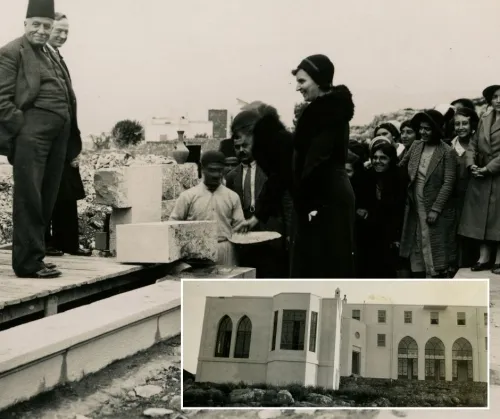
In March 1933, a group huddled together to watch the cornerstone laying of a new building for the American Junior College for Women in Lebanon.
The Rev. James Nichol, who served as general secretary of the Syria Mission in the 1920s, can be seen standing toward the left of the frame offering an address to the crowd.
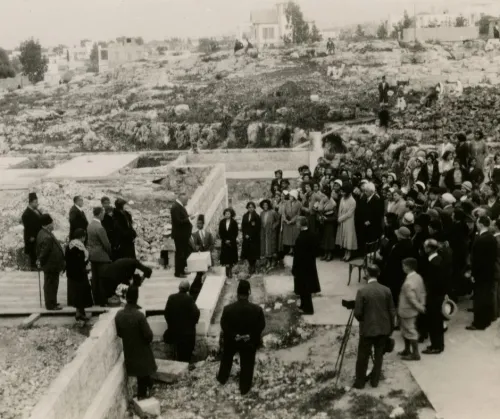
The photographs that document this momentous occasion are housed in the personal papers of Frances Pryor Irwin. Irwin was appointed by the Board of Foreign Missions to the Syria Mission in 1921 and taught at the American School for Girls in Beirut, in present-day Lebanon.
In 1924, Irwin assumed the principalship for the newly formed American Junior College for Women, a position she remained in until her retirement from missionary service in 1937. In a letter dated December 24, 1924, she writes, "that girls from Syria and Palestine were actively insisting that they be allowed a college education and were asking for admittance to the University ... Old ways are giving place to new, these lands are in a state of flux and there are all conditions and classes."
When the school first started, its faculty and students lived in rented buildings that served as dormitories. By 1927, the American Junior College for Women (AJC) consisted of a "multi-religious, multi-ethnic student body of twenty-one in leased premises in Ras Beirut," Ellen L. Fleishmann writes in "The Beginnings of the American Junior College for Women in Beirut," published in the Spring 2009 edition of The Arab Studies Journal. Over the course of a year, the college's student body doubled in size; by 1944, the number had quadrupled. The cornerstone ceremony pictured here was for a permanent dormitory, which was completed by 1937.
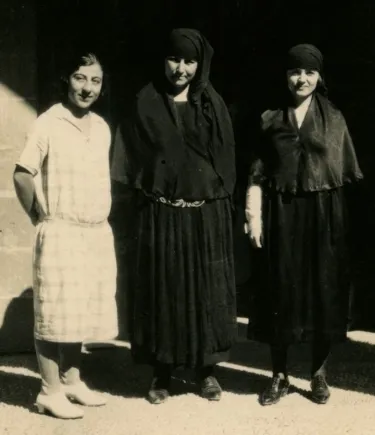
The college was founded by the American Presbyterian Syria Mission, which was established in 1823 in present-day Lebanon. The American Junior College for Women in Beirut attracted hundreds of young women -- the first graduates of the university culminated the year following the cornerstone-ceremony, with two of the three pictured alumni going on to become doctors.
A handful of additional archival images relating to the American Junior College for Women have been digitized and made available in Pearl.
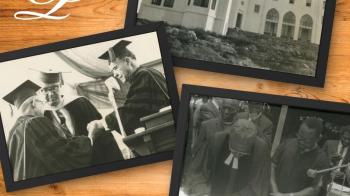
In early March 1962, the Inter American University in San Germán, Puerto Rico, celebrated the 50th anniversary of its founding by watching another class of graduates don their robes and receive their degrees.
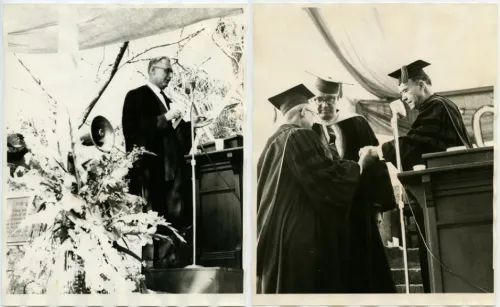
The Rev. Donald Harris, son of the institution’s founder, delivered the address at the Founders Day Convocation. Harris sat on the Board of Trustees of the University and headed all work in the Caribbean for the Presbyterian Church.
Donald wasn't the only Harris attending the 50th anniversary. Rather, "One of the features of Inter American University's Fiftieth Anniversary celebration was the gathering of the Harris clan" reads the caption of a group photo in Pearl Digital Collections. Donald's siblings were also present — Helen, Margaret, and Cleland — as well as his cousin Jean Harris Freemont, daughter of Clarence Harris, vice president of the school in its early years.
Dr. J. Will Harris, father of Donald, Helen, Margaret, and Cleland, founded the school in 1912 as the Polytechnic Institute of Puerto Rico. In its early years, it provided elementary and secondary school education; the first university-level courses were added to the curriculum in 1921. The first graduates of the university were awarded their bachelor's degrees in 1927. In 1944, the college became the first four-year liberal arts college in Puerto Rico to receive an accreditation by the Middle States Association of Colleges and Secondary Schools, one which is still maintained to this day.
When Dr. Harris passed in June 1956, a "resolution of condolence" was adopted by the Board of Trustees of the school and copies sent to his children. "The members present" at the session, held at Brick Presbyterian Church in New York City just days after Harris's death, "join in paying tribute to a great Christian missionary, statesman, whose prophetic vision brought into being, under the guidance of God, a great Christian institution, which in its history of forty-four years has helped to educate and form the character of thousands of Puerto Rican youth."
At the Founders Day Convocation ceremony in 1962, the Rev. Diego Rico-Soltero, the Superintendent of the Presbytery of Puerto Rico, received an honorary degree. He is seen in the photograph above shaking the hand of Dr. James Beverley, the President of the university’s Board of Trustees, while Dr. Ronald C. Bauer, the university’s President, looks on.
On its website, the college proudly refers to itself as "the most important private university in the country" that, in recent years, "has maintained an enrollment of over 43,000 students," a figure that represents around 21% of the total population of college students in Puerto Rico.
A handful of additional archival images relating to the University in San Germán have been digitized and made available in Pearl.
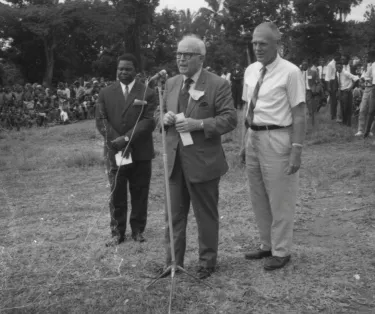
March 1970 saw the integration of the American Presbyterian Congo Mission (APCM) and the Église Presbyterienne au Congo, or the Presbyterian Church of the Congo. In the inventory list for RG 525, the Presbyterian Church in the U.S. Board of World Missions Photographs, which lives in the archives of the Presbyterian Historical Society, these records are grouped under the title "Congo Church Autonomy."
The first Presbyterian mission station in the Congo was established in Luebo in 1891. Other mission stations started popping up following the transfer of the Congo to Belgian rule, the first being founded at Mutoto in 1912. The American Presbyterian Congo Mission (APCM) grew rapidly in the early years of the 20th century — by 1919, it was the largest Protestant mission in the Congo with 48 missionaries and nearly 20,000 communicants.
The mission continued to grow until 1959 when the Eglise Presbytérienne au Congo organized as an independent ecclesiastical body. In 1970, the APCM was officially dissolved and its programs were integrated into the work of the Presbyterian Church of the Congo.
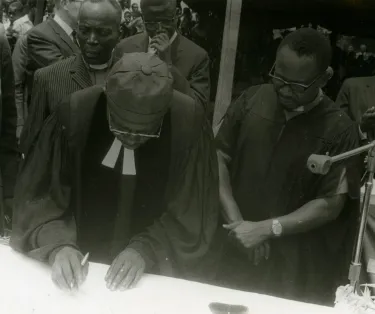
The photographed at left is the signing of Integration papers by Pastor Bakatushipa Pierre, legal representative, as Pastor Nsenda Joseph, the Executive Secretary of the Church, watches on over Pierre's shoulder. The activities of the day also included a "parade for Integration," in which local Luluabourg women marched in uniform and sang in celebration.
Also in attendance was Dr. R. Matthew Lynn, who served as Moderator of the PCUS in 1970. He was photographed speaking at the ceremony in Luebo, a throng of attentive participants gathered in the background behind him.
Additional archival images relating to the earlier years of the APCM have been digitized and made available in Pearl.
You may freely reuse and distribute this article in its entirety for non-commercial purposes in any medium. Please include author attribution, photography credits, and a link to the original article. This work is licensed under a Creative Commons Attribution-NonCommercial-NoDeratives 4.0 International License.